Department of Animal Science, Aarhus University, Aarhus, Denmark.
Psychiatric Centre Glostrup, Glostrup, Denmark.
PLoS One. 2021 May 26;16(5):e0251571. doi: 10.1371/journal.pone.0251571. eCollection 2021.
To compare the immediate response of nursing home residents to dog visits with or without an activity, and the impact of cognitive ability.
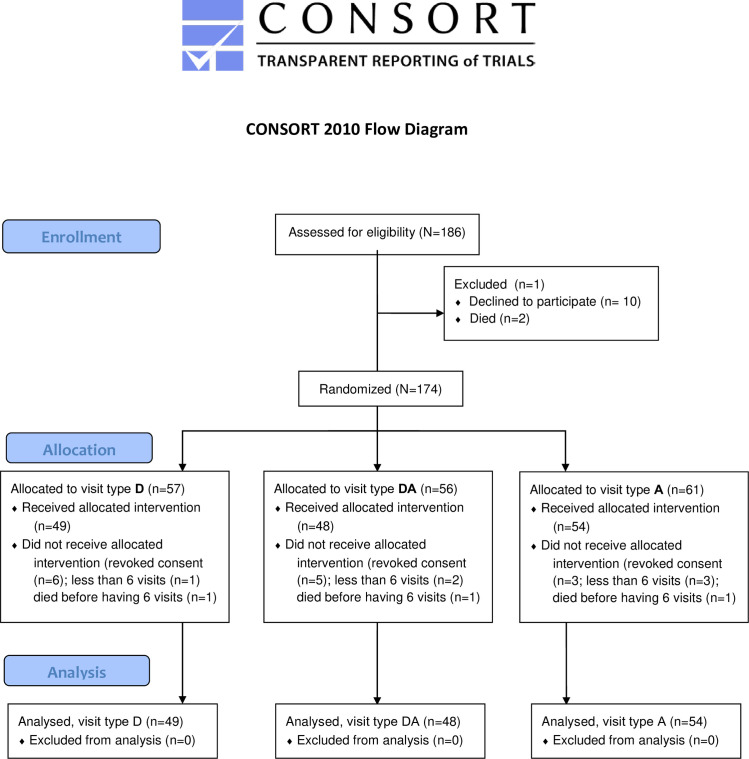
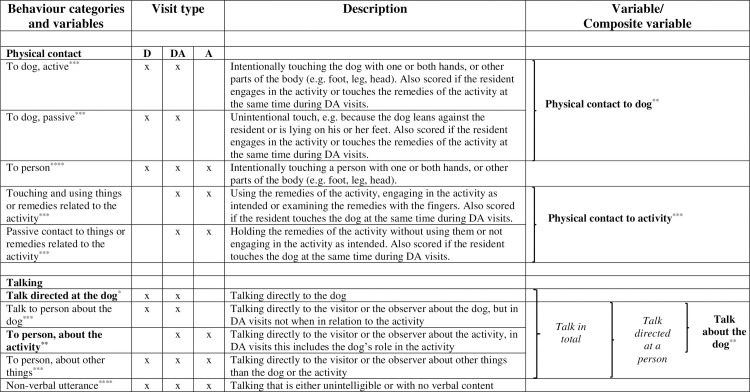
In a randomly controlled trial, 174 nursing home residents were allocated to 12 bi-weekly 10-minute visits: either ordinary dog visits (D, n = 57, 49 analysed), dog visits with an activity (DA, n = 56, 48 analysed), or visits with activity but no dog (A, n = 61, 54 analysed). We recorded frequency and duration of residents' verbal and physical interactions with the dog and persons. Data were analysed in three periods of four visits (period 1-3) as binomial variables (generalised linear models) or durations (non-parametric statistics).
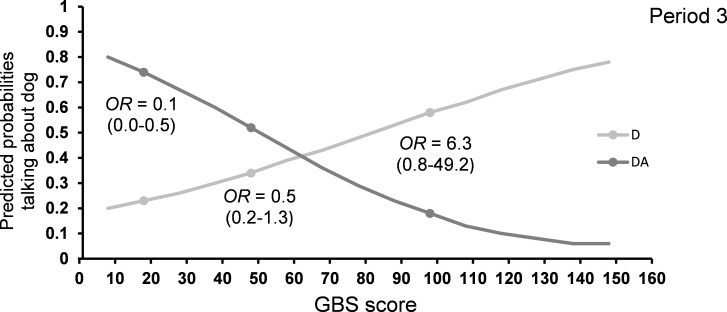
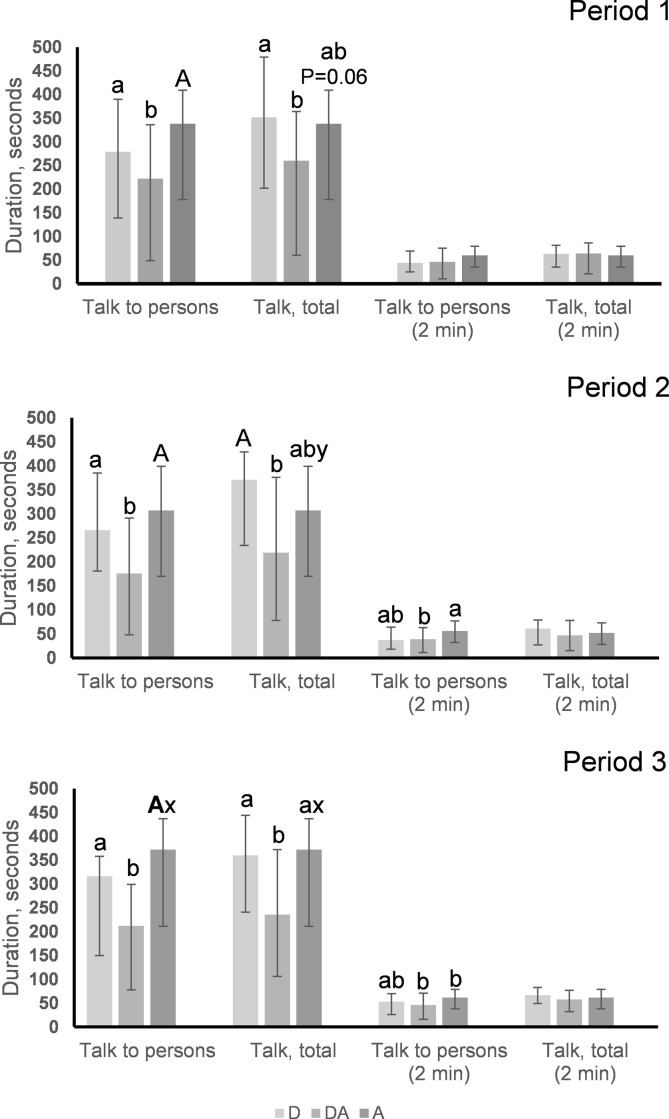
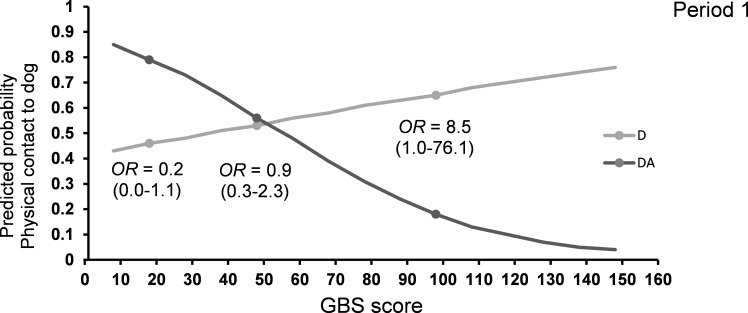
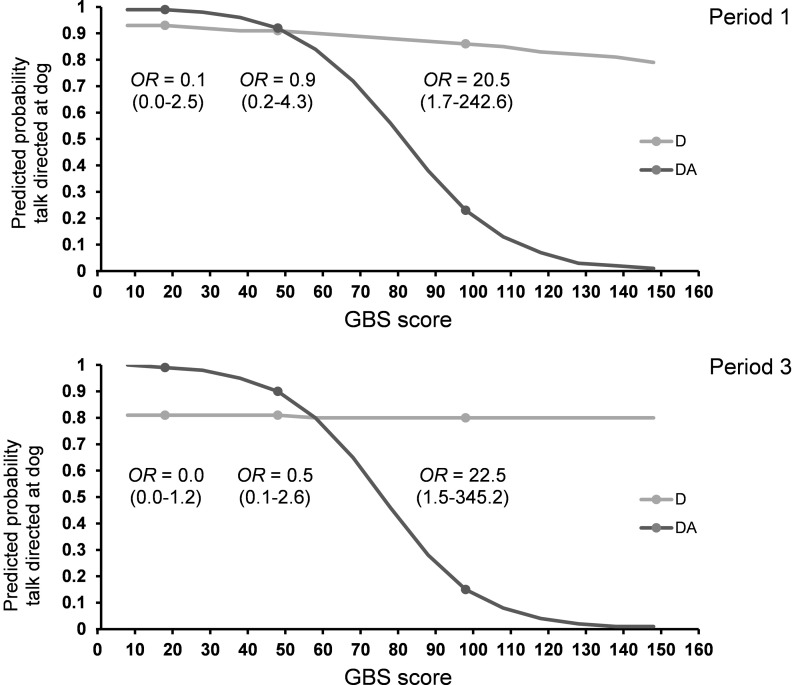
Both visit type and impairment level affected the likelihood of interacting with the dog (D and DA). In some periods increased cognitive impairment lowered odds of touching the dog in DA visits (period 1: F1,85 = 5.17, P < 0.05) and talking to it directly (period 1: F1,90 = 4.60, P < 0.05; period 3: F1,87 = 5.34, P < 0.05). Throughout, residents talked less to persons during DA visits compared to D and A (P = 0.01-0.05), and level of cognitive impairment correlated negatively with talk duration (P < 0.001). Generally, high cognitive impairment level lowered odds of interacting with (period 1: F1,89 = 7.89, P < 0.01; period 2: F1,97 = 6.76, P = 0.01; period 3: F1,92 = 13.57, P < 0.001) and talking about the activities (period 1: F1,89 = 13.78, P <0.001; period 2: F1,88 = 3.27, P = 0.07; period 3: F1,86 = 3.88, P = 0.05).
Visits without specific activities stimulated residents to interact with the dog, whereas increasing the complexity of dog visits by adding activities resulted in less interaction with the dog for severely impaired residents. The optimal dog visit for the less cognitively impaired residents could include activities and thereby a possibility to interact with the dog in different ways, whereas for severely impaired residents, just being with the dog seems more appropriate.
比较养老院居民在有或没有活动的情况下对狗的即时反应,以及认知能力的影响。
在一项随机对照试验中,174 名养老院居民被分配到 12 次每两周 10 分钟的访问中:普通狗访问(D 组,n=57,49 例分析)、带活动的狗访问(DA 组,n=56,48 例分析)或带活动但没有狗的访问(A 组,n=61,54 例分析)。我们记录了居民与狗和人与狗互动的频率和持续时间。数据以四个访问期(1-3 期)的二项变量(广义线性模型)或持续时间(非参数统计)进行分析。
访问类型和损伤水平都影响了与狗互动的可能性(D 和 DA)。在某些时期,认知障碍的加重降低了在 DA 访问中触摸狗的几率(第 1 期:F1,85=5.17,P<0.05)和直接与它交谈的几率(第 1 期:F1,90=4.60,P<0.05;第 3 期:F1,87=5.34,P<0.05)。整个过程中,与 D 和 A 相比,DA 访问期间居民与他人交谈的次数减少(P=0.01-0.05),认知障碍程度与交谈持续时间呈负相关(P<0.001)。一般来说,高认知障碍水平降低了与狗互动的几率(第 1 期:F1,89=7.89,P<0.01;第 2 期:F1,97=6.76,P=0.01;第 3 期:F1,92=13.57,P<0.001)和谈论活动的几率(第 1 期:F1,89=13.78,P<0.001;第 2 期:F1,88=3.27,P=0.07;第 3 期:F1,86=3.88,P=0.05)。
没有特定活动的访问刺激了居民与狗互动,而通过增加活动使狗访问变得更加复杂,导致严重受损的居民与狗的互动减少。对于认知能力较低的居民,最理想的狗访问可以包括活动,从而有可能以不同的方式与狗互动,而对于严重受损的居民,与狗在一起似乎更为合适。