Cardozo-Mino Magda G, Fadeev Eduard, Salman-Carvalho Verena, Boetius Antje
Max Planck Institute for Marine Microbiology, Bremen, Germany.
Alfred Wegener Institute, Helmholtz Center for Polar and Marine Research, Bremerhaven, Germany.
Front Microbiol. 2021 May 10;12:658803. doi: 10.3389/fmicb.2021.658803. eCollection 2021.
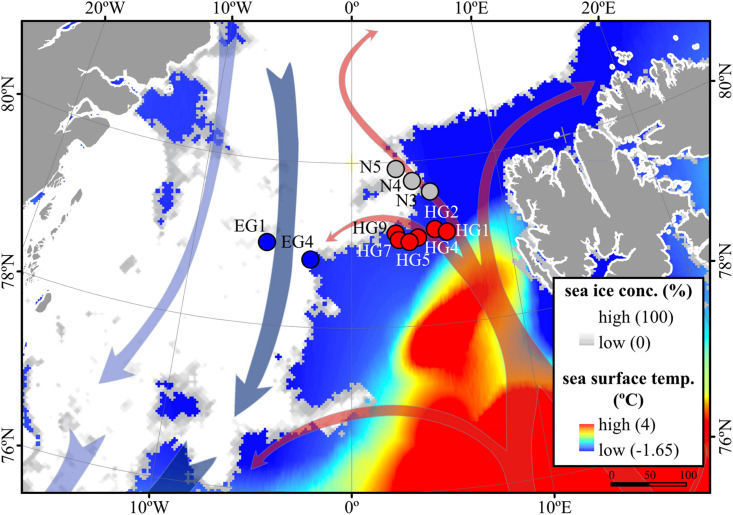
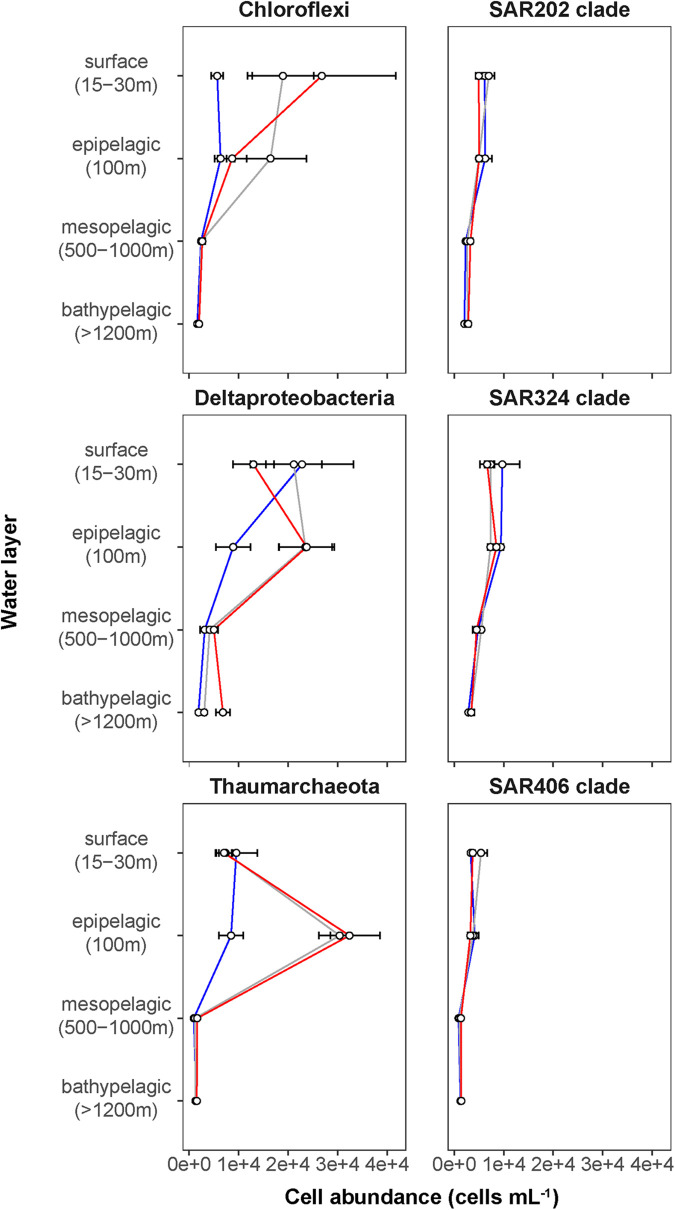
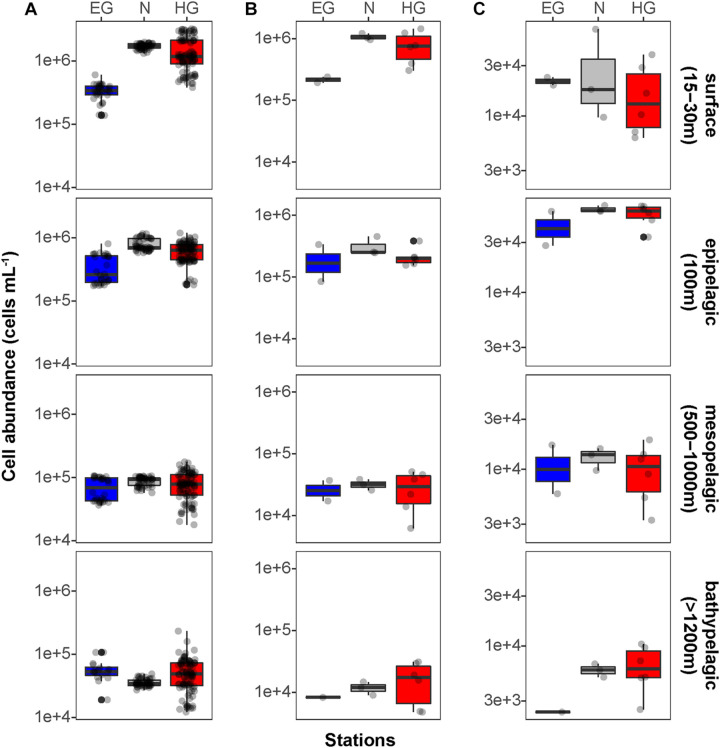
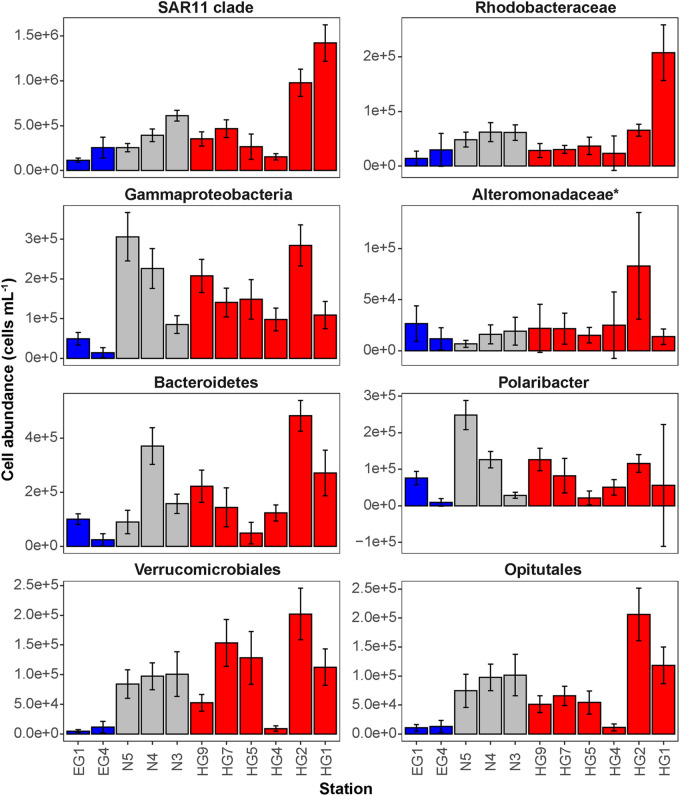
The Arctic is impacted by climate warming faster than any other oceanic region on Earth. Assessing the baseline of microbial communities in this rapidly changing ecosystem is vital for understanding the implications of ocean warming and sea ice retreat on ecosystem functioning. Using CARD-FISH and semi-automated counting, we quantified 14 ecologically relevant taxonomic groups of bacterioplankton ( and ) from surface (0-30 m) down to deep waters (2,500 m) in summer ice-covered and ice-free regions of the Fram Strait, the main gateway for Atlantic inflow into the Arctic Ocean. Cell abundances of the bacterioplankton communities in surface waters varied from 10 cells mL in ice-covered regions to 10 cells mL in the ice-free regions. Observations suggest that these were overall driven by variations in phytoplankton bloom conditions across the Strait. The bacterial groups and showed several-fold higher cell abundances under late phytoplankton bloom conditions of the ice-free regions. Other taxonomic groups, such as the , revealed a distinct association of cell abundances with the surface Atlantic waters. With increasing depth (>500 m), the total cell abundances of the bacterioplankton communities decreased by up to two orders of magnitude, while largely unknown taxonomic groups (e.g., SAR324 and SAR202 clades) maintained constant cell abundances throughout the entire water column (ca. 10 cells mL). This suggests that these enigmatic groups may occupy a specific ecological niche in the entire water column. Our results provide the first quantitative spatial variations assessment of bacterioplankton in the summer ice-covered and ice-free Arctic water column, and suggest that further shift toward ice-free Arctic summers with longer phytoplankton blooms can lead to major changes in the associated standing stock of the bacterioplankton communities.
北极地区受到气候变暖的影响比地球上其他任何海洋区域都要快。评估这个快速变化的生态系统中微生物群落的基线,对于理解海洋变暖和海冰消退对生态系统功能的影响至关重要。我们使用催化报告沉积荧光原位杂交技术(CARD-FISH)和半自动计数方法,对弗拉姆海峡夏季有冰覆盖和无冰区域的浮游细菌进行了量化,该海峡是大西洋流入北冰洋的主要通道,研究范围从表层(0 - 30米)到深层水域(2500米),涵盖了14个具有生态相关性的浮游细菌分类群。表层水域浮游细菌群落的细胞丰度在有冰覆盖区域为每毫升10个细胞,在无冰区域为每毫升10个细胞。观察结果表明,这些总体上是由海峡两岸浮游植物水华条件的变化驱动的。在无冰区域浮游植物水华后期条件下,细菌类群 和 显示出细胞丰度高出几倍。其他分类群,如 ,显示出细胞丰度与表层大西洋水域有明显关联。随着深度增加(>500米),浮游细菌群落的总细胞丰度下降了多达两个数量级,而大部分未知分类群(如SAR324和SAR202进化枝)在整个水柱中保持恒定的细胞丰度(约每毫升10个细胞)。这表明这些神秘的类群可能在整个水柱中占据特定的生态位。我们的结果首次提供了北极夏季有冰覆盖和无冰水柱中浮游细菌的定量空间变化评估,并表明进一步向无冰的北极夏季转变,伴随着更长时间的浮游植物水华,可能导致浮游细菌群落相关现存生物量的重大变化。