Gonçalves Diego Assis, Ribeiro Victória, Gualberto Ana, Peres Fernanda, Luconi Michaela, Gameiro Jacy
Department of Parasitology, Microbiology and Immunology, Federal University of Juiz de Fora, Juiz de Fora, Brazil.
Department of Experimental and Clinical Biomedical Sciences "Mario Serio", University of Florence, Florence, Italy.
Int J Endocrinol. 2021 May 5;2021:6667135. doi: 10.1155/2021/6667135. eCollection 2021.
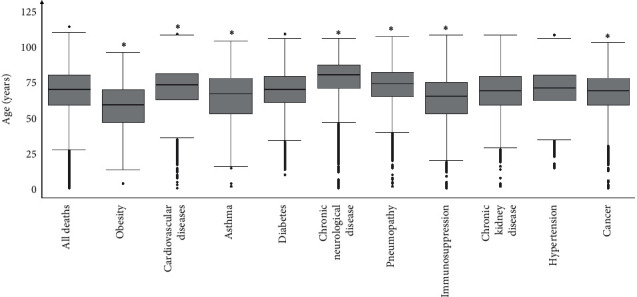
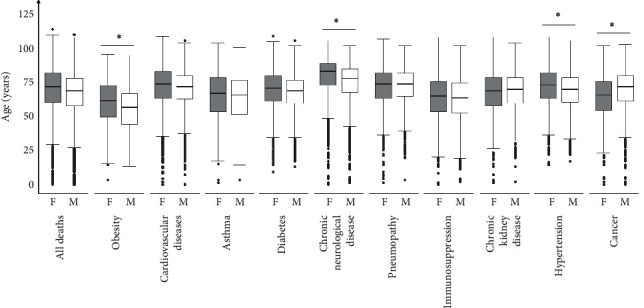
Brazil has the second highest number of deaths due to COVID-19. Obesity has been associated with an important role in disease development and a worse prognosis. We aimed to explore epidemiological data from Brazil, discussing the potential relationships between obesity and COVID-19 severity in this country. We used a public database made available by the Ministry of Health of Brazil (182700 patients diagnosed with COVID-19). Descriptive statistics were used to characterize our database. Continuous data were expressed as median and analyzed by the nonparametric tests Mann-Whitney or one-sample Wilcoxon. The frequencies of categorical variables have been analyzed by chi-square tests of independence or goodness-of-fit. Among the number of deaths, 74% of patients were 60 years of age or older. Patients with obesity who died of COVID-19 were younger (59 years (IQR = 23)) than those without obesity (71 years (IQR = 20), < 0.001, and = 0.0424). Women with obesity who died of COVID-19 were older than men (55 years (IQR = 25) vs. 50 (IQR = 22), < 0.001, and = 0.0263). Furthermore, obesity increases the chances of needing intensive care unit (OR: 1.783, CI: 95%, and < 0.001), needing ventilatory support (OR: 1.537, CI: 95%, and < 0.001 and OR: 2.302, CI: 95%, and < 0.001, for noninvasive and invasive, respectively), and death (OR: 1.411, CI: 95%, and < 0.001) of patients hospitalized with COVID-19. Our analysis supports obesity as a significant risk factor for the development of more severe forms of COVID-19. The present study can direct a more effective prevention campaign and appropriate management of subjects with obesity.
巴西因新冠病毒肺炎死亡的人数位居世界第二。肥胖在疾病发展过程中起着重要作用,且与更差的预后相关。我们旨在探究来自巴西的流行病学数据,讨论该国肥胖与新冠病毒肺炎严重程度之间的潜在关系。我们使用了巴西卫生部提供的一个公共数据库(182700例被诊断为新冠病毒肺炎的患者)。描述性统计用于描述我们的数据库。连续数据以中位数表示,并通过非参数检验曼-惠特尼检验或单样本威尔科克森检验进行分析。分类变量的频率通过独立性卡方检验或拟合优度卡方检验进行分析。在死亡人数中,74%的患者年龄在60岁及以上。死于新冠病毒肺炎的肥胖患者比非肥胖患者更年轻(59岁(四分位距=23))(71岁(四分位距=20),P<0.001,效应量=0.0424)。死于新冠病毒肺炎的肥胖女性比男性年龄更大(55岁(四分位距=25)对50岁(四分位距=22),P<0.001,效应量=0.0263)。此外,肥胖增加了新冠病毒肺炎住院患者需要重症监护病房(比值比:1.783,95%置信区间,P<0.001)、需要通气支持(非侵入性和侵入性的比值比分别为:1.537,95%置信区间,P<0.001和2.302,95%置信区间,P<0.001)以及死亡(比值比:1.411,95%置信区间,P<0.001)的几率。我们的分析支持肥胖是新冠病毒肺炎更严重形式发展的一个重要风险因素。本研究可为更有效的预防运动以及肥胖患者的适当管理提供指导。