Departamento de Medicina Preventiva, Escola Paulista de Medicina, Universidade Federal de São Paulo, São Paulo, SP, Brasil.
Instituto de Comunicação e Informação Científica e Tecnológica em Saúde, Fundação Instituto Oswaldo Cruz, Rio de Janeiro, RJ, Brasil.
Rev Saude Publica. 2020;54:50. doi: 10.11606/s1518-8787.2020054002596. Epub 2020 May 20.
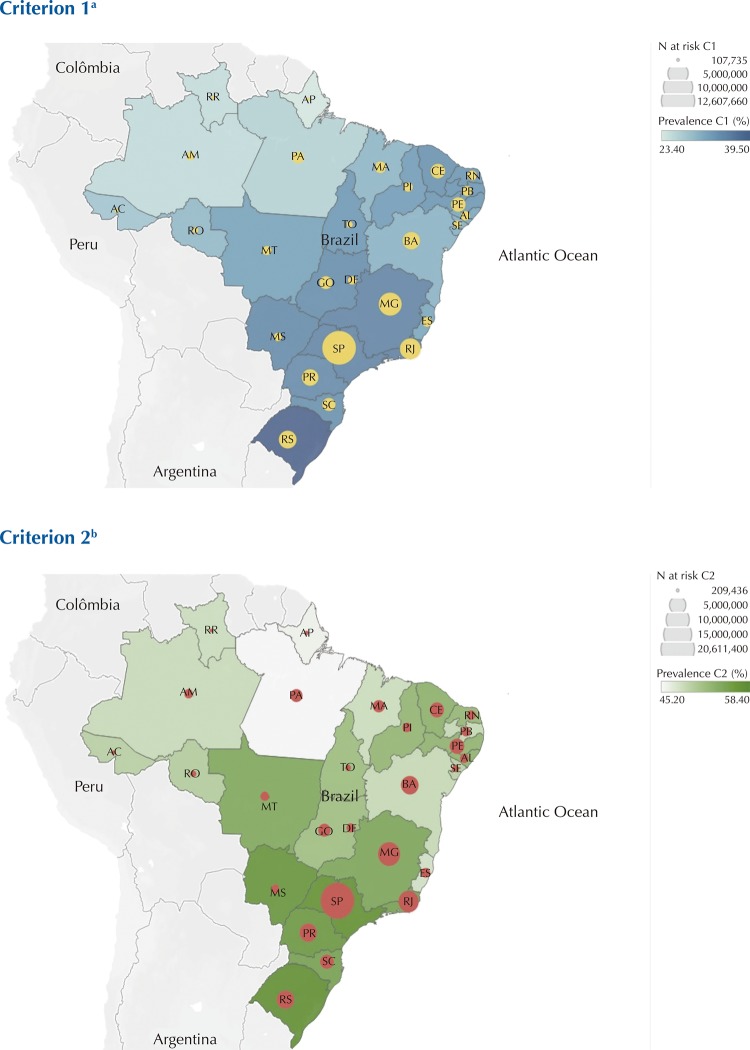
OBJECTIVE To estimate the proportion and total number of the general adult population who may be at higher risk of severe Covid-19 in Brazil. METHODS We included 51,770 participants from a nationally representative, household-based health survey (PNS) conducted in Brazil. We estimated the proportion and number of adults (≥ 18 years) at risk of severe Covid-19 by sex, educational level, race/ethnicity, and state based on the presence of one or more of the following risk factors: age ≥ 65 years or medical diagnosis of cardiovascular disease, diabetes, hypertension, chronic respiratory disease, cancer, stroke, chronic kidney disease and moderate to severe asthma, smoking status, and obesity. RESULTS Adults at risk of severe Covid-19 in Brazil varied from 34.0% (53 million) to 54.5% (86 million) nationwide. Less-educated adults present a 2-fold higher prevalence of risk factors compared to university graduated. We found no differences by sex and race/ethnicity. São Paulo, Rio de Janeiro, Minas Gerais, and Rio Grande do Sul were the most vulnerable states in absolute and relative terms of adults at risk. CONCLUSIONS Proportion and total number of adults at risk of severe Covid-19 are high in Brazil, with wide variation across states and adult subgroups. These findings should be considered while designing and implementing prevention measures in Brazil. We argue that these results support broad social isolation measures, particularly when testing capacity for SARS-CoV-2 is limited.
目的 估计巴西一般成年人群中可能有较高风险罹患严重新冠肺炎的比例和总人数。
方法 我们纳入了巴西一项全国性、基于家庭的健康调查(PNS)中的 51770 名参与者。我们根据以下一个或多个风险因素的存在,估计了按性别、教育程度、种族/民族和州划分的罹患严重新冠肺炎风险的成年人(≥18 岁)的比例和人数:年龄≥65 岁或有心血管疾病、糖尿病、高血压、慢性呼吸道疾病、癌症、中风、慢性肾病和中重度哮喘的医学诊断、吸烟状况和肥胖。
结果 巴西全国罹患严重新冠肺炎风险的成年人比例从 34.0%(5.3 亿)到 54.5%(8.6 亿)不等。与大学毕业的成年人相比,受教育程度较低的成年人出现风险因素的比例高 2 倍。我们未发现性别和种族/民族之间存在差异。圣保罗州、里约热内卢州、米纳斯吉拉斯州和南里奥格兰德州在风险成年人的绝对数量和相对数量方面是最脆弱的州。
结论 巴西罹患严重新冠肺炎风险的成年人比例和总人数较高,各州和成年人群体之间存在广泛差异。在巴西设计和实施预防措施时应考虑到这些发现。我们认为这些结果支持广泛的社会隔离措施,特别是在 SARS-CoV-2 检测能力有限的情况下。