Charbonnier Lorelei, Rouprêt-Serzec Julie, Caseris Marion, Danse Marion, Cointe Aurélie, Cohen Laure, Faye Albert, Ouldali Naïm, Gaschignard Jean
Assistance Publique Hopitaux De Paris, Paris, France.
Service de Pédiatrie Générale, Hôpital Robert-Debré, Paris, France.
Front Pediatr. 2021 May 10;9:638502. doi: 10.3389/fped.2021.638502. eCollection 2021.
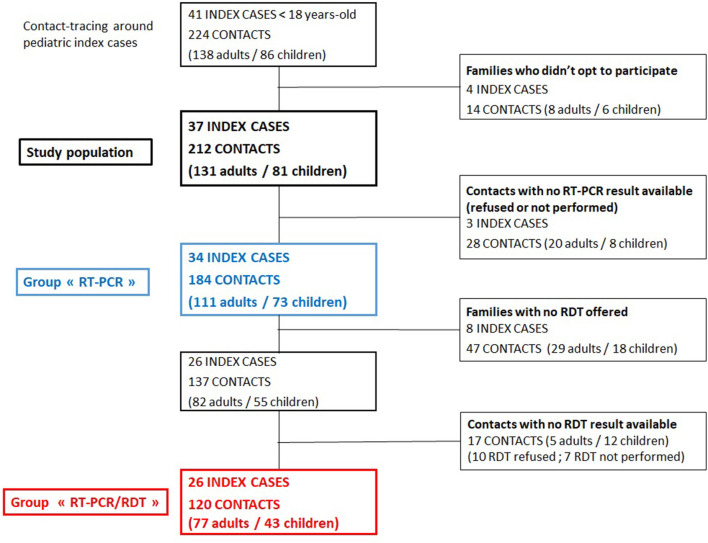
The contact tracing and isolation of contagious individuals are cornerstones in the control of the COVID-19 pandemic. Strategies to identify household contacts who should be isolated around index children that tested positive for SARS-CoV-2 remain to be clarified. We aimed to compare contact tracing strategies around an index child positive for SARS-CoV-2 using serological rapid diagnostic testing (RDT, chromatography immunoassay). We conducted a contact tracing study in households of index cases children in the Paris region, France, between May 8 and July 27, 2020. We compared two strategies, one using SARS-CoV-2 reverse transcriptase polymerase chain reaction (RT-PCR) and one combining RT-PCR and serological RDT, initiated once RDT was available. The contacts RT-PCR-/RDT+ were considered to have been previously infected and not requiring quarantine. The primary outcome was the proportion of contacts that could avoid quarantine with the two screening strategies. We included 34 children as index cases. Median age was 7 years. They generated 184 contacts (111 adults, 73 children) tested by RT-PCR: 24/184 (13%) were positive. The strategy combining RDT and RT-PCR was performed in 120/184 contacts (77 adults, 43 children) of 26 index children: 16/120 (13%) were RT-PCR+ and 47/120 (39%) were RDT+. Among the 16 individuals who were RT-PCR+, 14 (87%) were also RDT+. Among the 104 individuals who were RT-PCR-, 33 were RDT+. Hence 33/120 (27%) individuals were not isolated. Following the diagnosis of SARS-CoV-2 infection in children, a strategy combining serological RDT and nasopharyngeal RT-PCR enabled us to identify around one fourth of contacts with past infection and avoid unnecessary quarantine of these individuals.
追踪和隔离具有传染性的个体是控制新冠疫情的基石。对于确诊感染严重急性呼吸综合征冠状病毒2(SARS-CoV-2)的索引儿童,确定哪些家庭接触者应被隔离的策略仍有待明确。我们旨在比较使用血清学快速诊断检测(RDT,层析免疫测定法)对感染SARS-CoV-2的索引儿童进行接触者追踪的策略。2020年5月8日至7月27日,我们在法国巴黎地区索引病例儿童的家庭中开展了一项接触者追踪研究。我们比较了两种策略,一种使用SARS-CoV-2逆转录聚合酶链反应(RT-PCR),另一种在RDT可用后启动,将RT-PCR与血清学RDT相结合。RT-PCR阴性/RDT阳性的接触者被视为既往已感染,无需隔离。主要结果是两种筛查策略能够避免隔离的接触者比例。我们纳入了34名儿童作为索引病例。中位年龄为7岁。他们产生了184名接受RT-PCR检测的接触者(111名成人,73名儿童):24/184(13%)呈阳性。在26名索引儿童的120/184名接触者(77名成人,43名儿童)中采用了RDT与RT-PCR相结合的策略:16/120(13%)为RT-PCR阳性,47/120(39%)为RDT阳性。在16名RT-PCR阳性的个体中,14名(87%)也是RDT阳性。在104名RT-PCR阴性的个体中,33名RDT阳性。因此,33/120(27%)的个体未被隔离。在儿童确诊感染SARS-CoV-2后,一种将血清学RDT与鼻咽RT-PCR相结合的策略使我们能够识别约四分之一既往感染的接触者,并避免对这些个体进行不必要的隔离。