Department of Biostatistics, University of Florida, Gainesville.
Fred Hutchinson Cancer Research Center, Seattle, Washington.
JAMA Netw Open. 2021 Aug 2;4(8):e2122240. doi: 10.1001/jamanetworkopen.2021.22240.
A previous systematic review and meta-analysis of household transmission of SARS-CoV-2 that summarized 54 published studies through October 19, 2020, found an overall secondary attack rate (SAR) of 16.6% (95% CI, 14.0%-19.3%). However, the understanding of household secondary attack rates for SARS-CoV-2 is still evolving, and updated analysis is needed.
To use newly published data to further the understanding of SARS-CoV-2 transmission in the household.
PubMed and reference lists of eligible articles were used to search for records published between October 20, 2020, and June 17, 2021. No restrictions on language, study design, time, or place of publication were applied. Studies published as preprints were included.
Articles with original data that reported at least 2 of the following factors were included: number of household contacts with infection, total number of household contacts, and secondary attack rates among household contacts. Studies that reported household infection prevalence (which includes index cases), that tested contacts using antibody tests only, and that included populations overlapping with another included study were excluded. Search terms were SARS-CoV-2 or COVID-19 with secondary attack rate, household, close contacts, contact transmission, contact attack rate, or family transmission.
Meta-analyses were performed using generalized linear mixed models to obtain SAR estimates and 95% CIs. The Preferred Reporting Items for Systematic Reviews and Meta-analyses (PRISMA) reporting guideline was followed.
Overall household SAR for SARS-CoV-2, SAR by covariates (contact age, sex, ethnicity, comorbidities, and relationship; index case age, sex, symptom status, presence of fever, and presence of cough; number of contacts; study location; and variant), and SAR by index case identification period.
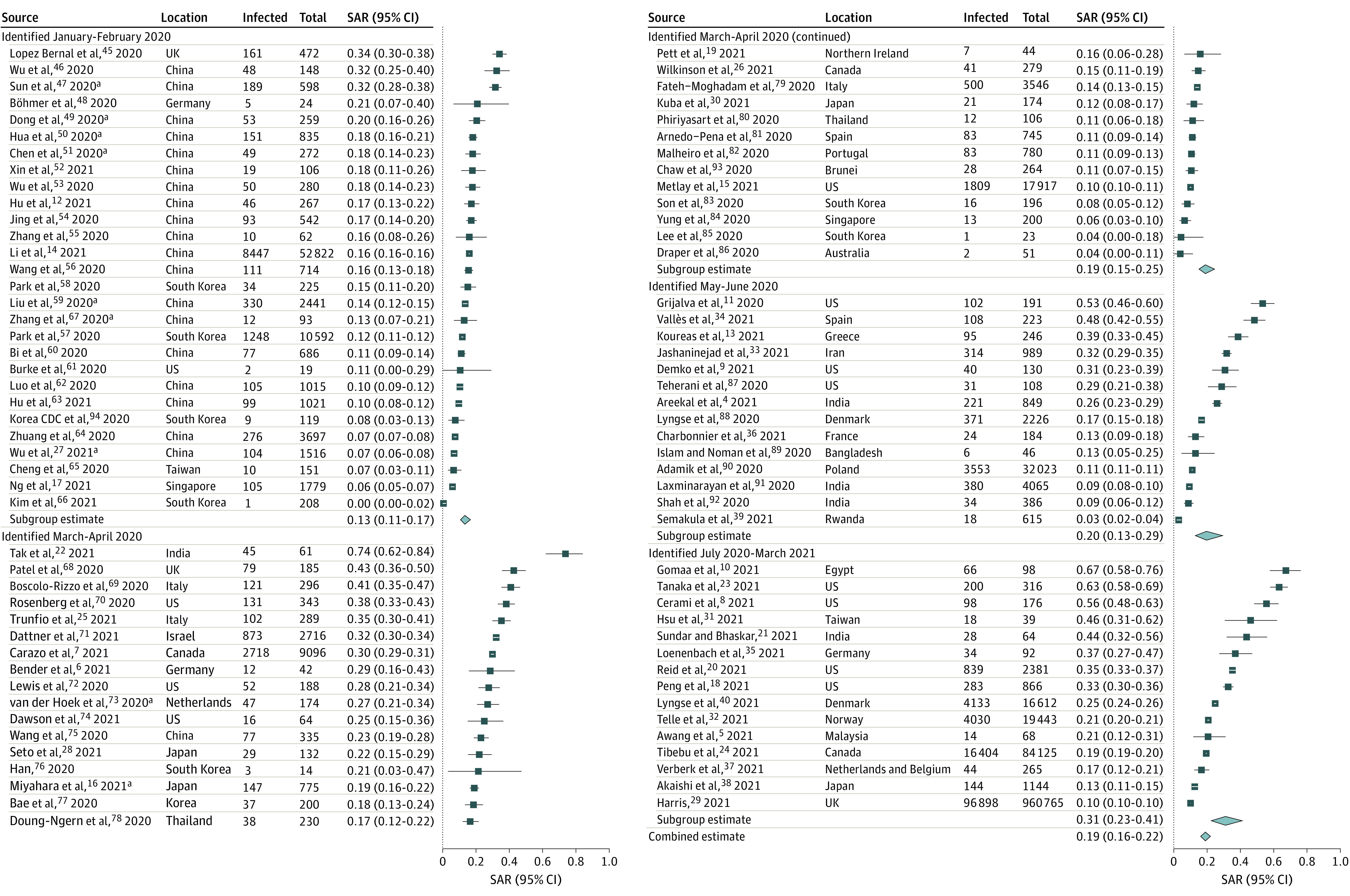
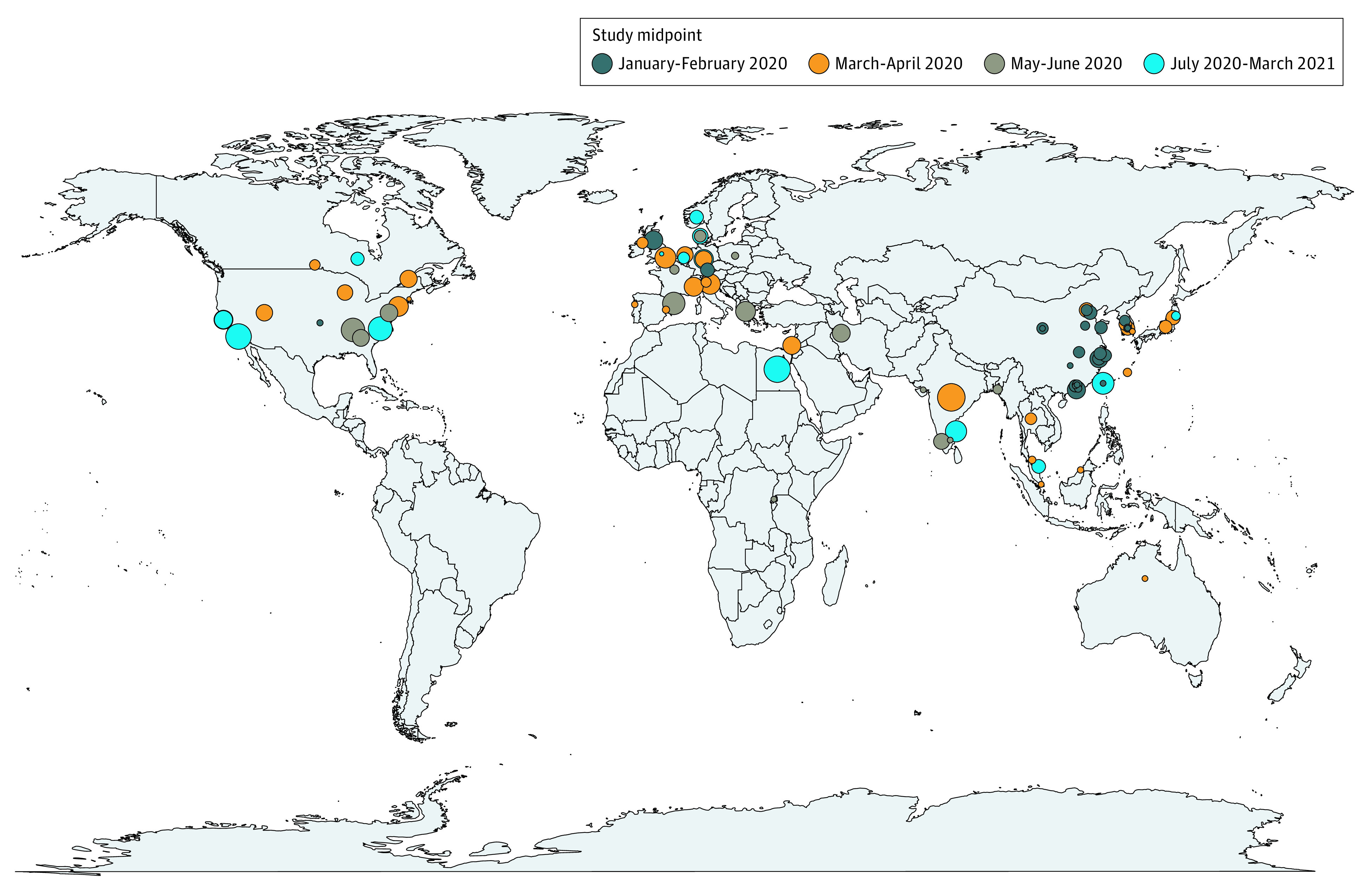
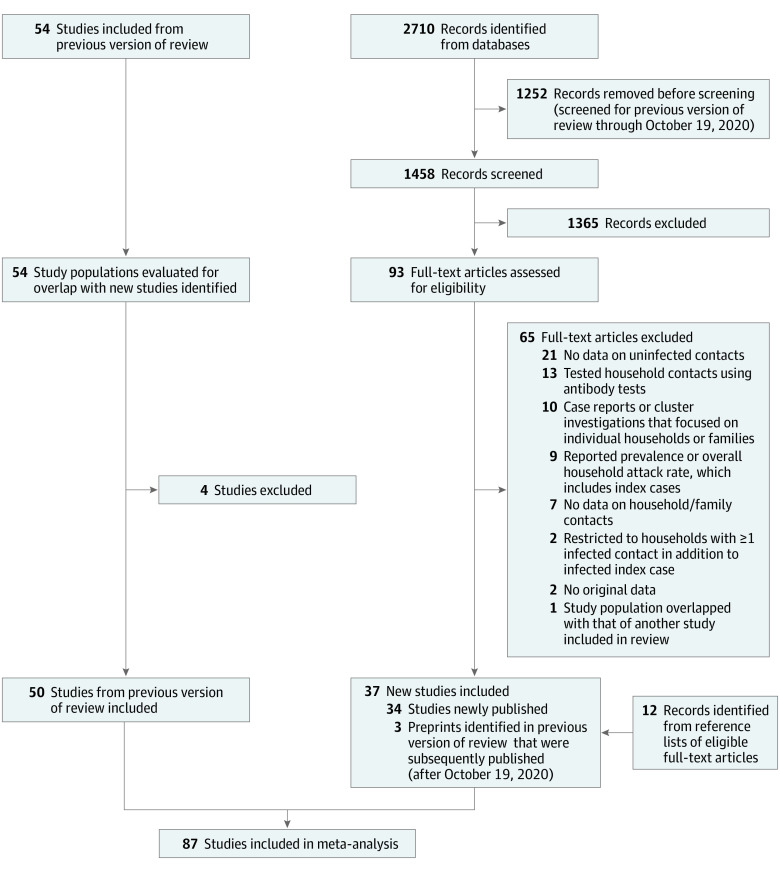
A total of 2722 records (2710 records from database searches and 12 records from the reference lists of eligible articles) published between October 20, 2020, and June 17, 2021, were identified. Of those, 93 full-text articles reporting household transmission of SARS-CoV-2 were assessed for eligibility, and 37 studies were included. These 37 new studies were combined with 50 of the 54 studies (published through October 19, 2020) from our previous review (4 studies from Wuhan, China, were excluded because their study populations overlapped with another recent study), resulting in a total of 87 studies representing 1 249 163 household contacts from 30 countries. The estimated household SAR for all 87 studies was 18.9% (95% CI, 16.2%-22.0%). Compared with studies from January to February 2020, the SAR for studies from July 2020 to March 2021 was higher (13.4% [95% CI, 10.7%-16.7%] vs 31.1% [95% CI, 22.6%-41.1%], respectively). Results from subgroup analyses were similar to those reported in a previous systematic review and meta-analysis; however, the SAR was higher to contacts with comorbidities (3 studies; 50.0% [95% CI, 41.4%-58.6%]) compared with previous findings, and the estimated household SAR for the B.1.1.7 (α) variant was 24.5% (3 studies; 95% CI, 10.9%-46.2%).
The findings of this study suggest that the household remains an important site of SARS-CoV-2 transmission, and recent studies have higher household SAR estimates compared with the earliest reports. More transmissible variants and vaccines may be associated with further changes.
先前对 SARS-CoV-2 家庭传播的系统评价和荟萃分析总结了截至 2020 年 10 月 19 日的 54 项已发表研究,发现总体二次攻击率(SAR)为 16.6%(95%CI,14.0%-19.3%)。然而,对 SARS-CoV-2 的家庭 SAR 的理解仍在不断发展,需要进行更新的分析。
使用新发表的数据进一步了解 SARS-CoV-2 在家庭中的传播。
使用 PubMed 和合格文章的参考文献列表搜索了 2020 年 10 月 20 日至 2021 年 6 月 17 日之间发表的记录。没有对语言、研究设计、时间或出版地点进行限制。包括预印本在内的发表文章都被包括在内。
纳入了有以下至少两项因素原始数据的文章:与感染有关的家庭接触人数、家庭接触总人数以及家庭接触者中的二次攻击率。排除了报告家庭感染流行率(包括索引病例)、仅使用抗体测试检测接触者以及包括与另一项已纳入研究重叠的人群的研究。搜索词包括 SARS-CoV-2 或 COVID-19 与二次攻击率、家庭、密切接触者、接触传播、接触攻击率或家庭传播。
使用广义线性混合模型进行荟萃分析,以获得 SAR 估计值和 95%CI。遵循系统评价和荟萃分析的首选报告项目(PRISMA)报告准则。
SARS-CoV-2 的总体家庭 SAR、按协变量(接触者年龄、性别、种族、合并症和关系;索引病例年龄、性别、症状状态、发热和咳嗽存在情况、接触者人数、研究地点;和变体)的 SAR,以及按索引病例识别期的 SAR。
共确定了 2020 年 10 月 20 日至 2021 年 6 月 17 日期间发表的 2722 条记录(数据库搜索记录 2710 条,合格文章参考文献列表记录 12 条)。其中,93 篇全文文章评估了 SARS-CoV-2 家庭传播的资格,纳入了 37 项研究。将这 37 项新研究与我们之前综述中的 54 项研究中的 50 项(排除了来自中国武汉的 4 项研究,因为其研究人群与另一项近期研究重叠)相结合,共涉及来自 30 个国家的 1249163 个家庭接触者。87 项研究的总体家庭 SAR 估计值为 18.9%(95%CI,16.2%-22.0%)。与 2020 年 1 月至 2 月的研究相比,2020 年 7 月至 2021 年 3 月的研究的 SAR 更高(分别为 13.4%[95%CI,10.7%-16.7%]和 31.1%[95%CI,22.6%-41.1%])。亚组分析结果与之前的系统评价和荟萃分析报告的结果相似;然而,与之前的发现相比,与合并症有关的接触者的 SAR 更高(3 项研究;50.0%[95%CI,41.4%-58.6%]),并且 B.1.1.7(α)变体的家庭 SAR 估计值为 24.5%(3 项研究;95%CI,10.9%-46.2%)。
这项研究的结果表明,家庭仍然是 SARS-CoV-2 传播的重要场所,与最早的报告相比,最近的研究有更高的家庭 SAR 估计值。更具传染性的变体和疫苗可能会进一步改变。