Ean Mom, Sanann Nou, Callery James J, Pell Christopher, Peto Thomas J, Tripura Rupam, Cheah Phaik Yeong
Mahidol Oxford Tropical Medicine Research Unit, Faculty of Tropical Medicine, Mahidol University, Bangkok, Thailand, 10400, Thailand.
University Research Company, Phnom Penh, Cambodia.
Wellcome Open Res. 2021 May 12;6:46. doi: 10.12688/wellcomeopenres.16574.2. eCollection 2021.
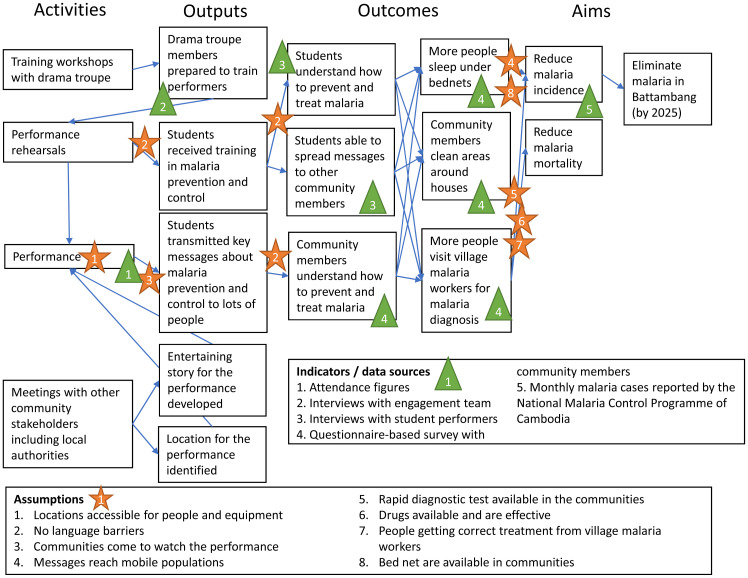
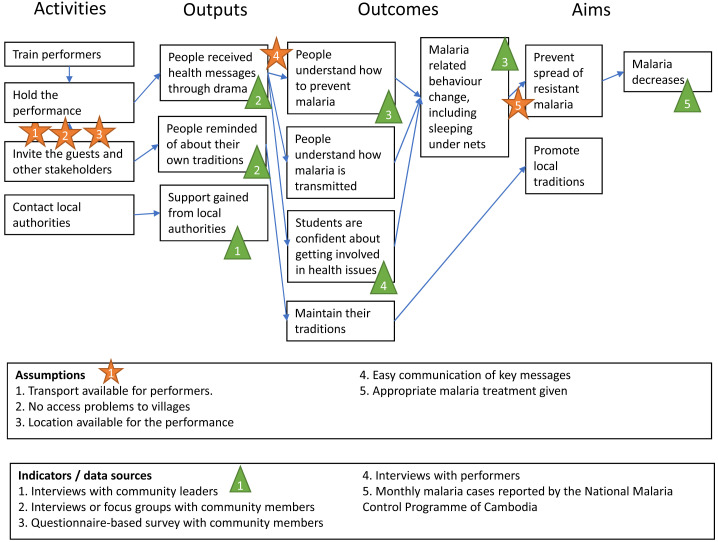
: Across the Greater Mekong Sub-region, malaria persists in isolated communities along international borders. Arts and drama have been used to reach to communities in Cambodia to engage them in malaria research, prevention and control. The "Village Drama Against Malaria" (VDAM) project was conducted in north eastern and western Cambodia: Stung Treng; Battambang and Pailin provinces during 2016 to 2019. In total, VDAM reached 55 rural villages, 2,378 student participants and 43,502 audience members. : This article presents the results of two stakeholder-led evaluation workshops in which participants collaboratively developed theories of change to better understand the potential and actual impact of arts and drama-based activities on malaria in these communities. The workshops had a particular focus on identifying areas for monitoring and evaluation so that impact can be measured. Workshop participants included village malaria workers, community leaders, professional and student drama performers, and representatives from the local health authorities and the national malaria control programme. : Five broad areas were identified as relevant for monitoring and evaluation: logistical and practical challenges; embeddedness and reach of engagement; health knowledge and confidence of young people; effectiveness of communications; impact on malaria. These areas align well with the monitoring and evaluation conducted to date and point to additional opportunities for data collection. : The findings from these workshops will inform future engagement strategies, for example, we may engage a smaller number of young people but over a longer period and more in-depth.
在大湄公河次区域,疟疾在国际边境沿线的孤立社区持续存在。艺术和戏剧已被用于接触柬埔寨的社区,让他们参与疟疾研究、预防和控制。“抗击疟疾乡村戏剧”(VDAM)项目于2016年至2019年在柬埔寨东北部和西部的上丁省、马德望省和拜林省开展。VDAM总共覆盖了55个乡村、2378名学生参与者和43502名观众。本文介绍了两次由利益相关者主导的评估研讨会的结果,参与者共同制定了变革理论,以更好地理解基于艺术和戏剧的活动对这些社区疟疾的潜在和实际影响。研讨会特别侧重于确定监测和评估领域,以便能够衡量影响。研讨会参与者包括乡村疟疾防治人员、社区领袖、专业和学生戏剧表演者,以及当地卫生当局和国家疟疾控制项目的代表。确定了五个与监测和评估相关的广泛领域:后勤和实际挑战;参与的嵌入性和覆盖面;年轻人的健康知识和信心;传播效果;对疟疾的影响。这些领域与迄今为止进行的监测和评估非常吻合,并指出了更多的数据收集机会。这些研讨会的结果将为未来的参与策略提供参考,例如,我们可能会接触较少数量的年轻人,但时间更长、更深入。