From the Vascular Pathophysiology Area (R.B.-D., R.S.-D., A.M.-M., M. Relaño, R.J.-A., B.L.-P., K.T., D.A.P.-F., V.F., F.S.-M., P.M.) and the Myocardial Pathophysiology Area (L.A.-H., M. Ricote, H.B., L.F.-F., B.I.), Centro Nacional de Investigaciones Cardiovasculares (CNIC), the Department of Immunology (H.F., F.S.-M.), the Department of Cardiology (L.J.J.-B., M.M.G.-G., F.A.), the Department of Dermatology (E.D.), and the Department of Rheumatology (I.G.-A.), Instituto de Investigación Sanitaria, Hospital Universitario de la Princesa, Fundación Jiménez Díaz (M.L.M.-M., B.I.), the Cardiology Department, Hospital Universitario 12 de Octubre, and Instituto de Investigación Sanitaria Hospital 12 de Octubre (G.M., R.M.-A., H.B.), the Department of Immunology, Hospital Ramón y Cajal (L.M.V.-G.), HM Hospitales-Centro Integral de Enfermedades Cardiovasculares (L.F.-F.), and CIBER de Enfermedades Cardiovasculares (R.S.-D., H.F., L.J.J.-B., F.A., D.A.P.-F., B.I., F.S.-M., P.M.), Madrid, Hospital Universitario Central de Asturias, Oviedo (A.M.-L.), and the Cardiology Department, Hospital Universitario Virgen de la Arrixaca, Murcia (D.A.P.-F.) - all in Spain; the Department of Cardiovascular Medicine, Mayo Clinic, Jacksonville, FL (K.A.B., D.F.); the Cardiovascular Division and Corrigan Minehan Heart Center, Massachusetts General Hospital, and Harvard Medical School, Boston (A.M.S.-G., S.A.M., N.E.I., J.L.J., S.D.); Kanntonsspital St. Gallen Klinik für Anesthesiologie und Intensivmedizin, St. Gallen, Switzerland (J.K.); Cardiology (S.I., A.B., A.L.P.C.) and the Cardiovascular Pathology Unit (C.B.), the Department of Cardiac, Thoracic, Vascular Sciences and Public Health, the Department of Laboratory Medicine (M.P., M.S.), and the Department of Medicine, Hematology and Clinical Immunology (R.M.), University of Padua, Padua, Italy; Charite Universitätsmedizin Berlin, Campus Benjamin Franklin, Berlin (B.H.); Imperial College and Royal Brompton and Harefield Hospital, London (T.F.L.); and the Cardiovascular Institute, Icahn School of Medicine at Mount Sinai, New York (V.F.).
N Engl J Med. 2021 May 27;384(21):2014-2027. doi: 10.1056/NEJMoa2003608.
The diagnosis of acute myocarditis typically requires either endomyocardial biopsy (which is invasive) or cardiovascular magnetic resonance imaging (which is not universally available). Additional approaches to diagnosis are desirable. We sought to identify a novel microRNA for the diagnosis of acute myocarditis.
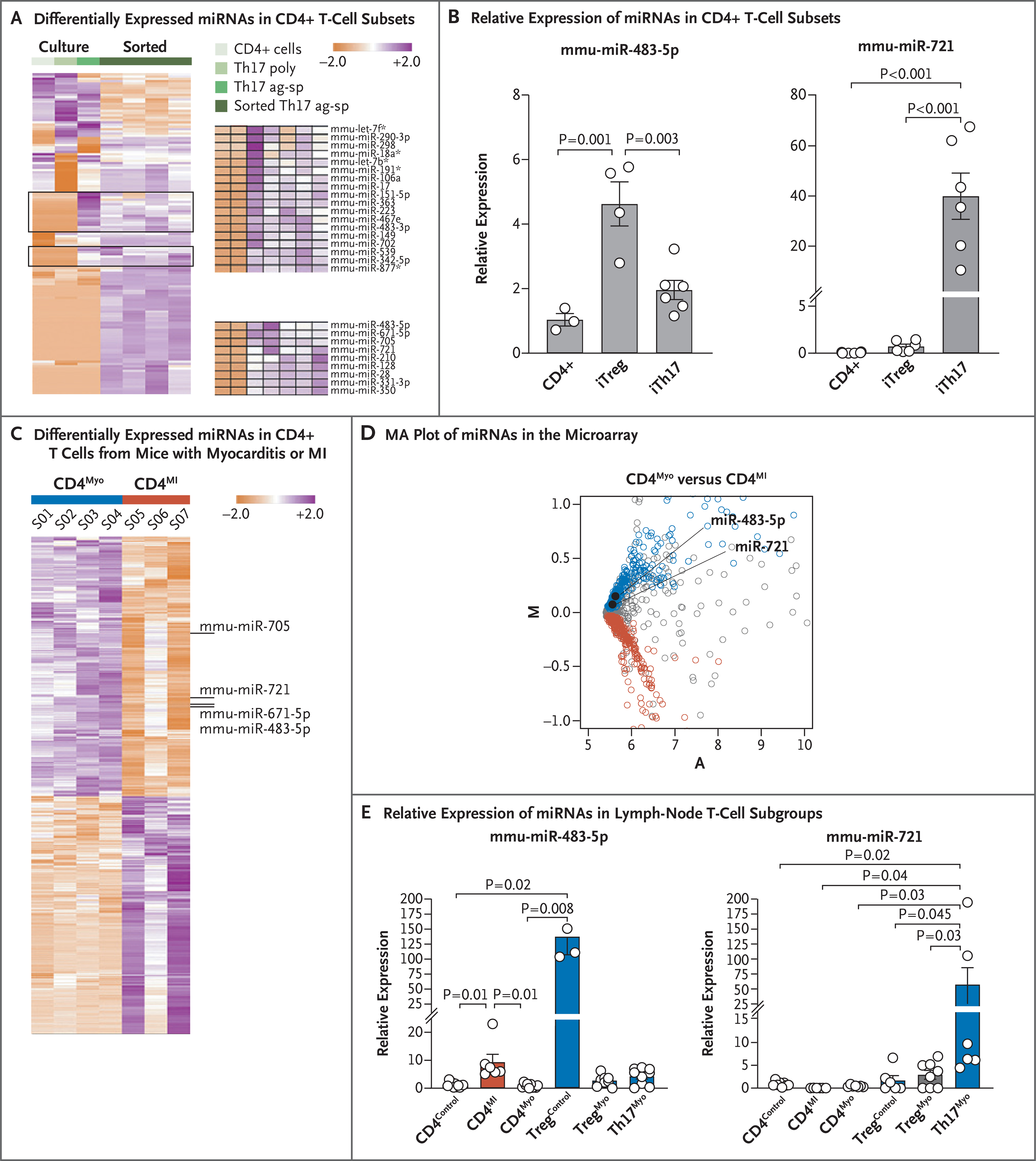
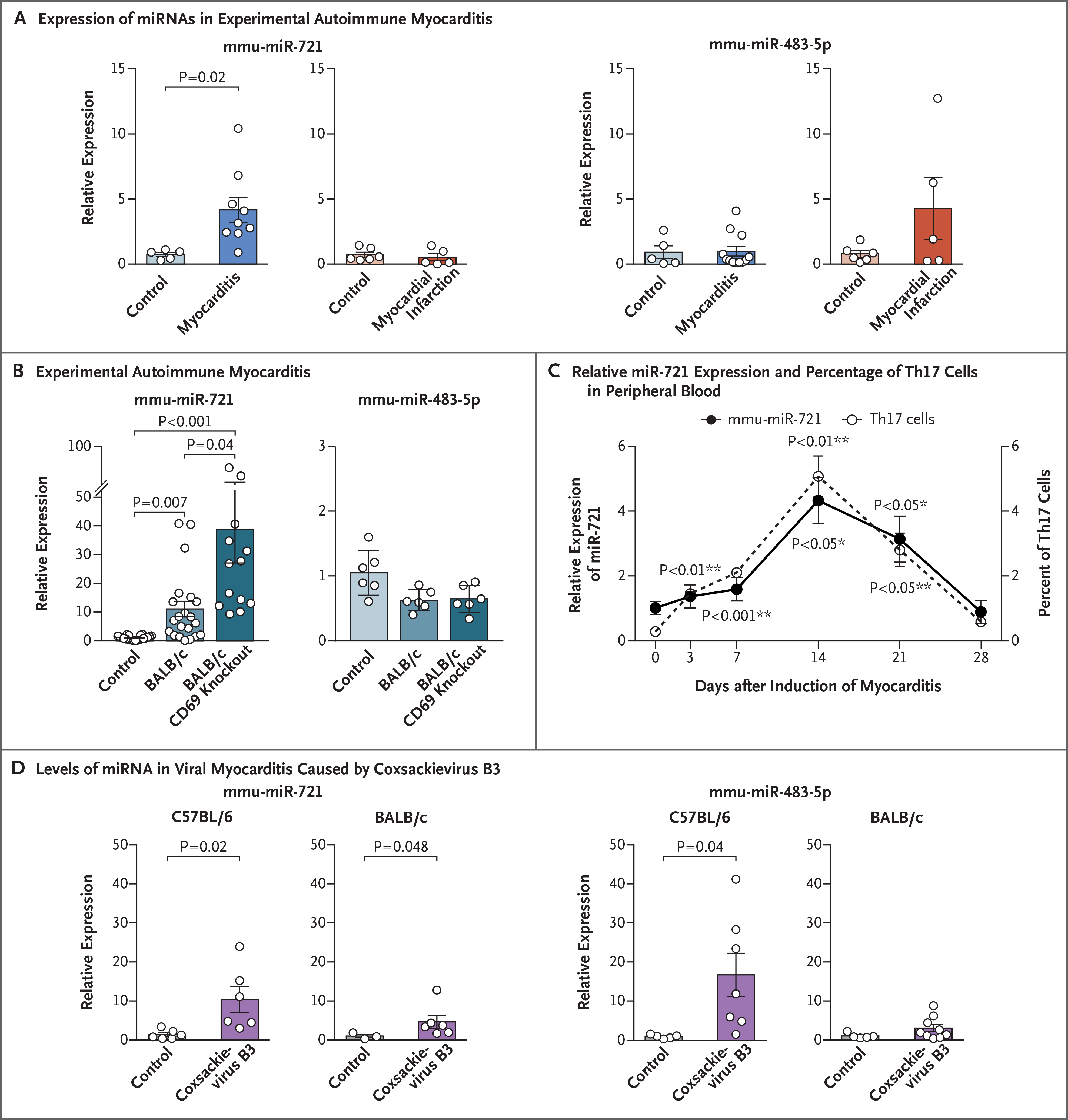
To identify a microRNA specific for myocarditis, we performed microRNA microarray analyses and quantitative polymerase-chain-reaction (qPCR) assays in sorted CD4+ T cells and type 17 helper T (Th17) cells after inducing experimental autoimmune myocarditis or myocardial infarction in mice. We also performed qPCR in samples from coxsackievirus-induced myocarditis in mice. We then identified the human homologue for this microRNA and compared its expression in plasma obtained from patients with acute myocarditis with the expression in various controls.
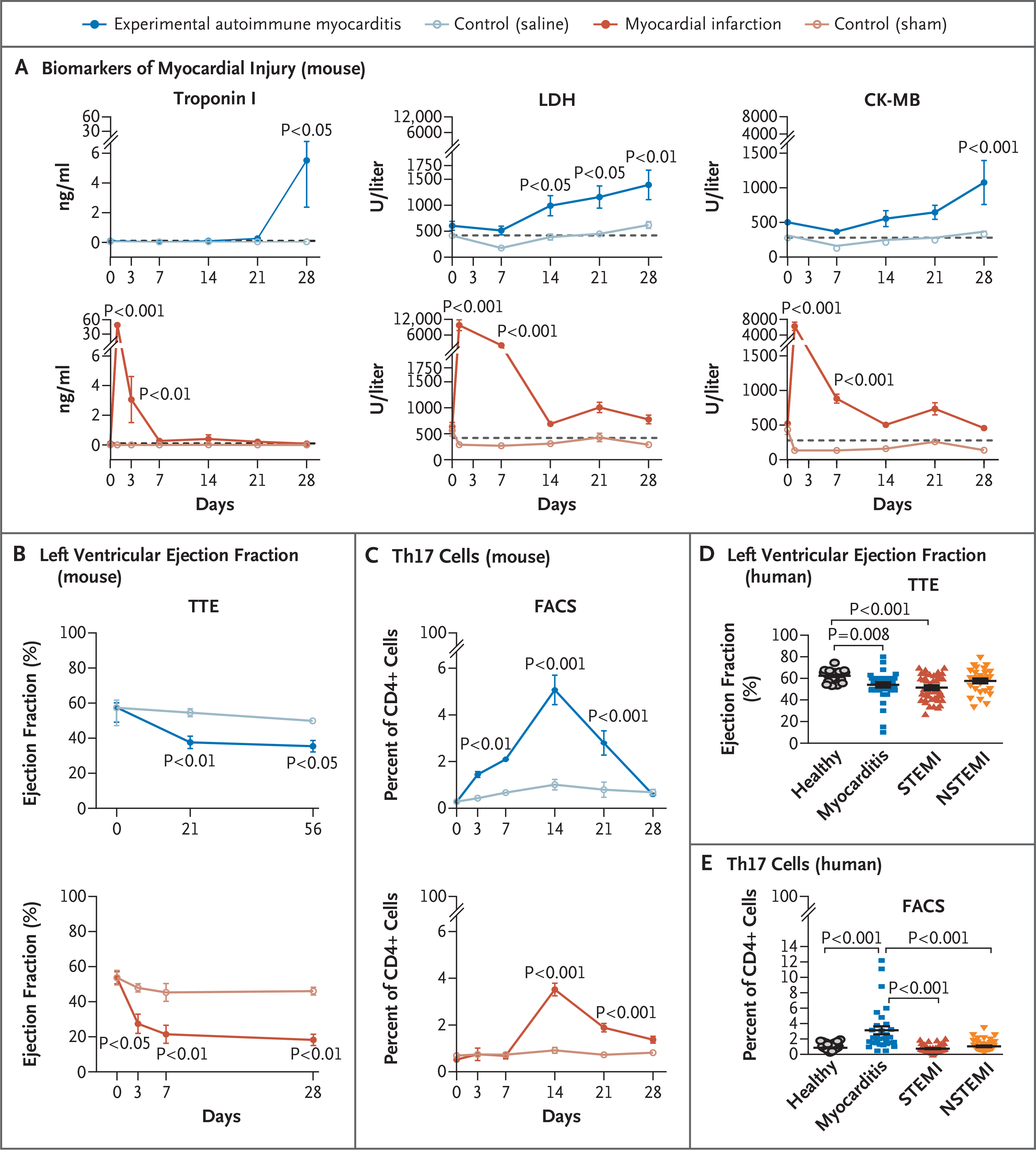
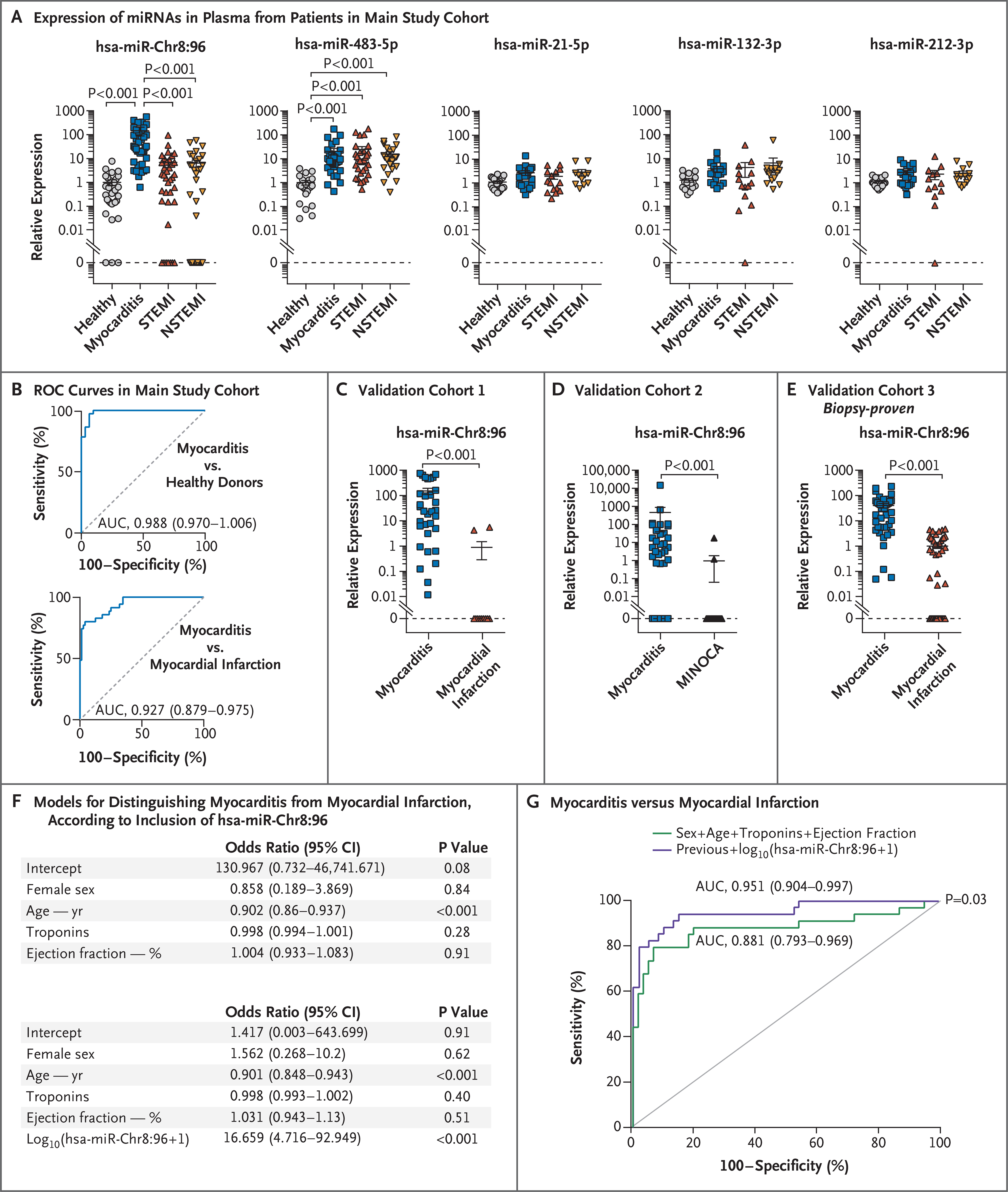
We confirmed that Th17 cells, which are characterized by the production of interleukin-17, are a characteristic feature of myocardial injury in the acute phase of myocarditis. The microRNA mmu-miR-721 was synthesized by Th17 cells and was present in the plasma of mice with acute autoimmune or viral myocarditis but not in those with acute myocardial infarction. The human homologue, designated hsa-miR-Chr8:96, was identified in four independent cohorts of patients with myocarditis. The area under the receiver-operating-characteristic curve for this novel microRNA for distinguishing patients with acute myocarditis from those with myocardial infarction was 0.927 (95% confidence interval, 0.879 to 0.975). The microRNA retained its diagnostic value in models after adjustment for age, sex, ejection fraction, and serum troponin level.
After identifying a novel microRNA in mice and humans with myocarditis, we found that the human homologue (hsa-miR-Chr8:96) could be used to distinguish patients with myocarditis from those with myocardial infarction. (Funded by the Spanish Ministry of Science and Innovation and others.).
急性心肌炎的诊断通常需要心内膜心肌活检(具有侵入性)或心血管磁共振成像(并非普遍适用)。需要有其他的诊断方法。我们试图寻找一种用于诊断急性心肌炎的新型 microRNA。
为了鉴定一种针对心肌炎的 microRNA,我们在诱导实验性自身免疫性心肌炎或心肌梗死的情况下,对分离的 CD4+T 细胞和 1 型 17 辅助性 T(Th17)细胞进行 microRNA 微阵列分析和实时定量聚合酶链反应(qPCR)检测。我们还在柯萨奇病毒诱导的心肌炎小鼠样本中进行了 qPCR。然后,我们鉴定了这种 microRNA 的人同源物,并比较了其在急性心肌炎患者血浆中的表达与各种对照中的表达。
我们证实 Th17 细胞(其特征是产生白细胞介素-17)是心肌炎急性期心肌损伤的特征。Th17 细胞合成的 microRNA mmu-miR-721 存在于急性自身免疫性或病毒性心肌炎的小鼠血浆中,但不存在于急性心肌梗死的小鼠血浆中。鉴定了四个独立的心肌炎患者队列中的人同源物,命名为 hsa-miR-Chr8:96。这种新型 microRNA 用于区分急性心肌炎患者与心肌梗死患者的受试者工作特征曲线下面积为 0.927(95%置信区间,0.879 至 0.975)。在调整年龄、性别、射血分数和血清肌钙蛋白水平后,该 microRNA 仍保留其诊断价值。
在鉴定了患有心肌炎的小鼠和人类中的一种新型 microRNA 后,我们发现其人类同源物(hsa-miR-Chr8:96)可用于区分心肌炎患者与心肌梗死患者。(由西班牙科学创新部等资助)。