Department of Metabolism and Nutrition, Institute of Food Science, Technology and Nutrition (ICTAN-CSIC), Madrid, Spain.
Department of Chemistry in Pharmaceutical Sciences, Faculty of Pharmacy, Complutense University of Madrid, Madrid, Spain.
PLoS One. 2021 May 27;16(5):e0251324. doi: 10.1371/journal.pone.0251324. eCollection 2021.
The dietary carotenoids lutein (L) and zeaxanthin (Z) are transported in the bloodstream by lipoproteins, sequestered by adipose tissue, and eventually captured in the retina where they constitute macular pigment. There are no L&Z dietary intake recommendations nor desired blood/tissue concentrations for the Spanish general population. Our aim was to assess the correlation of L&Z habitual dietary intake (excluding food supplements), resulting serum concentrations and lipid profile with macular pigment optical density (MPOD) as well as the contrast sensitivity (CT), as visual outcome in normolipemic subjects (n = 101) aged 45-65.
MPOD was measured by heterochromatic flicker photometry, serum L&Z by HPLC, the dietary intake by a 3-day food records and CT using the CGT-1000-Contrast-Glaretester at six stimulus sizes, with and without glare.
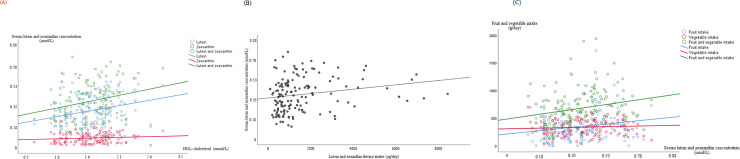
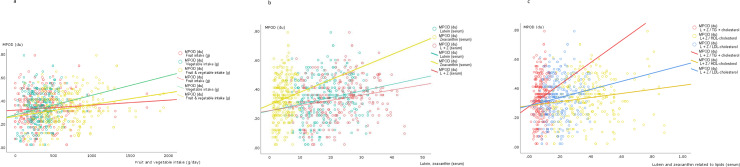
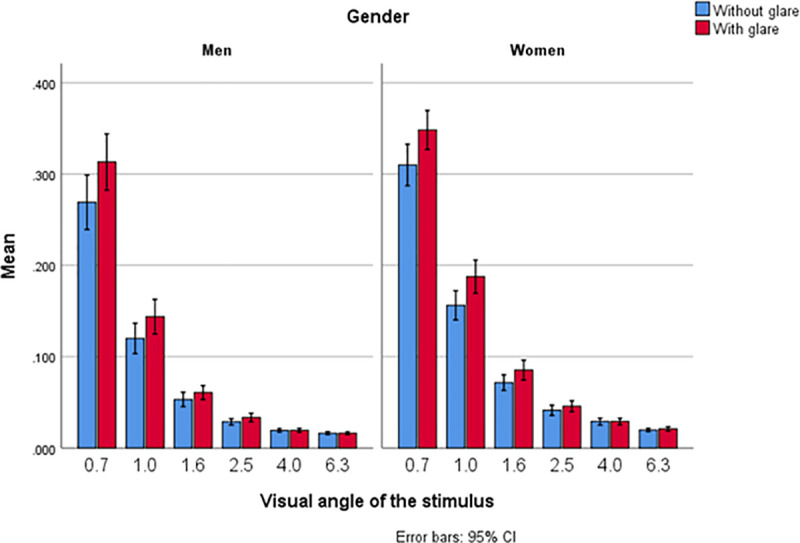
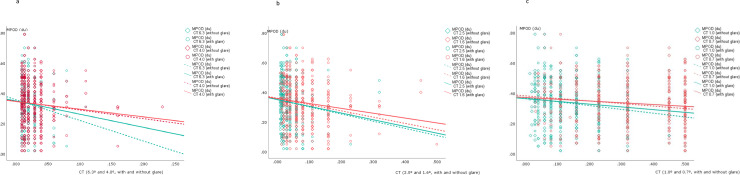
Lutein and zeaxanthin concentrations (median) in serum: 0.361 and 0.078 μmol/L, in dietary intake: 1.1 mg L+Z/day. MPOD: 0.34du. L+Z intake correlates with their serum concentrations (rho = 0.333, p = 0.001), which in turn correlates with MPOD (rho = 0.229, p = 0.000) and with fruit and vegetable consumption (rho = 0.202, p = 0.001), but not with lutein+zeaxanthin dietary intake. MPOD correlated with CT, with and without glare (rho ranges: -0.135, 0.160 and -0.121, -0.205, respectively). MPOD predictors: serum L+Z, L+Z/HDL-cholesterol (β-coeficient: -0.91±0.2, 95%CI: -1.3,-0.5) and HDL-cholesterol (R2 = 15.9%). CT predictors: MPOD, mainly at medium and smaller visual angles (corresponding to spatial frequencies for which sensitivity declines with age) and gender (β-coefficients ranges: -0.95,-0.39 and -0.13,-0.39, respectively).
A higher MPOD is associated with a lower ratio of L+Z/HDL-cholesterol and with a lower CT (higher contrast sensitivity). The HDL-cholesterol would also act indirectly on the CT improving the visual function.
膳食中叶黄素(L)和玉米黄质(Z)通过脂蛋白在血液中运输,被脂肪组织隔离,并最终在视网膜中被捕获,在那里它们构成黄斑色素。西班牙一般人群没有关于 L&Z 饮食摄入量的建议,也没有理想的血液/组织浓度。我们的目的是评估 L&Z 习惯性饮食摄入(不包括膳食补充剂)、血清浓度和血脂谱与黄斑色素光学密度(MPOD)以及对比敏感度(CT)的相关性,作为正常血脂个体(n = 101)的视觉结果,年龄在 45-65 岁之间。
通过异色调闪烁光度计测量 MPOD,用 HPLC 测量血清 L&Z,用 3 天食物记录测量饮食摄入,用 CGT-1000-Contrast-Glaretester 在六个刺激大小下测量 CT,有和没有眩光。
血清中 L 与 Z 的浓度(中位数):0.361 和 0.078 μmol/L,饮食中 L+Z 的摄入量为 1.1mg/天。MPOD:0.34du。L+Z 的摄入量与它们的血清浓度相关(rho = 0.333,p = 0.001),血清浓度与 MPOD 相关(rho = 0.229,p = 0.000),与水果和蔬菜的摄入量相关(rho = 0.202,p = 0.001),但与叶黄素+玉米黄质的饮食摄入量无关。MPOD 与 CT 有相关性,有和没有眩光(rho 范围:-0.135、0.160 和-0.121、-0.205)。MPOD 的预测因素:血清 L+Z、L+Z/高密度脂蛋白胆固醇(β-系数:-0.91±0.2,95%CI:-1.3,-0.5)和高密度脂蛋白胆固醇(R2 = 15.9%)。CT 的预测因素:MPOD,主要在中等和较小的视角(对应于敏感性随年龄下降的空间频率)和性别(β-系数范围:-0.95,-0.39 和-0.13,-0.39)。
较高的 MPOD 与较低的 L+Z/高密度脂蛋白胆固醇比值和较低的 CT(较高的对比敏感度)相关。高密度脂蛋白胆固醇也会间接作用于 CT,改善视觉功能。