Aix Marseille Univ, IRD, AP-HM, SSA, VITROME, Marseille, France; Institut Hospitalo-Universitaire-Méditerranée Infection, Marseille, France; Thai Binh University of Medicine and Pharmacy, Thai Binh, Viet nam.
Aix Marseille Univ, IRD, AP-HM, SSA, VITROME, Marseille, France; Institut Hospitalo-Universitaire-Méditerranée Infection, Marseille, France.
Clin Microbiol Infect. 2021 Oct;27(10):1516.e1-1516.e6. doi: 10.1016/j.cmi.2021.05.029. Epub 2021 May 24.
To compare the clinical and epidemiological aspects associated with different predominant lineages circulating in Marseille from March 2020 to January 2021.
In this single-centre retrospective cohort study, characteristics of patients infected with four different severe acute respiratory syndrome coronavirus 2 (SARS-CoV-2) variants were documented from medical files. The outcome was the occurrence of clinical failure, defined as hospitalization (for outpatients), transfer to the intensive care unit (inpatients) and death (all).
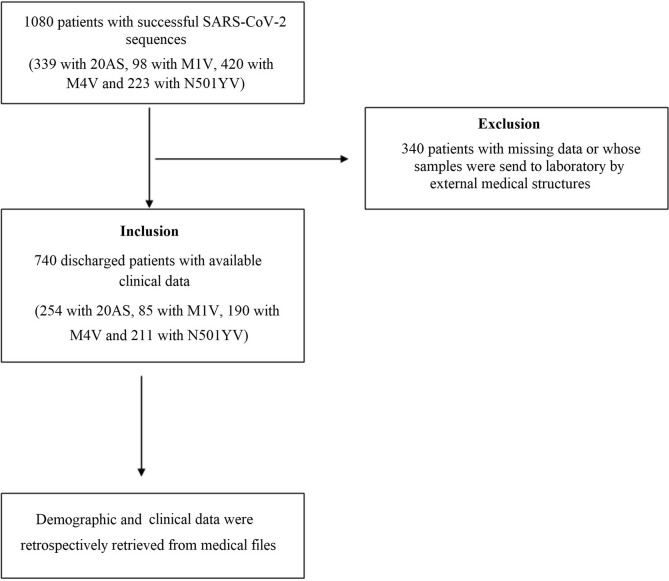
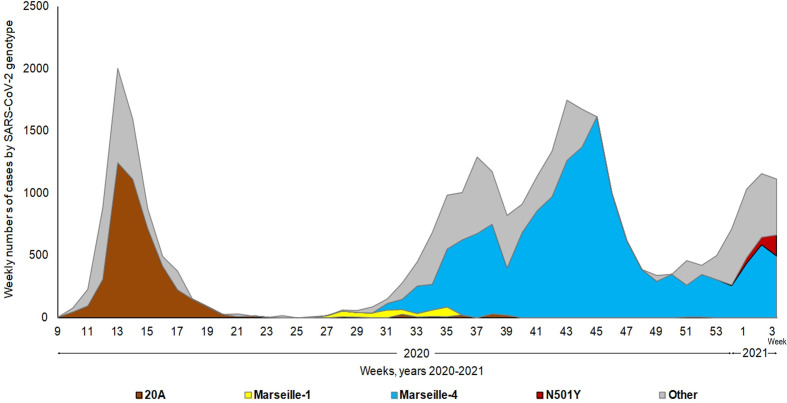
A total of 254 patients were infected with clade 20A (20AS), 85 with Marseille-1 (M1V), 190 with Marseille-4 (M4V) and 211 with N501Y (N501YV) variants. 20AS presented a bell-shaped epidemiological curve and nearly disappeared around May 2020. M1V reached a very weak peak, then disappeared after six weeks. M4V appeared in July presented an atypical wave form for 7 months. N501YV has only recently appeared. Compared with 20AS, patients infected with M1V were less likely to report dyspnoea (adjusted odds ratio (OR) 0.50, p 0.04), rhinitis (aOR 0.57, p 0.04) and to be hospitalized (aOR 0.22, p 0.002). Patients infected with M4V were more likely to report fever than those with 20AS and M1V (aOR 2.49, p < 0.0001 and aOR 2.30, p 0.007, respectively) and to be hospitalized than those with M1V (aOR 4.81, p 0.003). Patients infected with N501YV reported lower rate of rhinitis (aOR 0.50, p 0.001) and anosmia (aOR 0.57, p 0.02), compared with those infected with 20AS. A lower rate of hospitalization was associated with N501YV infection compared with 20AS and M4V (aOR 0.33, p < 0.0001 and aOR 0.27, p < 0.0001, respectively).
The four lineages have presentations that differ from one another, epidemiologically and clinically. This supports SARS-CoV-2 genomic surveillance through next-generation sequencing.
比较 2020 年 3 月至 2021 年 1 月马赛流行的不同主要谱系相关的临床和流行病学特征。
在这项单中心回顾性队列研究中,从病历中记录了感染四种不同严重急性呼吸综合征冠状病毒 2 (SARS-CoV-2)变体的患者的特征。结局是临床失败的发生,定义为住院(门诊患者)、转入重症监护病房(住院患者)和死亡(所有)。
共 254 例患者感染 20A 分支(20AS),85 例感染马赛-1 (M1V),190 例感染马赛-4 (M4V),211 例感染 N501Y (N501YV)变体。20AS 呈钟形流行曲线,2020 年 5 月左右几乎消失。M1V 达到一个非常微弱的高峰,六周后消失。M4V 于 7 月出现,呈现出 7 个月的非典型波型。N501YV 最近才出现。与 20AS 相比,感染 M1V 的患者更不可能报告呼吸困难(调整后的优势比(OR)0.50,p 0.04)、鼻炎(aOR 0.57,p 0.04)和住院(aOR 0.22,p 0.002)。感染 M4V 的患者比感染 20AS 和 M1V 的患者更有可能报告发热(aOR 2.49,p < 0.0001 和 aOR 2.30,p 0.007),且比感染 M1V 的患者更有可能住院(aOR 4.81,p 0.003)。与感染 20AS 的患者相比,感染 N501YV 的患者报告鼻炎(aOR 0.50,p 0.001)和嗅觉丧失(aOR 0.57,p 0.02)的比例较低。与感染 20AS 和 M4V 相比,感染 N501YV 与较低的住院率相关(aOR 0.33,p < 0.0001 和 aOR 0.27,p < 0.0001)。
这四种谱系在流行病学和临床方面表现不同。这支持通过下一代测序进行 SARS-CoV-2 基因组监测。