Institute of Environmental Sciences (CML), Leiden University, Leiden 2300 RA, The Netherlands.
School of Environmental Science and Engineering, Collaborative Innovation Center of Atmospheric Environment and Equipment Technology, Jiangsu Key Laboratory of Atmospheric Environment Monitoring and Pollution Control, Nanjing University of Information Science and Technology, Nanjing 210044, PR China.
Ecotoxicol Environ Saf. 2021 Aug;219:112357. doi: 10.1016/j.ecoenv.2021.112357. Epub 2021 May 19.
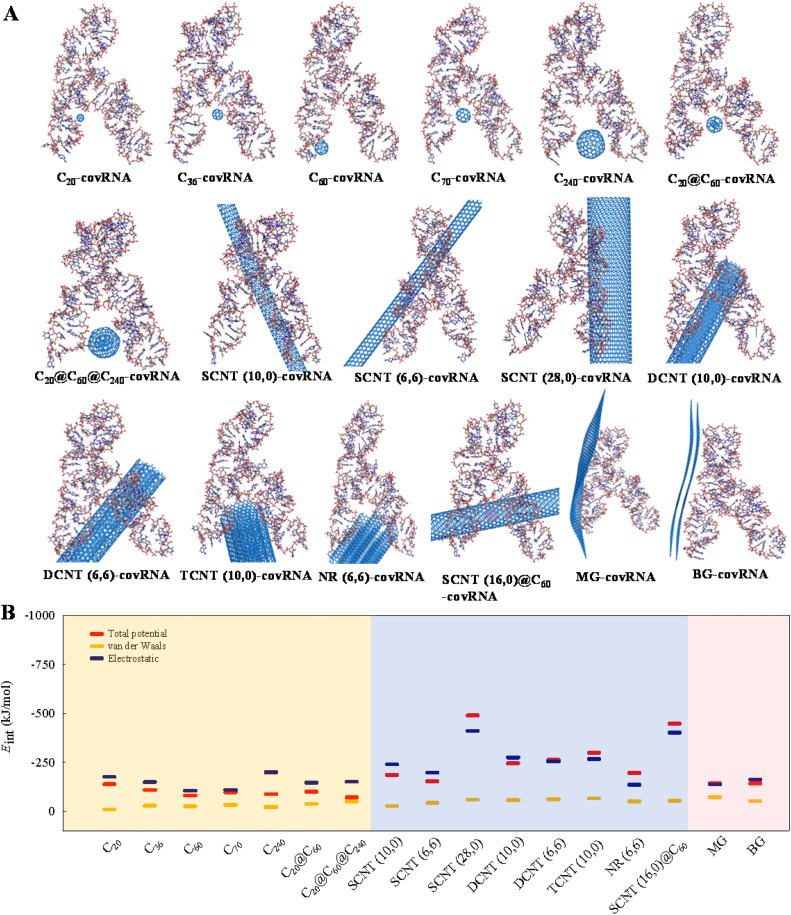
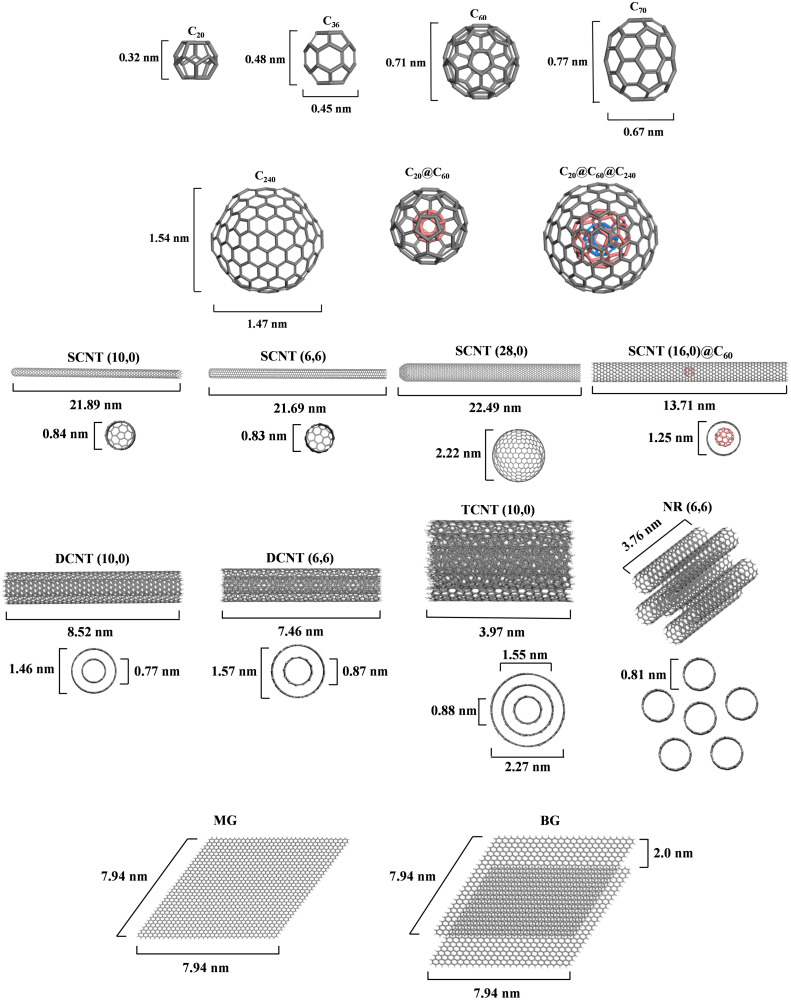
The coronavirus disease-19 (COVID-19) pandemic caused by the severe acute respiratory syndrome coronavirus 2 (SARS-CoV-2) is rampant in the world and is a serious threat to global health. The SARS-CoV-2 RNA has been detected in various environmental media, which speeds up the pace of the virus becoming a global biological pollutant. Because many engineered nanomaterials (ENMs) are capable of inducing anti-microbial activity, ENMs provide excellent solutions to overcome the virus pandemic, for instance by application as protective coatings, biosensors, or nano-agents. To tackle some mechanistic issues related to the impact of ENMs on SARS-CoV-2, we investigated the molecular interactions between carbon nanoparticles (CNPs) and a SARS-CoV-2 RNA fragment (i.e., a model molecule of frameshift stimulation element from the SARS-CoV-2 RNA genome) using molecular mechanics simulations. The interaction affinity between the CNPs and the SARS-CoV-2 RNA fragment increased in the order of fullerenes < graphenes < carbon nanotubes. Furthermore, we developed quantitative structure-activity relationship (QSAR) models to describe the interactions of 17 different types of CNPs from three dimensions with the SARS-CoV-2 RNA fragment. The QSAR models on the interaction energies of CNPs with the SARS-CoV-2 RNA fragment show high goodness-of-fit and robustness. Molecular weight, surface area, and the sum of degrees of every carbon atom were found to be the primary structural descriptors of CNPs determining the interactions. Our research not only offers a theoretical insight into the adsorption/separation and inactivation of SARS-CoV-2, but also allows to design novel ENMs which act efficiently on the genetic material RNA of SARS-CoV-2. This contributes to minimizing the challenge of time-consuming and labor-intensive virus experiments under high risk of infection, whilst meeting our precautionary demand for options to handle any new versions of the coronavirus that might emerge in the future.
由严重急性呼吸系统综合症冠状病毒 2 型(SARS-CoV-2)引起的 2019 冠状病毒病(COVID-19)大流行在世界范围内肆虐,对全球健康构成严重威胁。SARS-CoV-2 的 RNA 已在各种环境介质中被检测到,这加速了病毒成为全球生物污染物的速度。由于许多工程纳米材料(ENMs)能够诱导抗菌活性,因此 ENMs 为克服病毒大流行提供了极好的解决方案,例如作为防护涂层、生物传感器或纳米剂应用。为了解决与 ENMs 对 SARS-CoV-2 影响相关的一些机制问题,我们使用分子力学模拟研究了碳纳米粒子(CNPs)与 SARS-CoV-2 RNA 片段(即 SARS-CoV-2 RNA 基因组中移码刺激元件的模型分子)之间的分子相互作用。CNPs 与 SARS-CoV-2 RNA 片段之间的相互作用亲和力依次为富勒烯<石墨烯<碳纳米管。此外,我们开发了定量结构-活性关系(QSAR)模型,以从三个维度描述 17 种不同类型的 CNPs 与 SARS-CoV-2 RNA 片段的相互作用。CNPs 与 SARS-CoV-2 RNA 片段相互作用能量的 QSAR 模型显示出良好的拟合度和稳健性。发现分子量、表面积和每个碳原子的度数之和是决定相互作用的 CNPs 的主要结构描述符。我们的研究不仅为 SARS-CoV-2 的吸附/分离和失活提供了理论见解,而且还允许设计出对 SARS-CoV-2 的遗传物质 RNA 有效作用的新型 ENMs。这有助于减少在高感染风险下进行耗时和费力的病毒实验的挑战,同时满足我们对处理未来可能出现的任何新型冠状病毒的选择的预防需求。