Alzheimer Center, Department of Neurology, Amsterdam UMC, Amsterdam, The Netherlands.
Brain Research Center, Amsterdam, The Netherlands.
Alzheimers Res Ther. 2021 May 27;13(1):106. doi: 10.1186/s13195-021-00843-2.
In preclinical studies, p38⍺ kinase is implicated in Alzheimer's disease (AD) pathogenesis. In animal models, it mediates impaired synaptic dysfunction in the hippocampus, causing memory deficits, and is involved in amyloid-beta (Aβ) production and tau pathology.
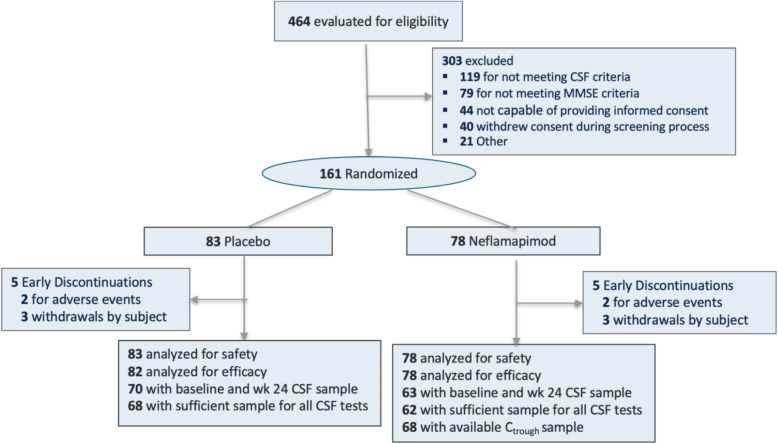
The REVERSE-SD (synaptic dysfunction) study was a multi-center phase 2, randomized, double-blind, placebo-controlled trial of the p38⍺ kinase inhibitor neflamapimod; conducted December 29, 2017, to June 17, 2019; 464 participants screened, and 161 randomized to either 40 mg neflamapimod (78 study participants) or matching placebo (83 study participants), orally twice daily for 24 weeks. Study participants are as follows: CSF AD-biomarker confirmed, Clinical Dementia Rating (CDR)-global score 0.5 or 1.0, CDR-memory score ≥0.5, and Mini-Mental State Examination (MMSE) 20-28. The primary endpoint was the improvement in episodic memory, assessed by combined change in Z-scores of Hopkins Verbal Learning Test-Revised (HVLT-R) Total and Delayed Recall. Secondary endpoints included change in Wechsler Memory Scale-IV (WMS) Immediate and Delayed Recall composites, CDR-SB, MMSE, and CSF biomarkers [total and phosphorylated tau (T-tau and p-tau), Aβ, Aβ, neurogranin, and neurofilament light chain].
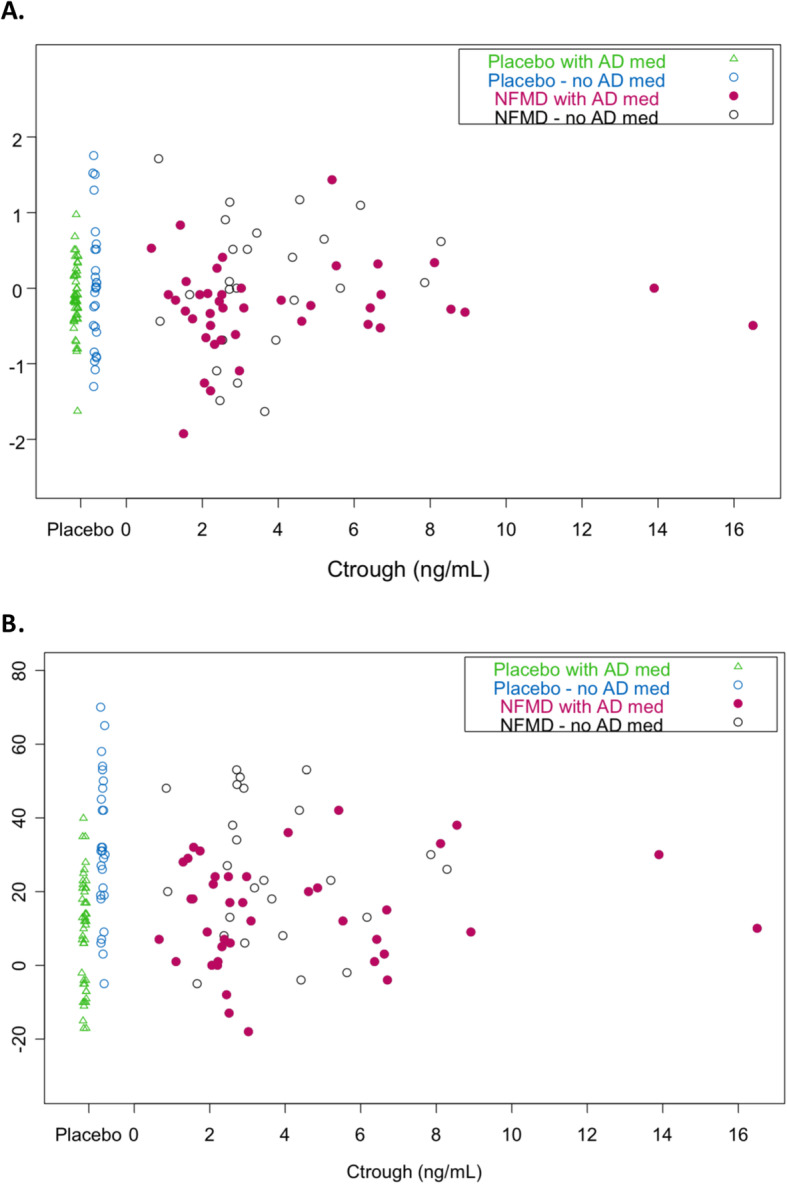
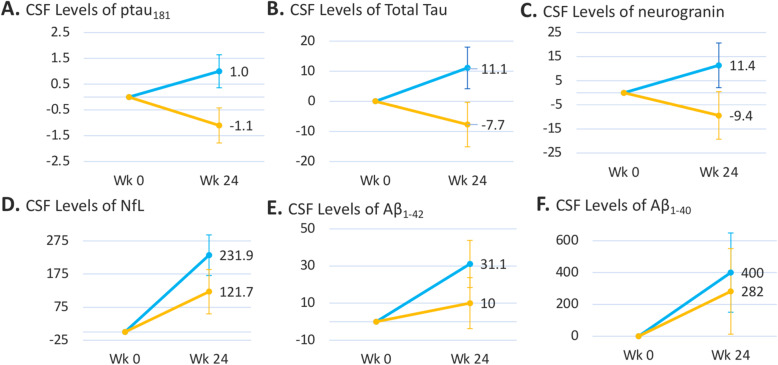
At randomization, the mean age is 72, 50% female, 77% with CDR-global score 0.5, and mean MMSE score 23.8. The incidence of discontinuation for adverse events and serious adverse events (all considered unrelated) was 3% each. No significant differences between treatment groups were observed in the primary or secondary clinical endpoints. Significantly reduced CSF levels with neflamapimod treatment, relative to placebo, were evident for T-tau [difference (95% CI): -18.8 (-35.8, -1.8); P=0.031] and p-tau [-2.0 (-3.6, -0.5); P=0.012], with a trend for neurogranin [-21.0 (-43.6, 1.6); P=0.068]. In pre-specified pharmacokinetic-pharmacodynamic (PK-PD) analyses, subjects in the highest quartile of trough plasma neflamapimod levels demonstrated positive trends, compared with placebo, in HLVT-R and WMS.
A 24-week treatment with 40 mg neflamapimod twice daily did not improve episodic memory in patients with mild AD. However, neflamapimod treatment lowered CSF biomarkers of synaptic dysfunction. Combined with PK-PD findings, the results indicate that a longer duration study of neflamapimod at a higher dose level to assess effects on AD progression is warranted.
ClinicalTrials.gov identifier: NCT03402659 . Registered on January 18, 2018.
在临床前研究中,p38 ⍺ 激酶与阿尔茨海默病(AD)的发病机制有关。在动物模型中,它介导海马突触功能障碍,导致记忆缺陷,并参与淀粉样蛋白-β(Aβ)的产生和 tau 病理学。
REVERSE-SD(突触功能障碍)研究是一项多中心的 2 期、随机、双盲、安慰剂对照的 p38 ⍺ 激酶抑制剂 neflamapimod 的临床试验;于 2017 年 12 月 29 日至 2019 年 6 月 17 日进行;共筛选了 464 名参与者,其中 161 名随机分为 40mg neflamapimod(78 名研究参与者)或匹配的安慰剂(83 名研究参与者),每日两次口服,共 24 周。研究参与者如下:脑脊液 AD 生物标志物证实,临床痴呆评定量表(CDR)-全球评分 0.5 或 1.0,CDR-记忆评分≥0.5,以及简易精神状态检查(MMSE)20-28。主要终点是通过 Hopkins 言语学习测试修订版(HVLT-R)总评分和延迟回忆的 Z 评分的联合变化来评估的情景记忆改善。次要终点包括韦氏记忆量表-IV(WMS)即刻和延迟回忆的复合变化、CDR-SB、MMSE 和脑脊液生物标志物[总和磷酸化 tau(T-tau 和 p-tau)、Aβ、Aβ、神经颗粒蛋白和神经丝轻链]。
在随机分组时,平均年龄为 72 岁,50%为女性,77%的 CDR-全球评分 0.5,平均 MMSE 评分为 23.8。因不良事件和严重不良事件(均认为与治疗无关)而停药的发生率各为 3%。治疗组在主要或次要临床终点均未见显著差异。与安慰剂相比,neflamapimod 治疗组脑脊液 T-tau[差异(95%CI):-18.8(-35.8,-1.8);P=0.031]和 p-tau[-2.0(-3.6,-0.5);P=0.012]水平显著降低,神经颗粒蛋白呈下降趋势[-21.0(-43.6,1.6);P=0.068]。在预先指定的药代动力学-药效学(PK-PD)分析中,与安慰剂相比,血浆 neflamapimod 浓度最高四分位数的受试者在 HVLT-R 和 WMS 上表现出阳性趋势。
每日两次服用 40mg neflamapimod 24 周治疗并未改善轻度 AD 患者的情景记忆。然而,neflamapimod 治疗降低了突触功能障碍的脑脊液生物标志物。结合 PK-PD 研究结果,表明需要进行更高剂量水平的更长时间的 neflamapimod 研究,以评估其对 AD 进展的影响。
ClinicalTrials.gov 标识符:NCT03402659。于 2018 年 1 月 18 日注册。