Public Health Computational and Operations Research (PHICOR), Johns Hopkins Bloomberg School of Public Health, Baltimore, MD, United States; Department of International Health, Johns Hopkins Bloomberg School of Public Health, Baltimore, MD, United States; Global Obesity Prevention Center (GOPC), Johns Hopkins University, Baltimore, MD, United States.
Pittsburgh Supercomputing Center (PSC), Carnegie Mellon University, Pittsburgh, PA, United States; McGill Centre for Integrative Neuroscience, McGill Neurological Institute, McGill University, Montreal, Canada.
Vaccine. 2019 Apr 17;37(17):2377-2386. doi: 10.1016/j.vaccine.2019.03.007. Epub 2019 Mar 25.
Since special efforts are necessary to vaccinate people living far from fixed vaccination posts, decision makers are interested in knowing the economic value of such efforts.
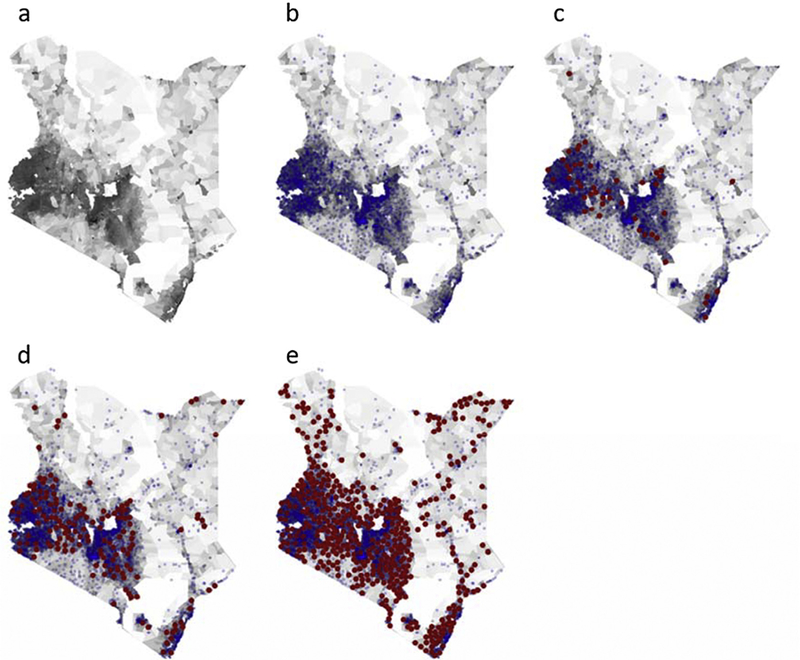
Using our immunization geospatial information system platform and a measles compartment model, we quantified the health and economic value of a 2-dose measles immunization outreach strategy for children <24 months of age in Kenya who are geographically hard-to-reach (i.e., those living outside a specified catchment radius from fixed vaccination posts, which served as a proxy for access to services).
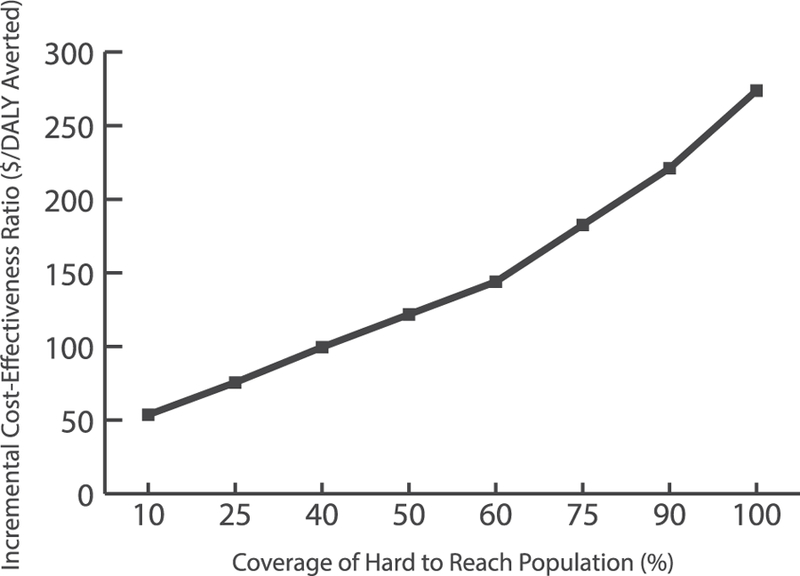
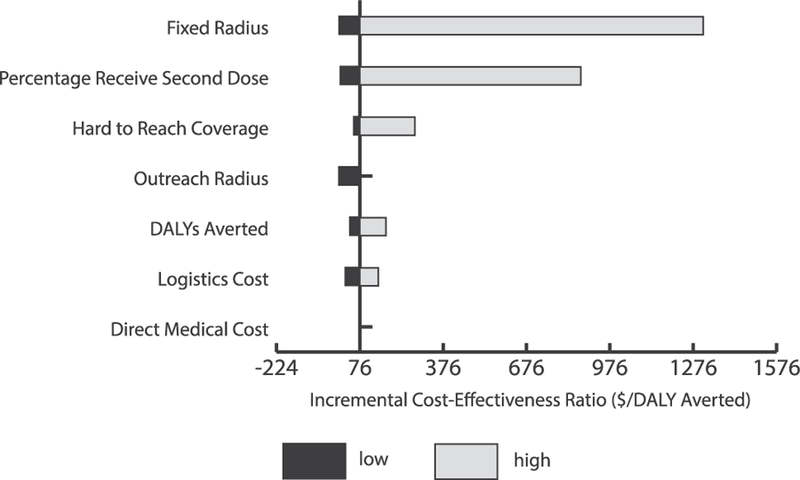
When geographically hard-to-reach children were not vaccinated, there were 1427 total measles cases from 2016 to 2020, resulting in $9.5 million ($3.1-$18.1 million) in direct medical costs and productivity losses and 7504 (3338-12,903) disability-adjusted life years (DALYs). The outreach strategy cost $76 ($23-$142)/DALY averted (compared to no outreach) when 25% of geographically hard-to-reach children received MCV1, $122 ($40-$226)/DALY averted when 50% received MCV1, and $274 ($123-$478)/DALY averted when 100% received MCV1.
Outreach vaccination among geographically hard-to-reach populations was highly cost-effective in a wide variety of scenarios, offering support for investment in an effective outreach vaccination strategy.
由于需要特别努力为远离固定接种点的人群接种疫苗,决策者有兴趣了解这些努力的经济价值。
我们使用免疫地理空间信息系统平台和麻疹 compartment 模型,量化了肯尼亚为 24 个月以下的儿童提供两剂麻疹免疫接种外展策略的健康和经济价值,这些儿童在地理上难以到达(即居住在固定接种点指定集水区半径之外,该半径可作为获得服务的替代指标)。
当地理上难以到达的儿童未接种疫苗时,2016 年至 2020 年期间共发生 1427 例麻疹总病例,导致直接医疗费用和生产力损失 950 万美元(310 万至 1810 万美元),以及 7504 个(3338-12903)残疾调整生命年(DALY)。当 25%的地理上难以到达的儿童接种 MCV1 时,外展策略的成本为 76 美元(23-142)/DALY 避免(与没有外展相比),当 50%的儿童接种 MCV1 时,成本为 122 美元(40-226)/DALY 避免,当 100%的儿童接种 MCV1 时,成本为 274 美元(123-478)/DALY 避免。
在各种情况下,针对地理上难以到达的人群进行外展接种疫苗具有很高的成本效益,为投资有效的外展接种疫苗策略提供了支持。