World Health Organization, Nigeria.
World Health Organization, Nigeria.
Vaccine. 2018 Nov 19;36(48):7361-7368. doi: 10.1016/j.vaccine.2018.10.020. Epub 2018 Oct 23.
The OPV 3 coverage for Kaduna State, 12-23 months old children was 34.4%. The low OPV 3 coverage, due mainly to weak demand for routine antigens and the need to rapidly boost population immunity against the disabling Wild Polio Virus (WPV), led the Global Polio Eradication Initiatives (GPEI) to increase supplemental OPV campaigns in Kaduna State, despite the huge cost and great burden on personnel. The OPV campaigns, especially in high risk (low vaccine uptake, <80% OPV 3 coverage and high vaccines refusal rate) states of northern Nigeria with poliovirus transmission has resulted in overestimated denominators or target population, as the highest ever vaccinated is used to set OPV campaign targets.
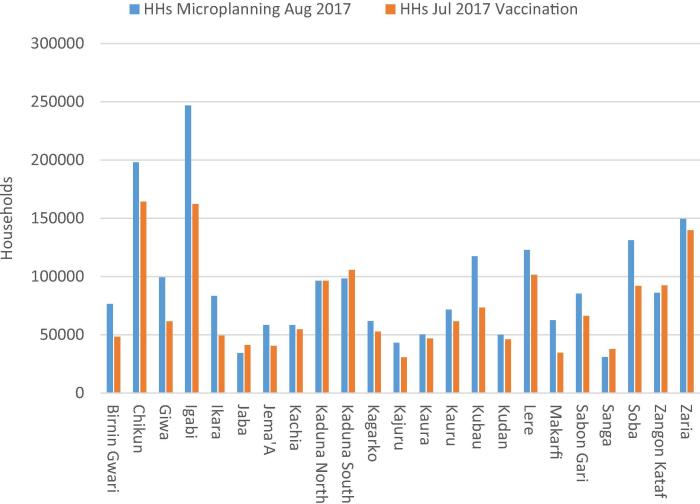
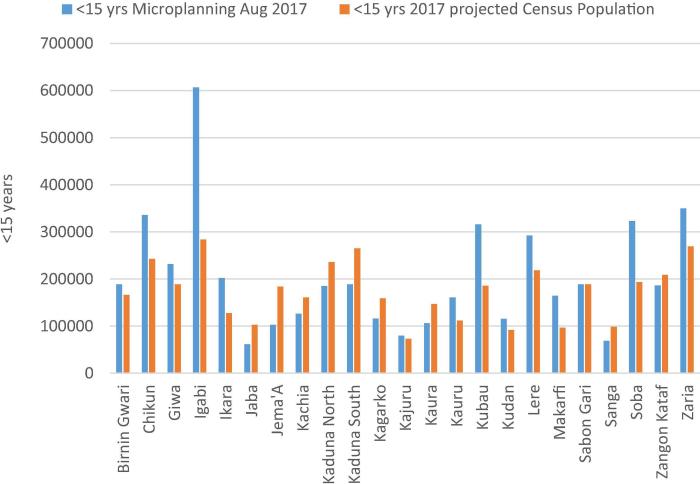
We utilized a cross-sectional study that assessed the impacts and possible solutions to the challenges of overestimated denominators in immunization services planning, delivery and performance evaluation in Kaduna State, Nigeria. We used both descriptive and quantitative approaches. We enumerated households and obtained the target populations for routine immunization (<1 year), polio campaign (<5 years) and acute flaccid paralysis surveillance (<15 years).
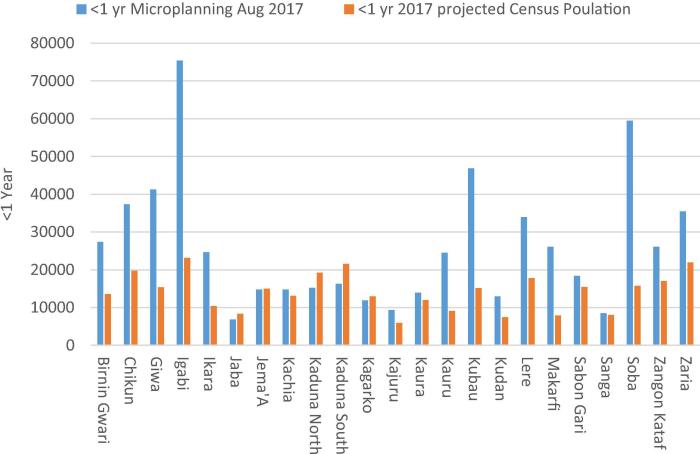
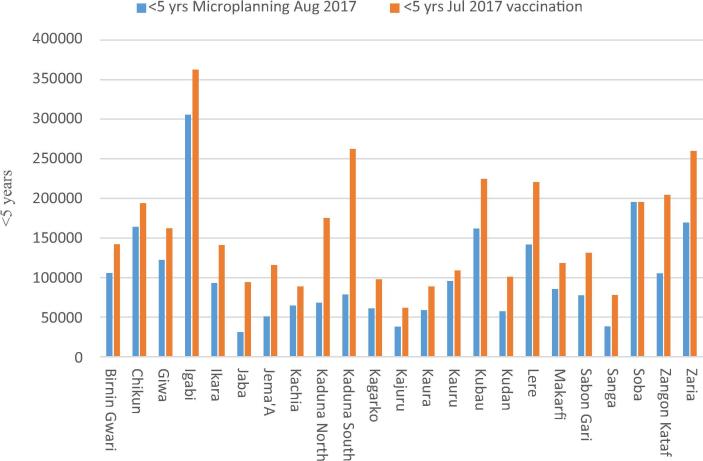
We found a significant difference in mean scores between the micro-planning and supplemental vaccination data on a number of <5 years (M = 102967, SD = 62405, micro-planning compared to M = 157716, SD = 72212, supplemental vaccination, p < 0.05). We also found a significant difference in mean scores between the micro-planning and projected census data on a number of <1 year (M = 26128, SD = 16828, micro-planning compared to M = 14154, SD = 4894, census, p < 0.05).
Periodic household-based micro-planning, aided with the use of technology for validation remains a useful tool in addressing gaps in immunization planning, delivery and performance evaluation in developing countries, such as Nigeria with overestimated denominators.
卡杜纳州 12-23 个月大儿童的口服脊髓灰质炎疫苗 3 型(OPV3)覆盖率为 34.4%。OPV3 覆盖率低主要是由于对常规抗原的需求较弱,以及需要迅速提高人口对致残野生脊髓灰质炎病毒(WPV)的免疫力,这导致全球根除脊髓灰质炎行动(GPEI)在卡杜纳州增加补充 OPV 运动,尽管这需要巨大的成本和人员负担。OPV 运动,特别是在尼日利亚北部高风险(疫苗接种率低、OPV3 覆盖率低于 80%和疫苗拒绝率高)的州,导致分母或目标人群被高估,因为使用有史以来最高的接种人数来设定 OPV 运动目标。
我们利用了一项横断面研究,评估了在尼日利亚卡杜纳州,免疫服务规划、提供和绩效评估中高估分母的影响和可能的解决方案。我们使用了描述性和定量方法。我们对家庭进行了计数,并获得了常规免疫(<1 岁)、脊髓灰质炎运动(<5 岁)和急性弛缓性麻痹监测(<15 岁)的目标人群。
我们发现,在许多<5 岁的儿童中,微观规划和补充疫苗接种数据之间的平均得分存在显著差异(M=102967,SD=62405,微观规划与 M=157716,SD=72212,补充疫苗接种,p<0.05)。我们还发现,在许多<1 岁的儿童中,微观规划和预测人口普查数据之间的平均得分存在显著差异(M=26128,SD=16828,微观规划与 M=14154,SD=4894,人口普查,p<0.05)。
定期进行基于家庭的微观规划,并借助技术进行验证,仍然是解决发展中国家(如尼日利亚)免疫规划、提供和绩效评估中出现的差距的有用工具,这些国家的分母被高估。