Virginia Institute for Psychiatric and Behavioral Genetics, Virginia Commonwealth University, Richmond, VA, USA.
Department of Psychiatry, Virginia Commonwealth University, Richmond, VA, USA.
Transl Psychiatry. 2021 May 27;11(1):326. doi: 10.1038/s41398-021-01454-z.
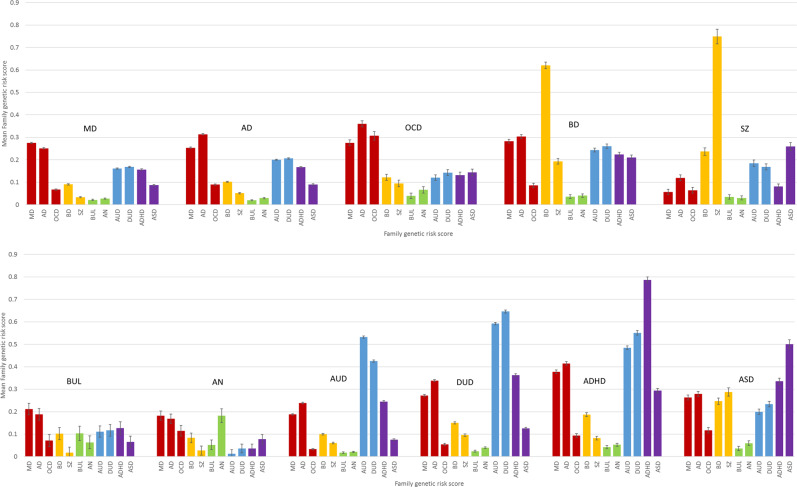
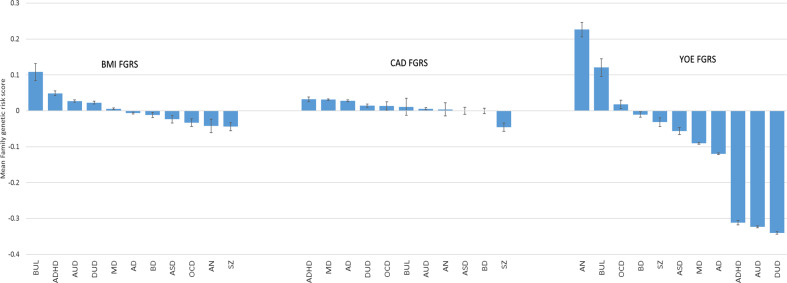
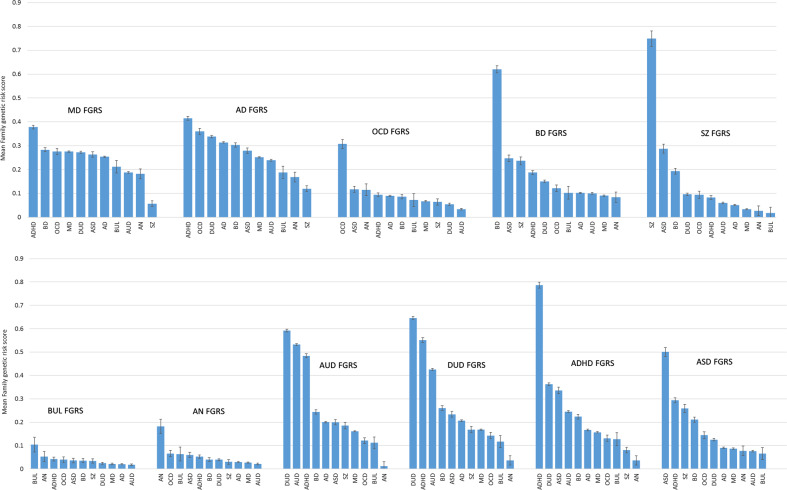
To clarify the structure of genetic risks for 11 major psychiatric disorders, we calculated, from morbidity risks for disorders in 1st-5th degree relatives controlling for cohabitation effects, in the Swedish population born between 1932 and 1995 (n = 5,830,014), the family genetic risk scores (FGRS) for major depression (MD), anxiety disorders (AD), obsessive-compulsive disorder (OCD), bipolar disorder (BD), schizophrenia (SZ), bulimia (BUL), anorexia nervosa (AN), alcohol use disorder (AUD), drug use disorder (DUD), ADHD, and autism-spectrum disorder (ASD). For all affected individuals, we calculated their mean standardized FGRS for each disorder. The patterns of FGRS were quite similar for MD and AD, and for AUD and DUD, but substantially less similar for BUL and AN, BD and SZ, and ADHD and ASD. While OCD had high levels of FGRS for MD and AD, the overall FGRS profile differed considerably from MD and AD. ADHD FGRS scores were substantially elevated in AUD and DUD. FGRS scores for BD, OCD, AN, ASD, ADHD, and especially SZ were relatively disorder-specific while genetic risk for MD and AD had more generalized effects. The levels of FGRS for BMI, coronary artery disease, and educational attainment across our disorders replicated prior associations found using molecular genetic methods. All diagnostic categories examined had elevated FGRS for many disorders producing, for each condition, an informative FGRS profile. Using a novel method which approximates, from pedigree data, aggregate genetic risk, we have replicated and extended prior insights into the structure of genetic risk factors for key psychiatric illnesses.
为了阐明 11 种主要精神疾病的遗传风险结构,我们计算了 1932 年至 1995 年期间在瑞典出生的人群中一级至五级亲属的患病风险(共 5830014 人),以控制同居效应,得到了重度抑郁症(MD)、焦虑症(AD)、强迫症(OCD)、双相情感障碍(BD)、精神分裂症(SZ)、贪食症(BUL)、神经性厌食症(AN)、酒精使用障碍(AUD)、药物使用障碍(DUD)、注意缺陷多动障碍(ADHD)和自闭症谱系障碍(ASD)的家族遗传风险评分(FGRS)。对于所有受影响的个体,我们计算了他们每种疾病的平均标准化 FGRS。MD 和 AD 的 FGRS 模式非常相似,AUD 和 DUD 也是如此,但 BUL 和 AN、BD 和 SZ 以及 ADHD 和 ASD 的 FGRS 模式则明显不同。虽然 OCD 对 MD 和 AD 的 FGRS 水平较高,但总体 FGRS 特征与 MD 和 AD 有很大不同。ADHD 的 FGRS 评分在 AUD 和 DUD 中显著升高。BD、OCD、AN、ASD、ADHD 尤其是 SZ 的 FGRS 评分相对特定于疾病,而 MD 和 AD 的遗传风险则具有更广泛的影响。我们在各疾病中观察到的 FGRS 评分与 BMI、冠状动脉疾病和受教育程度的水平复制了先前使用分子遗传学方法发现的关联。我们检查的所有诊断类别都对许多疾病的 FGRS 评分升高,从而为每种疾病产生了有信息量的 FGRS 图谱。使用一种从系谱数据中近似聚合遗传风险的新方法,我们复制并扩展了先前对主要精神疾病遗传风险因素结构的见解。