Rodriguez-Morrison Victoria, Llewellyn David, Zheng Youbin
School of Environmental Sciences, University of Guelph, Guelph, ON, Canada.
Front Plant Sci. 2021 May 11;12:646020. doi: 10.3389/fpls.2021.646020. eCollection 2021.
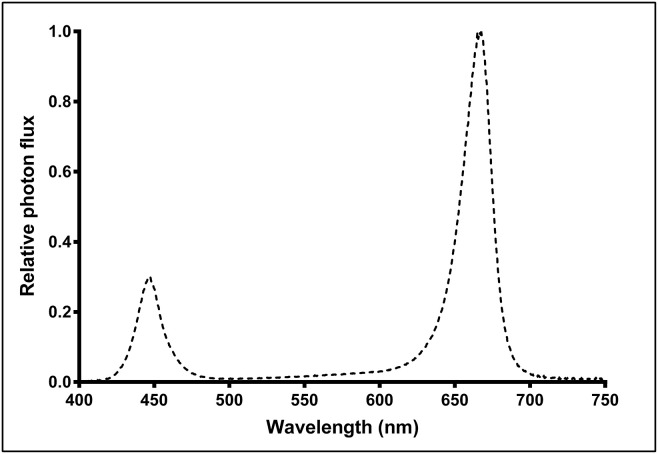
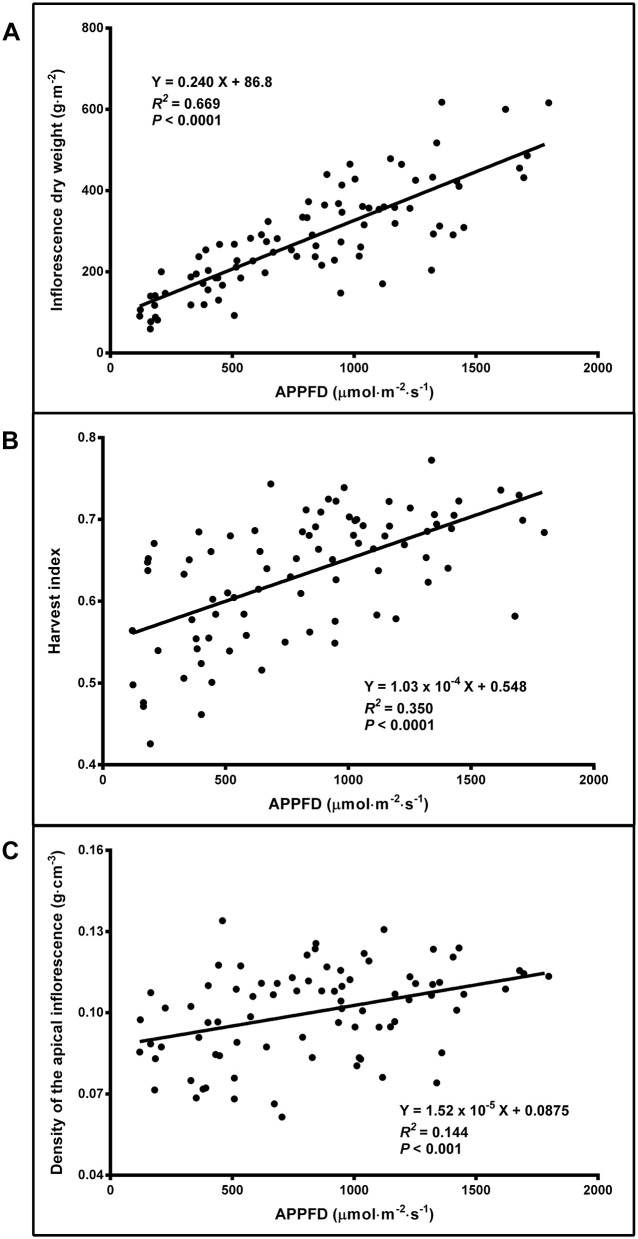
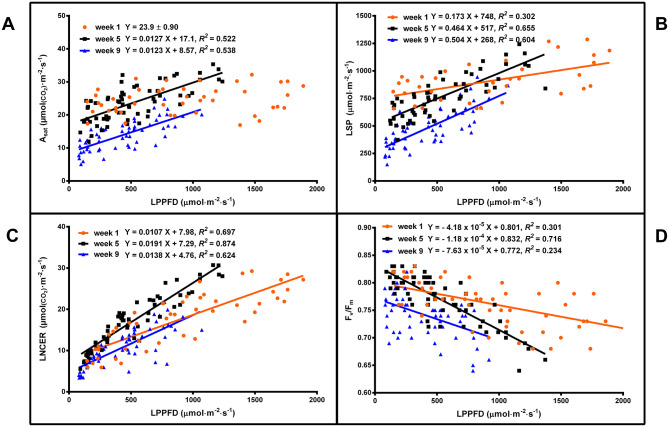
Since the recent legalization of medical and recreational use of cannabis () in many regions worldwide, there has been high demand for research to improve yield and quality. With the paucity of scientific literature on the topic, this study investigated the relationships between light intensity (LI) and photosynthesis, inflorescence yield, and inflorescence quality of cannabis grown in an indoor environment. After growing vegetatively for 2 weeks under a canopy-level photosynthetic photon flux density (PPFD) of ≈425 μmol·m·s and an 18-h light/6-h dark photoperiod, plants were grown for 12 weeks in a 12-h light/12-h dark "flowering" photoperiod under canopy-level PPFDs ranging from 120 to 1,800 μmol·m·s provided by light emitting diodes. Leaf light response curves varied both with localized (i.e., leaf-level) PPFD and temporally, throughout the flowering cycle. Therefore, it was concluded that the leaf light response is not a reliable predictor of whole-plant responses to LI, particularly crop yield. This may be especially evident given that dry inflorescence yield increased linearly with increasing canopy-level PPFD up to 1,800 μmol·m·s, while leaf-level photosynthesis saturated well-below 1,800 μmol·m·s. The density of the apical inflorescence and harvest index also increased linearly with increasing LI, resulting in higher-quality marketable tissues and less superfluous tissue to dispose of. There were no LI treatment effects on cannabinoid potency, while there were minor LI treatment effects on terpene potency. Commercial cannabis growers can use these light response models to determine the optimum LI for their production environment to achieve the best economic return; balancing input costs with the commercial value of their cannabis products.
鉴于最近全球许多地区大麻在医疗和娱乐用途上实现了合法化,对提高产量和质量的研究需求很高。由于关于该主题的科学文献匮乏,本研究调查了室内环境下种植的大麻的光强(LI)与光合作用、花序产量和花序质量之间的关系。在冠层水平光合光子通量密度(PPFD)约为425 μmol·m²·s且光周期为18小时光照/6小时黑暗的条件下营养生长2周后,植株在由发光二极管提供的冠层水平PPFD为120至1800 μmol·m²·s的12小时光照/12小时黑暗“开花”光周期下生长12周。叶片光响应曲线在整个开花周期中随局部(即叶片水平)PPFD和时间而变化。因此,得出的结论是,叶片光响应不是全株对LI反应的可靠预测指标,尤其是作物产量。考虑到干花序产量随冠层水平PPFD增加至1800 μmol·m²·s呈线性增加,而叶片水平光合作用在远低于1800 μmol·m²·s时就已饱和,这一点可能尤其明显。顶端花序密度和收获指数也随LI增加呈线性增加,从而产生更高质量的适销组织且需要处理的多余组织更少。LI处理对大麻素效力没有影响,而对萜烯效力有轻微的LI处理效应。商业大麻种植者可以使用这些光响应模型来确定其生产环境的最佳LI,以实现最佳经济回报;在投入成本与大麻产品商业价值之间取得平衡。