Cheney Sarah, Casey Ellen, Abutalib Zafir, Tepper Kenneth B, Dressler Reuven, Sutton Karen Michelle
Georgetown University School of Medicine, Washington, District of Columbia, USA.
Hospital for Special Surgery, New York, New York, USA.
Orthop J Sports Med. 2021 May 19;9(5):23259671211007951. doi: 10.1177/23259671211007951. eCollection 2021 May.
Limited data exist on injuries in men's lacrosse at the international level. As lacrosse's popularity grows rapidly across the globe, health care providers must understand how to treat lacrosse athletes.
To analyze injury data from the 2018 Men's World Lacrosse Championship.
Descriptive epidemiology study.
This study prospectively observed injuries that occurred during the 2018 Men's World Lacrosse Championship. The medical staff of each team completed injury report forms, and data were categorized into body part injury, type, mechanism, time, and location of injury.
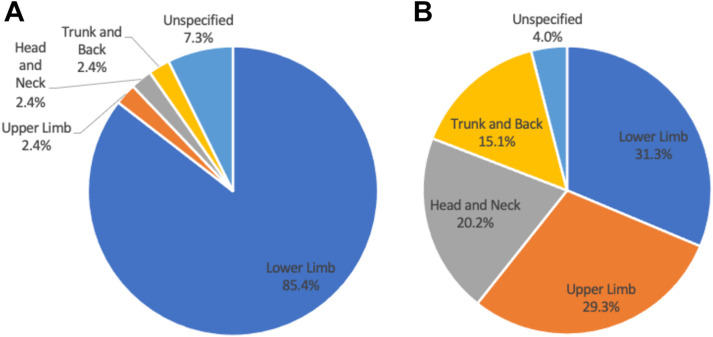
Over 11 days, 1019 athletes competed in 170 games, resulting in a total of 7147 athlete-exposures (AEs). A total of 140injuries were recorded during the tournament for an injury rate of 19.6 per 1000 AEs (95% CI, 16.4-22.7). Overall, there were more contact injuries (n = 99; 70.7%) than noncontact injuries (n = 41; 29.3%) ( < .0001). Contact injuries most commonly affected the upper extremity, while noncontact injuries most commonly affected the lower extremity. Contusions were the most commonly reported injury type in the tournament (n = 41; 29.3%), followed by ligament sprains (n = 32; 22.9%) and muscle strains (n = 21; 15.0%). Although there was no difference between the first and second half of gameplay, the injury rate increased in the latter portion of each half (the first and third quarters vs the second and fourth quarters) ( < .0001). A total of 4 injuries required trips to the hospital.
Lacrosse has a unique injury profile, as it includes both overhead and collision activity as well as multidirectional, cutting movements. Understanding common injury patterns may help with treatment and prevention. Fatigue may play a role in injury rate, and future research of within-game and within-tournament fatigue should explore this relationship.
关于国际男子长曲棍球运动中损伤情况的数据有限。随着长曲棍球运动在全球范围内迅速普及,医疗保健人员必须了解如何治疗长曲棍球运动员。
分析2018年男子世界长曲棍球锦标赛的损伤数据。
描述性流行病学研究。
本研究前瞻性观察了2018年男子世界长曲棍球锦标赛期间发生的损伤情况。各队医务人员填写损伤报告表,数据按身体部位损伤、类型、机制、时间和损伤部位进行分类。
在11天的时间里,1019名运动员参加了170场比赛,共计7147人次运动员暴露(AE)。比赛期间共记录到140例损伤,损伤发生率为每1000 AE中有19.6例(95%置信区间,16.4 - 22.7)。总体而言,接触性损伤(n = 99;70.7%)多于非接触性损伤(n = 41;29.3%)(P <.0001)。接触性损伤最常累及上肢,而非接触性损伤最常累及下肢。挫伤是比赛中最常报告的损伤类型(n = 41;29.3%),其次是韧带扭伤(n = 32;22.9%)和肌肉拉伤(n = 21;15.0%)。虽然比赛的上半场和下半场之间没有差异,但每半场的后半段(第一节和第三节与第二节和第四节相比)损伤发生率有所增加(P <.0001)。共有4例损伤需要送往医院治疗。
长曲棍球运动有其独特的损伤特征,因为它既包括头顶上方和碰撞活动,也包括多方向的切入动作。了解常见的损伤模式可能有助于治疗和预防。疲劳可能在损伤发生率中起作用,未来关于比赛内和赛事内疲劳的研究应探索这种关系。