Division for Healthcare Technology Assessment Research, National Evidence-Based Healthcare Collaborating Agency, Seoul, Korea.
Department of Radiology, Samsung Medical Center, Sungkyunkwan University School of Medicine, Seoul, Korea.
Korean J Radiol. 2021 Aug;22(8):1240-1252. doi: 10.3348/kjr.2020.1227. Epub 2021 May 20.
To compare the accuracy for detecting breast cancer in the diagnostic setting between the use of digital breast tomosynthesis (DBT), defined as DBT alone or combined DBT and digital mammography (DM), and the use of DM alone through a systematic review and meta-analysis.
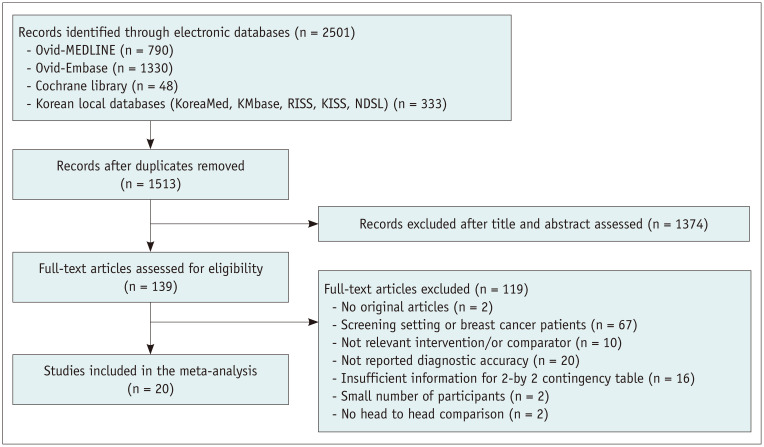
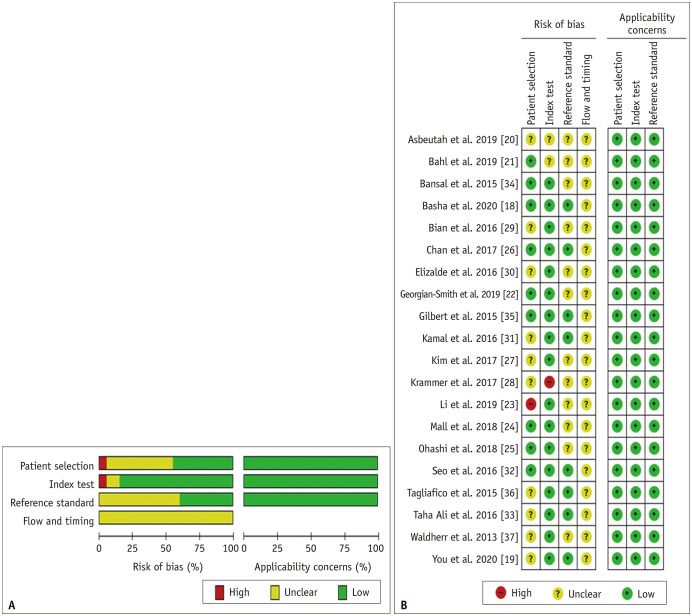
Ovid-MEDLINE, Ovid-Embase, Cochrane Library and five Korean local databases were searched for articles published until March 25, 2020. We selected studies that reported diagnostic accuracy in women who were recalled after screening or symptomatic. Study quality was assessed using the Quality Assessment of Diagnostic Accuracy Studies-2 tool. A bivariate random effects model was used to estimate pooled sensitivity and specificity. We compared the diagnostic accuracy between DBT and DM alone using meta-regression and subgroup analyses by modality of intervention, country, existence of calcifications, breast density, Breast Imaging Reporting and Data System category threshold, study design, protocol for participant sampling, sample size, reason for diagnostic examination, and number of readers who interpreted the studies.
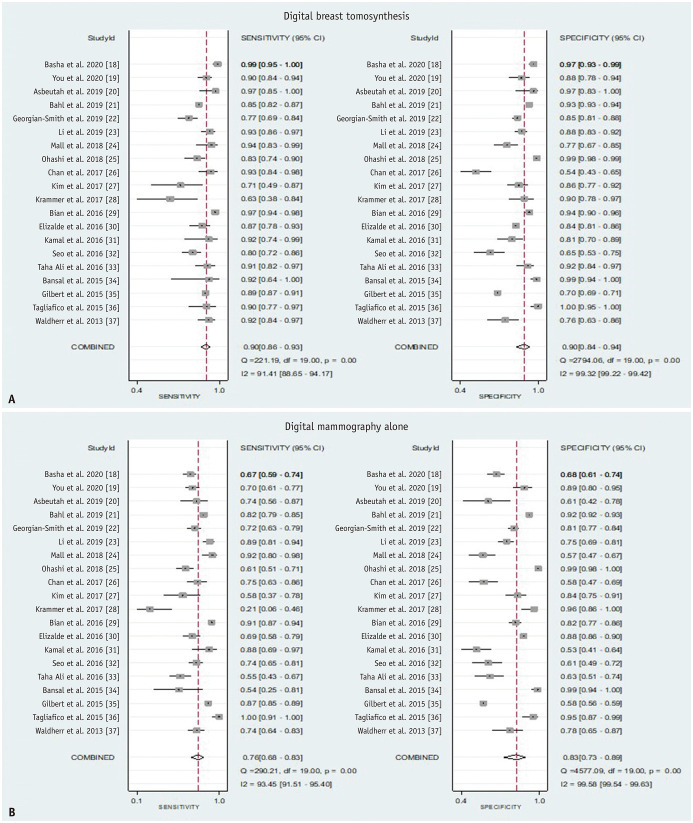
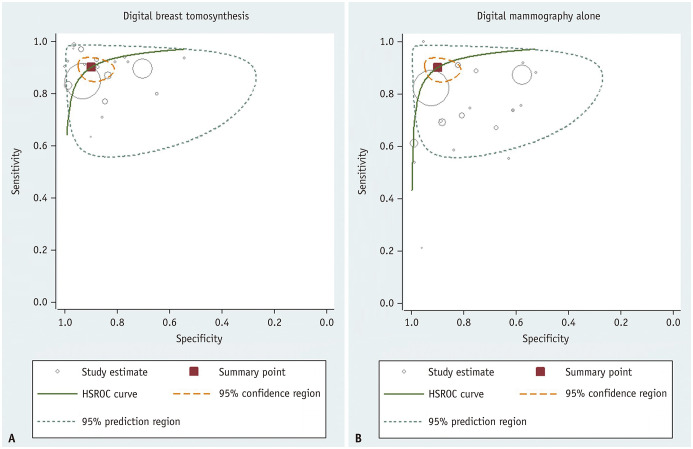
Twenty studies (n = 44513) that compared DBT and DM alone were included. The pooled sensitivity and specificity were 0.90 (95% confidence interval [CI] 0.86-0.93) and 0.90 (95% CI 0.84-0.94), respectively, for DBT, which were higher than 0.76 (95% CI 0.68-0.83) and 0.83 (95% CI 0.73-0.89), respectively, for DM alone ( < 0.001). The area under the summary receiver operating characteristics curve was 0.95 (95% CI 0.93-0.97) for DBT and 0.86 (95% CI 0.82-0.88) for DM alone. The higher sensitivity and specificity of DBT than DM alone were consistently noted in most subgroup and meta-regression analyses.
Use of DBT was more accurate than DM alone for the diagnosis of breast cancer. Women with clinical symptoms or abnormal screening findings could be more effectively evaluated for breast cancer using DBT, which has a superior diagnostic performance compared to DM alone.
通过系统评价和荟萃分析比较单独使用数字乳腺断层摄影术(DBT)、DBT 联合数字乳腺摄影术(DM)与单独使用 DM 在诊断环境中检测乳腺癌的准确性。
检索截至 2020 年 3 月 25 日在 Ovid-MEDLINE、Ovid-Embase、Cochrane 图书馆和五个韩国本地数据库发表的文章。我们选择了报告了在筛查或症状后召回的女性中诊断准确性的研究。使用诊断准确性研究质量评估工具 2 对研究质量进行评估。使用双变量随机效应模型估计合并的敏感性和特异性。我们使用荟萃回归和亚组分析比较了 DBT 和 DM 单独使用的诊断准确性,亚组分析按干预方式、国家、钙化存在情况、乳腺密度、乳腺成像报告和数据系统类别阈值、研究设计、参与者采样方案、样本量、诊断检查原因和解释研究的读者数量进行分组。
共纳入 20 项(n = 44513)比较 DBT 和 DM 单独使用的研究。DBT 的合并敏感性和特异性分别为 0.90(95%置信区间[CI] 0.86-0.93)和 0.90(95% CI 0.84-0.94),高于 DM 单独使用的 0.76(95% CI 0.68-0.83)和 0.83(95% CI 0.73-0.89)(<0.001)。DBT 的汇总受试者工作特征曲线下面积为 0.95(95% CI 0.93-0.97),DM 单独使用的为 0.86(95% CI 0.82-0.88)。在大多数亚组和荟萃回归分析中,DBT 的敏感性和特异性均高于 DM 单独使用。
与单独使用 DM 相比,使用 DBT 诊断乳腺癌更准确。对于有临床症状或异常筛查结果的女性,使用 DBT 可以更有效地评估乳腺癌,其诊断性能优于单独使用 DM。