Qi Fei, Cao Zheng, Chen Bo, Chai Yue, Lin Jing, Ye Junyi, Wei Yuce, Liu Hao, Han-Zhang Han, Mao Xinru, Feng Xiaoli, Dong Mei
Key Laboratory of Carcinogenesis and Translational Research (Ministry of Education/Beijing), Department of Lymphoma, Peking University Cancer Hospital & Institute, Beijing, China.
Department of Medical Oncology.
Blood Adv. 2021 Jun 8;5(11):2505-2514. doi: 10.1182/bloodadvances.2020001637.
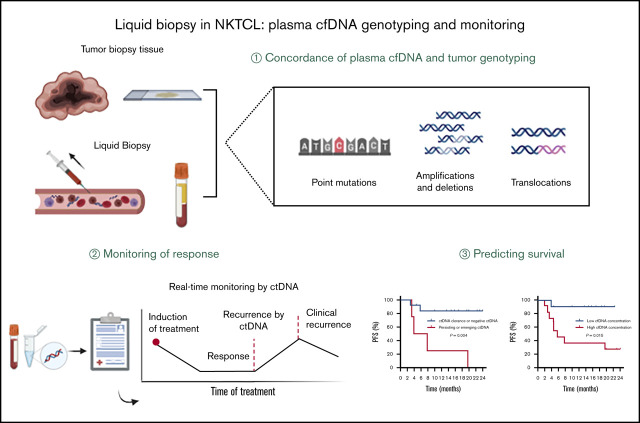
Satisfactory tumor material is often hard to obtain for molecular analysis in extranodal natural killer (NK)/T-cell lymphoma (NKTCL) at present. However, the accuracy and utility of circulating cell-free DNA (cfDNA) genotyping have not been adequately assessed in NKTCL. We therefore performed targeted next-generation sequencing on tumor tissues and a series of longitudinal plasma samples prospectively collected from a cohort of high-risk NKTCL patients. Concordance of genotyping results of paired baseline tumor and cfDNA and the predictive value of dynamic cfDNA monitoring were evaluated. At baseline, 59 somatic variants in 31 genes were identified in tumor and/or plasma cfDNA among 19 out of 24 high-risk NKTCL patients (79.2%). Plasma cfDNA had a sensitivity of 72.4% for detection of somatic variants identified in tumor biopsies before treatment. Plasma cfDNA also allowed the identification of mutations that were undetectable in tumor biopsies. These results were also verified in a validation cohort of an additional 23 high-risk NKTCL patients. Furthermore, longitudinal analysis showed that patients with rapid clearance of NKTCL-related mutations from plasma had higher complete remission rates (80.0% vs 0%; P = .004) and more favorable survival (1-year progression-free survival [PFS] rate, 79.0% vs 20.0%; P = .002) compared with those with persisting or emerging mutations in plasma. In addition, low cfDNA concentration before treatment was associated with favorable survival outcome for patients with NKTCL (1-year PFS, 90.0% vs 36.4%; P = .012). In conclusion, cfDNA mirrors tumor biopsy for detection of genetic alterations in NKTCL and noninvasive dynamic plasma cfDNA monitoring might be a promising approach for tracking response and survival outcome for patients with NKTCL.
目前,在结外自然杀伤(NK)/T细胞淋巴瘤(NKTCL)中,往往难以获得用于分子分析的理想肿瘤材料。然而,循环游离DNA(cfDNA)基因分型在NKTCL中的准确性和实用性尚未得到充分评估。因此,我们对一组高危NKTCL患者前瞻性收集的肿瘤组织和一系列纵向血浆样本进行了靶向二代测序。评估了配对的基线肿瘤和cfDNA基因分型结果的一致性以及动态cfDNA监测的预测价值。在基线时,24例高危NKTCL患者中有19例(79.2%)在肿瘤和/或血浆cfDNA中鉴定出31个基因中的59个体细胞变异。血浆cfDNA对治疗前肿瘤活检中鉴定出的体细胞变异的检测灵敏度为72.4%。血浆cfDNA还能够鉴定出肿瘤活检中未检测到的突变。这些结果在另外23例高危NKTCL患者的验证队列中也得到了验证。此外,纵向分析表明,与血浆中存在持续或新出现突变的患者相比,血浆中NKTCL相关突变快速清除的患者完全缓解率更高(80.0%对0%;P = 0.004),生存情况更优(1年无进展生存率[PFS],79.0%对20.0%;P = 0.002)。此外,治疗前cfDNA浓度低与NKTCL患者良好的生存结果相关(1年PFS,90.0%对36.4%;P = 0.012)。总之,cfDNA在检测NKTCL的基因改变方面可反映肿瘤活检情况,无创动态血浆cfDNA监测可能是追踪NKTCL患者反应和生存结果的一种有前景的方法。