Department of Radiation Oncology, Sun Yat-sen University Cancer Center, State Key Laboratory of Oncology in South China, Collaborative Innovation Center for Cancer Medicine, Guangdong Key Laboratory of Nasopharyngeal Carcinoma Diagnosis and Therapy, Guangzhou, People's Republic of China.
Zhongshan School of Medicine, Sun Yat-sen University, Guangzhou, China.
JAMA Netw Open. 2021 May 3;4(5):e2111813. doi: 10.1001/jamanetworkopen.2021.11813.
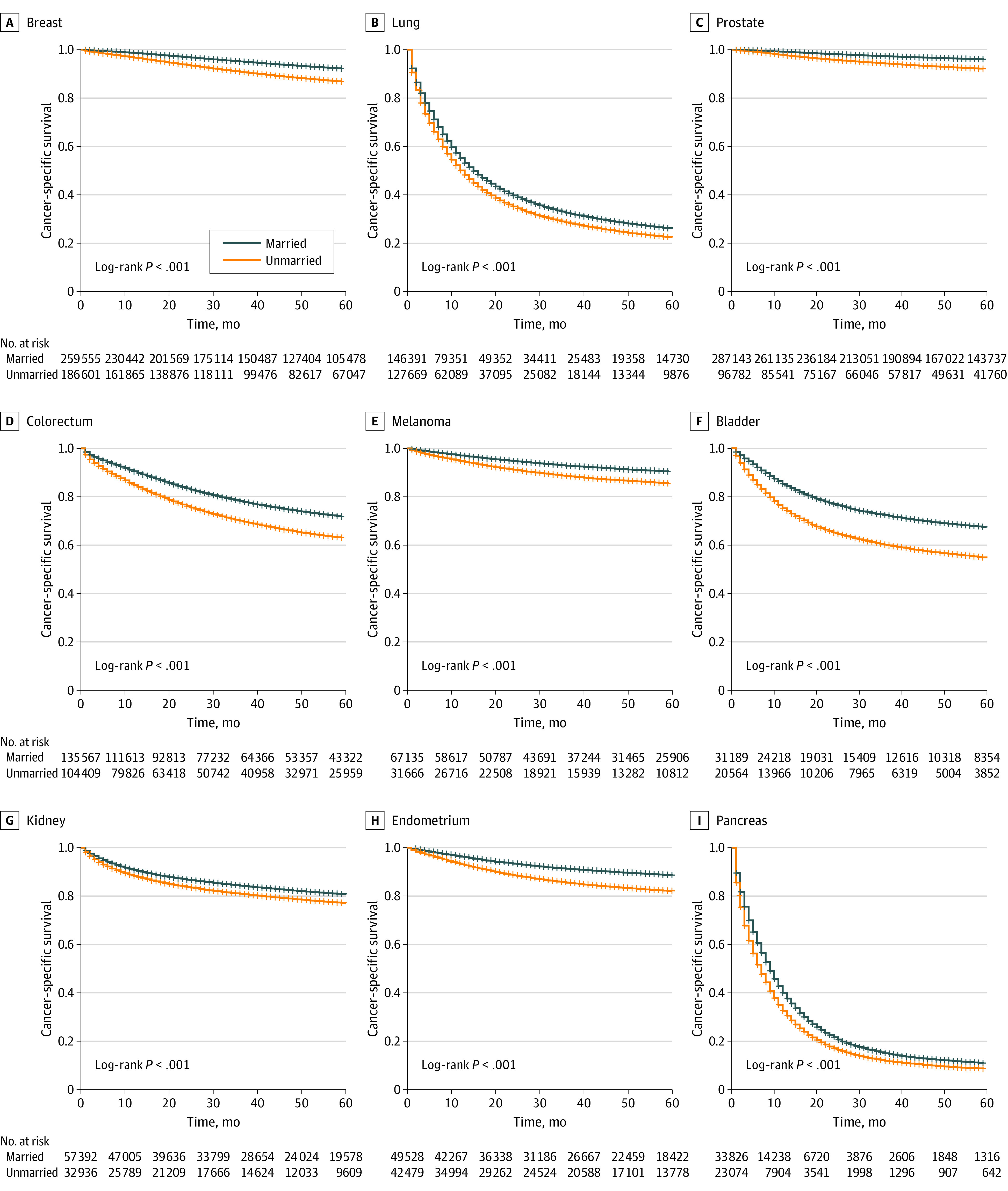
Married patients with cancer have better cancer-specific survival than unmarried patients. Increasing the early diagnosis and definitive treatment of cancer among unmarried patients may reduce the survival gap.
To evaluate the extent to which marriage is associated with cancer-specific survival, stage at diagnosis, and treatment among patients with 9 common solid cancers and to recommend methods for reducing the survival gap.
DESIGN, SETTING, AND PARTICIPANTS: This retrospective, population-based cohort study included patients older than 18 years who were diagnosed with 1 of 9 common cancers between January 1, 2007, and December 31, 2016. Patient data were retrieved from the Surveillance, Epidemiology, and End Results Program. Statistical analyses were performed from August 1 to October 1, 2020.
Marital status, classified as married and unmarried (including single, separated, divorced, widowed, and unmarried patients or domestic partners).
The primary outcome was the time ratio (TR) of cancer-specific survival (married vs unmarried). Mediation analyses were conducted to determine the extent to which the association of marriage with cancer-specific survival was mediated by stage at diagnosis and treatment.
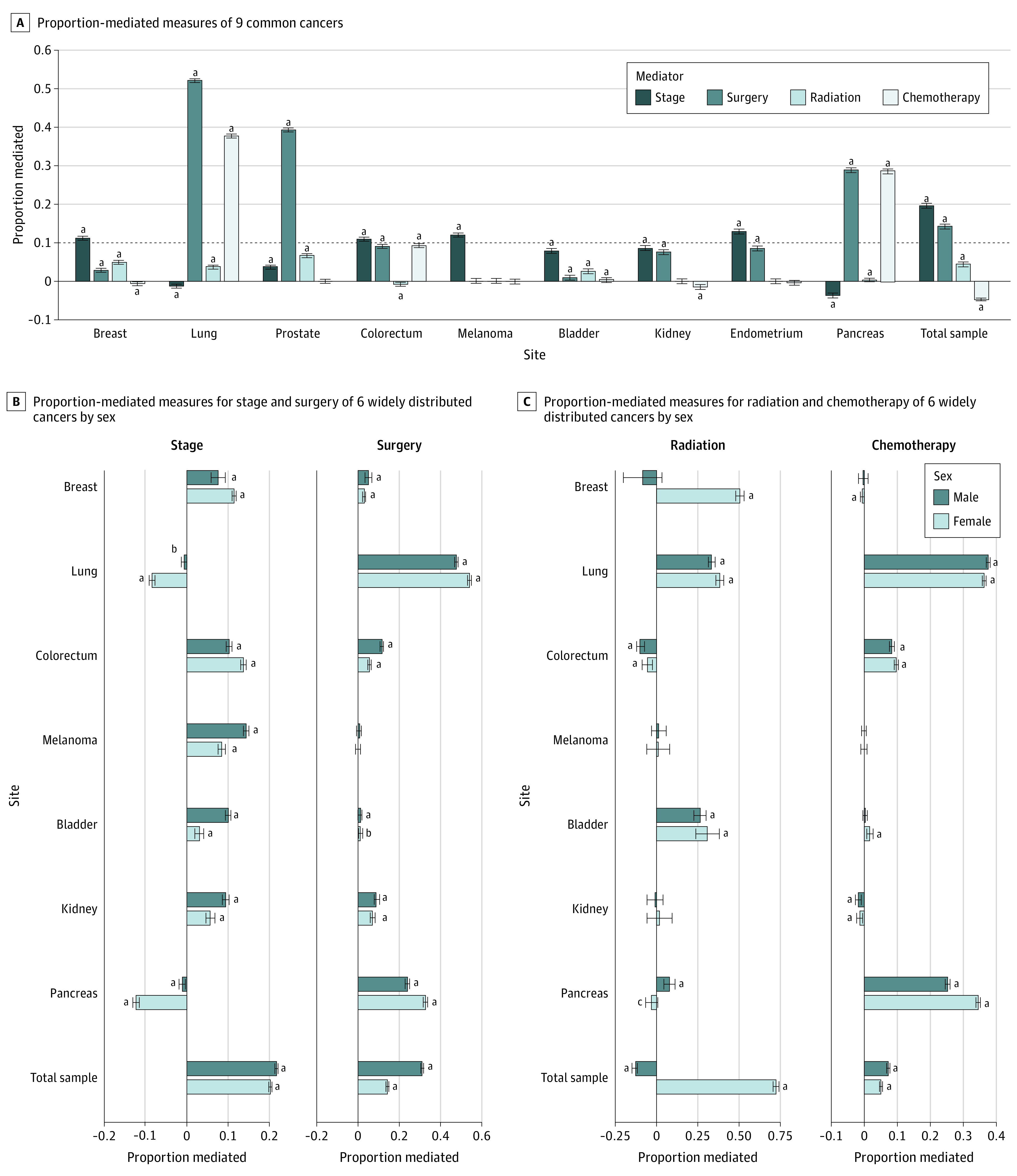
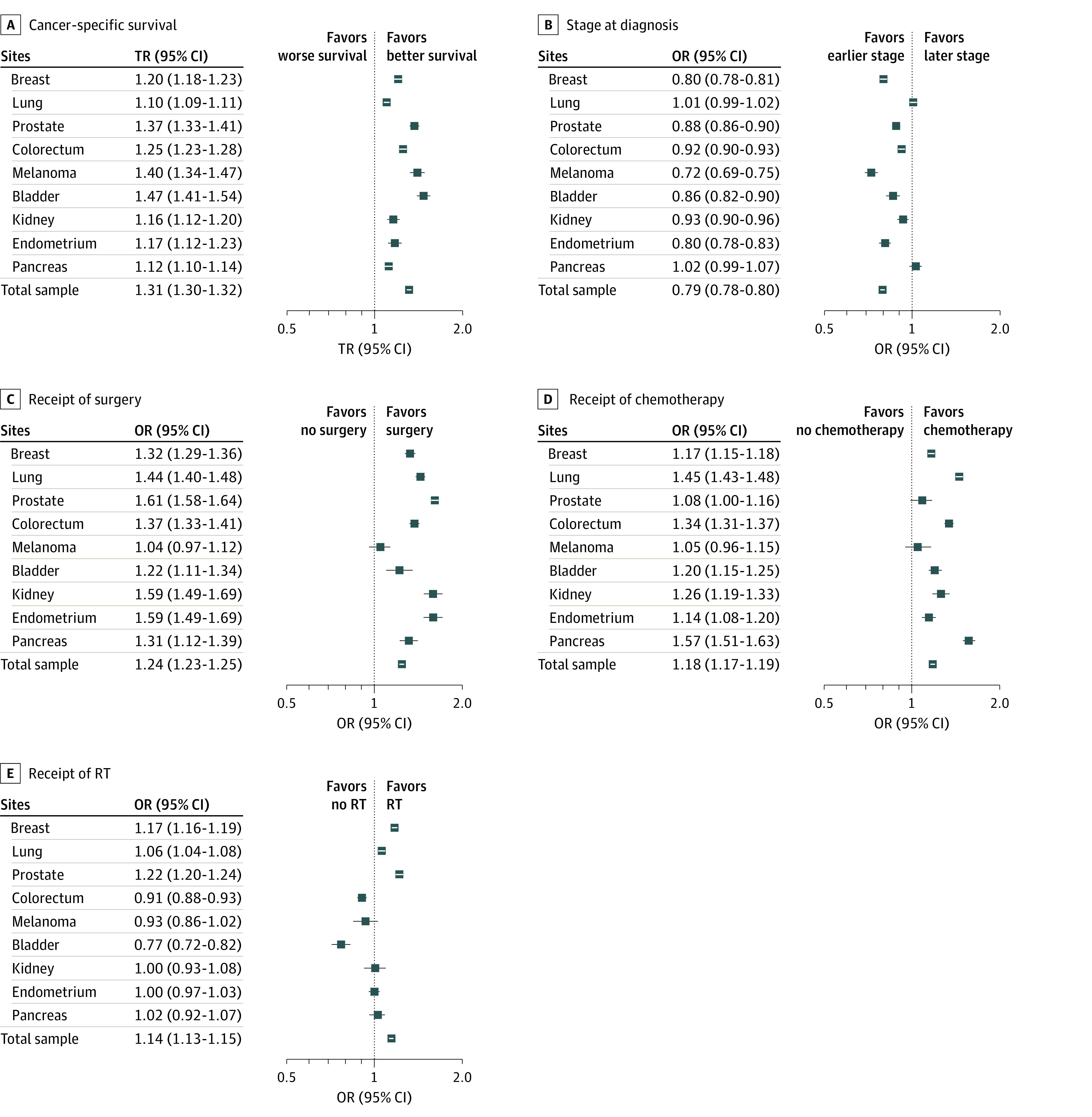
This study included 1 733 906 patients (894 379 [51.6%] women; 1 067 726 [61.6%] married; mean [SD] age, 63.76 [12.60] years). Multivariate analyses found that those who were married were associated with better cancer-specific survival than unmarried patients (TR, 1.36; 95% CI, 1.35-1.37). Early diagnosis in breast cancer, colorectal cancer, endometrial cancer, and melanoma mediated the association between marital status and cancer-specific survival (breast cancer: proportion mediated [PM], 11.4%; 95% CI, 11.2%-11.6%; colorectal cancer: PM, 10.9%; 95% CI, 10.7%-11.2%; endometrial cancer: PM, 12.9%; 95% CI, 12.5%-13.3%; melanoma: PM, 12.0%; 95% CI, 11.7-12.4%). Surgery mediated the association between marital status and cancer-specific survival in lung (PM, 52.2%; 95% CI, 51.9%-52.4%), pancreatic (PM, 28.9%; 95% CI, 28.6%-29.3%), and prostate (PM, 39.3%; 95% CI, 39.0%-39.6%) cancers. Chemotherapy mediated the association of marital status with cancer-specific survival in lung (PM, 37.7%; 95% CI, 37.6%-37.9%) and pancreatic (PM, 28.6%; 95% CI, 28.4%-28.9%) cancers. Improved cancer-specific survival associated with marriage was greater among men than women (men: TR, 1.27; 95% CI, 1.25-1.28; women: TR, 1.20; 95% CI, 1.19-1.21). The contribution of receiving an early diagnosis and treatment with surgery or chemotherapy to the association between marital status and cancer-specific survival was greater among men than women (early diagnosis: PM, 21.7% [95% CI, 21.5%-21.9%] vs PM, 20.3% [95% CI, 20.2%-20.4%]; surgery: PM, 26.6% [95% CI, 26.4%-26.7%] vs PM, 11.1% [95% CI, 11.0%-11.2%]; chemotherapy: PM, 6.8% [95% CI, 6.7%-6.8%] vs PM, 5.1% [95% CI, 5.0%-5.2%]).
In this study, survival disparities associated with marital status were attributable to early diagnosis in breast, colorectal, and endometrial cancers as well as melanoma and to treatment-related variables in lung, pancreatic, and prostate cancers. The findings also suggest that marriage may play a greater protective role in the cancer-specific survival of men than of women.
已婚癌症患者的癌症特异性生存率优于未婚患者。增加未婚患者癌症的早期诊断和明确治疗可能会缩小生存率差距。
评估婚姻与 9 种常见实体癌患者的癌症特异性生存率、诊断时的分期和治疗之间的关联程度,并为缩小生存率差距提出方法。
设计、地点和参与者:本回顾性、基于人群的队列研究纳入了 2007 年 1 月 1 日至 2016 年 12 月 31 日期间被诊断为 1 种常见癌症的年龄大于 18 岁的患者。患者数据来自监测、流行病学和最终结果计划。统计分析于 2020 年 8 月 1 日至 10 月 1 日进行。
婚姻状况,分为已婚和未婚(包括单身、分居、离婚、丧偶和未婚或未婚伴侣)。
主要结果是癌症特异性生存率的时间比(已婚与未婚)。进行中介分析以确定婚姻与癌症特异性生存率之间的关联在多大程度上受到诊断时的分期和治疗的影响。
本研究纳入了 1733906 名患者(894379 名女性[51.6%];1067726 名已婚患者[61.6%];平均[标准差]年龄为 63.76[12.60]岁)。多变量分析发现,与未婚患者相比,已婚患者的癌症特异性生存率更好(时间比,1.36;95%置信区间,1.35-1.37)。乳腺癌、结直肠癌、子宫内膜癌和黑色素瘤的早期诊断在婚姻状况与癌症特异性生存率之间的关联中起中介作用(乳腺癌:中介比例[PM],11.4%;95%置信区间,11.2%-11.6%;结直肠癌:PM,10.9%;95%置信区间,10.7%-11.2%;子宫内膜癌:PM,12.9%;95%置信区间,12.5%-13.3%;黑色素瘤:PM,12.0%;95%置信区间,11.7%-12.4%)。肺癌、胰腺癌和前列腺癌中手术在婚姻状况与癌症特异性生存率之间的关联中起中介作用(肺癌:PM,52.2%;95%置信区间,51.9%-52.4%;胰腺癌:PM,28.9%;95%置信区间,28.6%-29.3%;前列腺癌:PM,39.3%;95%置信区间,39.0%-39.6%)。肺癌和胰腺癌中化疗在婚姻状况与癌症特异性生存率之间的关联中起中介作用(肺癌:PM,37.7%;95%置信区间,37.6%-37.9%;胰腺癌:PM,28.6%;95%置信区间,28.4%-28.9%)。与婚姻相关的癌症特异性生存率的提高在男性中比女性更为显著(男性:时间比,1.27;95%置信区间,1.25-1.28;女性:时间比,1.20;95%置信区间,1.19-1.21)。早期诊断和手术或化疗治疗对婚姻状况与癌症特异性生存率之间关联的贡献在男性中大于女性(早期诊断:PM,21.7%[95%置信区间,21.5%-21.9%]比 PM,20.3%[95%置信区间,20.2%-20.4%];手术:PM,26.6%[95%置信区间,26.4%-26.7%]比 PM,11.1%[95%置信区间,11.0%-11.2%];化疗:PM,6.8%[95%置信区间,6.7%-6.8%]比 PM,5.1%[95%置信区间,5.0%-5.2%])。
在这项研究中,与婚姻状况相关的生存差异归因于乳腺癌、结直肠癌和子宫内膜癌以及黑色素瘤的早期诊断,以及肺癌、胰腺癌和前列腺癌的治疗相关变量。研究结果还表明,婚姻对男性的癌症特异性生存率的保护作用可能大于女性。