Department of Biomedical Engineering and Chemical Engineering, University of Texas at San Antonio, One UTSA Circle, San Antonio, TX, 78249, USA.
Kogod Center on Aging and Division of Endocrinology, Mayo Clinic College of Medicine, Mayo Clinic, Rochester, MN, USA.
Eur Radiol. 2021 Dec;31(12):9428-9435. doi: 10.1007/s00330-021-08071-w. Epub 2021 May 28.
Quantitative computed tomography (QCT)-based finite element analysis (FEA) implements a calibration phantom to estimate bone mineral density (BMD) and assign material properties to the models. The objectives of this study were to (1) propose robust phantom-less calibration methods, using subject-specific tissues, to obtain vertebral fracture properties estimations using QCT/FEA; and (2) correlate QCT/FEA predictions to DXA values of areal BMD.
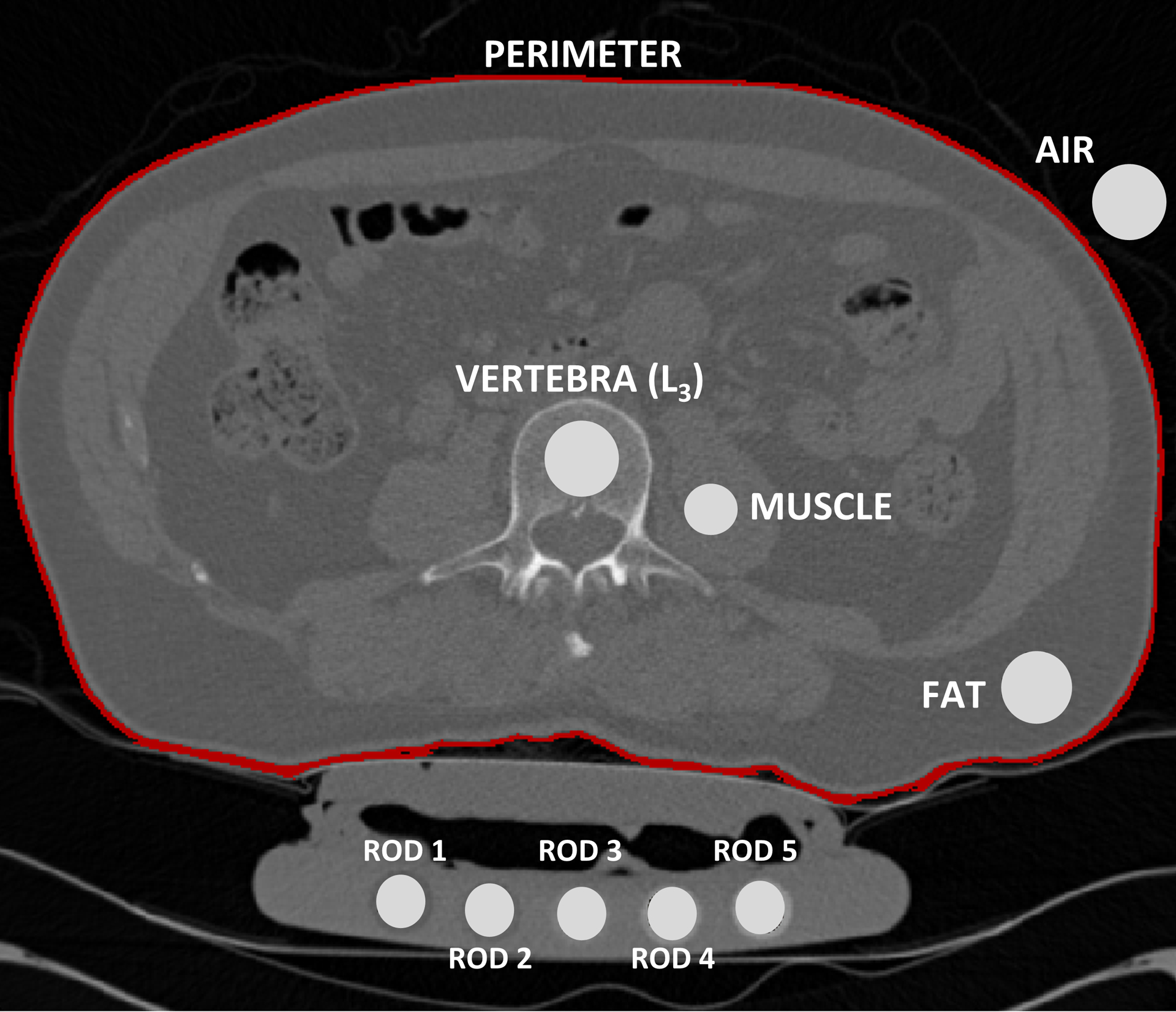
Eighty of a cohort of 111 clinical QCT scans were used to obtain subject-specific parameters using a phantom calibration approach and for the development of the phantom-less calibration equations. Equations were developed based on the HU measured from various soft tissues and regions, and using multiple linear regression analyses. Thirty-one additional QCT scans were used for cross-validation of QCT/FEA estimated fracture loads from the L vertebrae based on the phantom and phantom-less equations. Finally, QCT/FEA-predicted fracture loads were correlated with aBMD obtained from DXA.
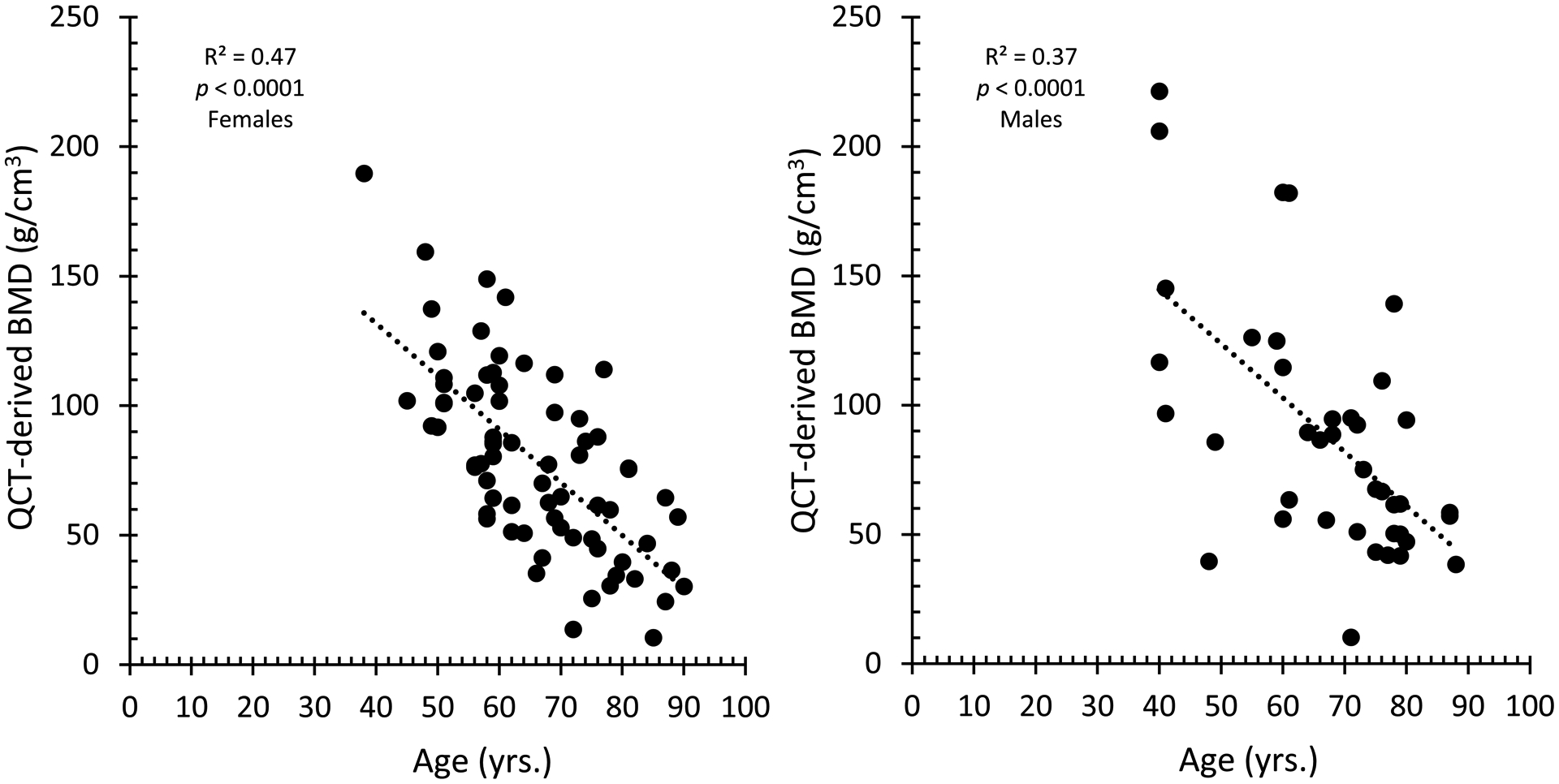
Overall, 217 QCT/FEA models from 31 subjects (20 females, 11 men) with mean ages of 69.6 (13.1) and 67.3 (14) were used to cross-validate the phantom-less equations and assess bone strength. The proposed phantom-less equations showed high correlations with phantom-based estimates of BMD (99%). Cross-validation of QCT/FEA-predicted fracture loads from phantom-less equations and phantom-specific outcomes resulted in high correlations for all proposed methods (0.94-0.99). QCT/FEA correlation outcomes from the phantom-less equations and DXA-aBMD were moderately high (0.64-0.68).
The proposed QCT/FEA subject-specific phantom-less calibration methods demonstrated the potential to be applied to both prospective and retrospective applications in the clinical setting.
• QCT/FEA overcomes the disadvantages of DXA and improves fracture properties predictions of vertebrae. • QCT/FEA fracture estimates using the phantom-less approach highly correlated to values obtained using a calibration phantom. • QCT/FEA prediction using a phantom-less approach is an accurate alternative over phantom-based methods.
定量计算机断层扫描(QCT)基于有限元分析(FEA)采用校准体模来估计骨密度(BMD)并为模型分配材料属性。本研究的目的是:(1) 提出使用特定于受试者的组织的稳健无体模校准方法,以使用 QCT/FEA 获得椎体骨折属性估计值;(2) 将 QCT/FEA 预测值与 DXA 面积 BMD 值相关联。
从 111 例临床 QCT 扫描的队列中选择了 80 例,以使用校准体模获得特定于受试者的参数,并开发无体模校准方程。方程是基于从各种软组织和区域测量的 HU 值,并使用多元线性回归分析得出的。使用另外 31 例 QCT 扫描,根据校准体模和无体模方程,验证基于 L 椎体的 QCT/FEA 估计骨折载荷。最后,将 QCT/FEA 预测的骨折载荷与 DXA 获得的 aBMD 进行相关性分析。
总体而言,31 名受试者(20 名女性,11 名男性)的 217 个 QCT/FEA 模型(年龄 69.6[13.1]和 67.3[14])用于验证无体模方程和评估骨强度。所提出的无体模方程与基于校准体模的 BMD 估计值高度相关(99%)。无体模方程和特定于体模的方法的 QCT/FEA 预测骨折载荷的验证结果高度相关(0.94-0.99)。无体模方程和 DXA-aBMD 的 QCT/FEA 相关性结果中度相关(0.64-0.68)。
所提出的 QCT/FEA 特定于受试者的无体模校准方法具有在临床环境中应用于前瞻性和回顾性研究的潜力。
• QCT/FEA 克服了 DXA 的缺点,并提高了椎体骨折属性的预测能力。• 使用无体模方法的 QCT/FEA 骨折估计值与使用校准体模获得的值高度相关。• 与基于体模的方法相比,使用无体模方法进行 QCT/FEA 预测是一种准确的替代方法。