Department of Diagnostic and Interventional Neuroradiology, Klinikum rechts der Isar, Technische Universität München, München, Germany.
Philips Research Hamburg, Hamburg, Germany.
Osteoporos Int. 2019 Jun;30(6):1275-1285. doi: 10.1007/s00198-019-04910-1. Epub 2019 Mar 4.
Our study proposed an automatic pipeline for opportunistic osteoporosis screening using 3D texture features and regional vBMD using multi-detector CT images. A combination of different local and global texture features outperformed the global vBMD and showed high discriminative power to identify patients with vertebral fractures.
Many patients at risk for osteoporosis undergo computed tomography (CT) scans, usable for opportunistic (non-dedicated) screening. We compared the performance of global volumetric bone mineral density (vBMD) with a random forest classifier based on regional vBMD and 3D texture features to separate patients with and without osteoporotic fractures.
In total, 154 patients (mean age 64 ± 8.5, male; n = 103) were included in this retrospective single-center analysis, who underwent contrast-enhanced CT for other reasons than osteoporosis screening. Patients were dichotomized regarding prevalent vertebral osteoporotic fractures (noFX, n = 101; FX, n = 53). Vertebral bodies were automatically segmented, and trabecular vBMD was calculated with a dedicated phantom. For 3D texture analysis, we extracted gray-level co-occurrence matrix Haralick features (HAR), histogram of gradients (HoG), local binary patterns (LBP), and wavelets (WL). Fractured vertebrae were excluded for texture-feature and vBMD data extraction. The performance to identify patients with prevalent osteoporotic vertebral fractures was evaluated in a fourfold cross-validation.
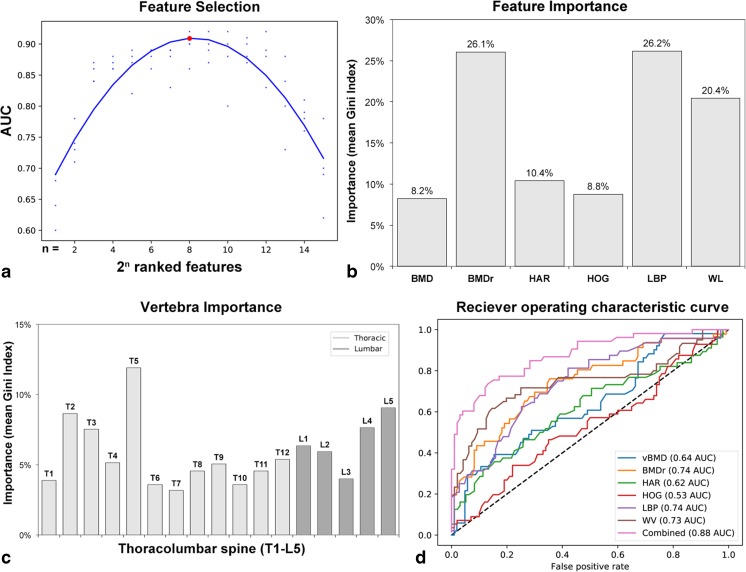
The random forest classifier showed a high discriminatory power (AUC = 0.88). Parameters of all vertebral levels significantly contributed to this classification. Importantly, the AUC of the proposed algorithm was significantly higher than that of volumetric global BMD alone (AUC = 0.64).
The presented classifier combining 3D texture features and regional vBMD including the complete thoracolumbar spine showed high discriminatory power to identify patients with vertebral fractures and had a better diagnostic performance than vBMD alone.
本研究提出了一种利用多探测器 CT 图像的 3D 纹理特征和区域 vBMD 进行机会性骨质疏松筛查的自动流水线。不同的局部和全局纹理特征的组合优于全局 vBMD,并且具有很高的鉴别能力,可以识别出患有椎体骨折的患者。
许多有骨质疏松风险的患者接受计算机断层扫描(CT)扫描,可用于机会性(非专用)筛查。我们比较了基于区域 vBMD 和 3D 纹理特征的全局体积骨矿物质密度(vBMD)与随机森林分类器的性能,以区分有和无骨质疏松性骨折的患者。
共纳入 154 例(平均年龄 64±8.5,男性;n=103)回顾性单中心分析患者,这些患者因非骨质疏松筛查原因接受了增强 CT 检查。根据是否存在先前存在的椎体骨质疏松性骨折(无 FX,n=101;FX,n=53)将患者分为两组。自动对椎体进行分割,并使用专用的体模计算小梁 vBMD。对于 3D 纹理分析,我们提取灰度共生矩阵 Haralick 特征(HAR)、梯度直方图(HoG)、局部二值模式(LBP)和小波(WL)。为了提取纹理特征和 vBMD 数据,排除了骨折椎体。在 4 折交叉验证中评估了识别先前存在的骨质疏松性椎体骨折患者的性能。
随机森林分类器具有很高的鉴别能力(AUC=0.88)。所有椎体水平的参数都对这种分类有重要贡献。重要的是,所提出的算法的 AUC 明显高于单独的容积全局 BMD(AUC=0.64)。
结合 3D 纹理特征和包括整个胸腰椎在内的区域 vBMD 的分类器显示出很高的鉴别能力,可用于识别患有椎体骨折的患者,并且其诊断性能优于单独的 vBMD。