Endocrinology, Diabetology and Medical Andrology Unit, IRCCS Humanitas Research Hospital, Rozzano, 20089, Milan, Italy.
Radiology Unit, IRCCS Humanitas Research Hospital, Rozzano, 20089, Milan, Italy.
Endocrine. 2021 Aug;73(2):255-260. doi: 10.1007/s12020-021-02758-2. Epub 2021 May 28.
To evaluate the post- coronavirus disease-19 (COVID-19) outcome of thyroid function in patients with severe acute respiratory syndrome coronavirus 2 (SARS-CoV-2)-related thyrotoxicosis.
This was a single-center prospective study involving 29 patients (11 females, 18 males; median age 64 years, range: 43-85) with thyrotoxicosis diagnosed after hospitalization for COVID-19 and then followed-up for a median period of 90 days (range: 30-120) after hospital discharge. At follow-up, patients were evaluated for serum thyrotropin (TSH), free-thyroxine (FT4), free-triiodiothyronine (FT3), TSH receptor antibodies (TRAb), thyroglobulin antibodies (TgAb), thyroperoxidase antibodies (TPOAb) and ultrasonographic thyroid structure.
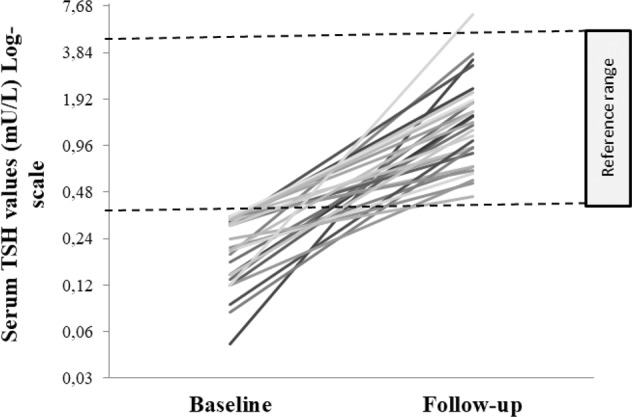
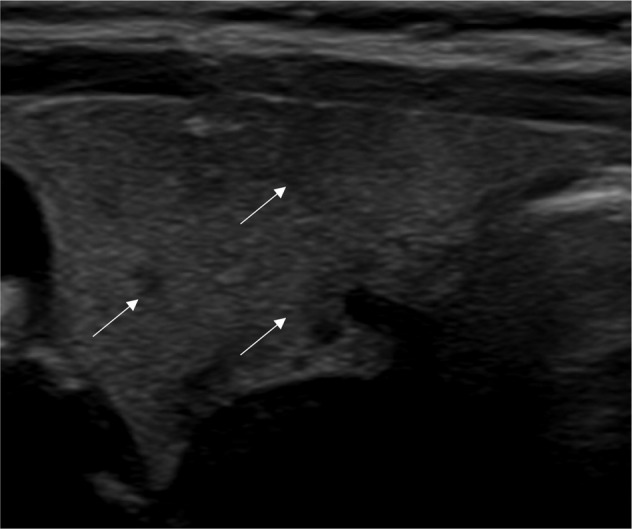
After recovery of COVID-19, serum TSH values significantly increased (P < 0.001) and FT4 values significantly decreased (P = 0.001), without significant change in serum FT3 (P = 0.572). At follow-up, 28 subjects (96.6%) became euthyroid whereas overt hypothyroidism developed in one case. At the ultrasound evaluation of thyroid gland, hypoecogenicity was found in 10 patients (34.5%) and in these cases serum TSH values tended to be higher than those without thyroid hypoecogenity (P = 0.066). All subjects resulted to be negative for TgAb, TPOAb and TRAb.
In a short-term follow-up, thyroid function spontaneously normalized in most subjects with SARS-CoV-2-related thyrotoxicosis. However, thyroid hypoecogenicity was found in a remarkable number of them and future longer-term studies are needed to clarify whether this ultrasonographic alteration may predispose to develop late-onset thyroid dysfunction.
评估与严重急性呼吸综合征冠状病毒 2(SARS-CoV-2)相关的甲状腺功能亢进症患者在新冠病毒(COVID-19)后的甲状腺功能结局。
这是一项单中心前瞻性研究,共纳入 29 例 COVID-19 住院患者(11 名女性,18 名男性;中位年龄 64 岁,范围:43-85 岁),这些患者在住院期间被诊断为甲状腺功能亢进症,并在出院后中位随访 90 天(范围:30-120 天)。在随访时,评估患者的血清促甲状腺激素(TSH)、游离甲状腺素(FT4)、游离三碘甲状腺原氨酸(FT3)、促甲状腺激素受体抗体(TRAb)、甲状腺球蛋白抗体(TgAb)、甲状腺过氧化物酶抗体(TPOAb)和甲状腺超声结构。
在 COVID-19 康复后,血清 TSH 值显著升高(P<0.001),FT4 值显著降低(P=0.001),而血清 FT3 值无显著变化(P=0.572)。在随访时,28 例(96.6%)患者转为甲状腺功能正常,而有 1 例发展为明显的甲状腺功能减退。在甲状腺超声评估中,10 例(34.5%)患者发现甲状腺低回声,这些患者的血清 TSH 值倾向于高于甲状腺无低回声的患者(P=0.066)。所有患者的 TgAb、TPOAb 和 TRAb 均为阴性。
在短期随访中,大多数 SARS-CoV-2 相关甲状腺功能亢进症患者的甲状腺功能自发恢复正常。然而,他们中有相当数量的人出现了甲状腺低回声,需要进一步进行更长时间的研究来阐明这种超声改变是否可能导致迟发性甲状腺功能障碍。