Department of Medicine, The University of Hong Kong, Queen Mary Hospital, Hong Kong, China.
Division of Chemical Pathology, Queen Mary Hospital, Hong Kong, China.
Endocrinol Metab (Seoul). 2021 Jun;36(3):582-589. doi: 10.3803/EnM.2021.983. Epub 2021 Jun 8.
The occurrence of Graves' disease and Hashimoto thyroiditis after coronavirus disease 2019 (COVID-19) raised concerns that severe acute respiratory syndrome coronavirus 2 (SARS-CoV-2) may trigger thyroid autoimmunity. We aimed to address the current uncertainties regarding incident thyroid dysfunction and autoimmunity among COVID-19 survivors.
We included consecutive adult COVID-19 patients without known thyroid disorders, who were admitted to Queen Mary Hospital from July 21 to September 21, 2020 and had serum levels of thyroid-stimulating hormone, free thyroxine, free triiodothyronine (fT3), and anti-thyroid antibodies measured both on admission and at 3 months.
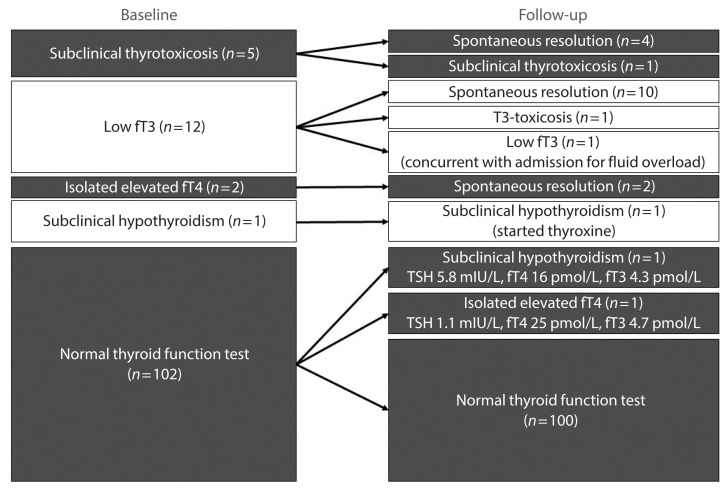
In total, 122 patients were included. Among 20 patients with abnormal thyroid function tests (TFTs) on admission (mostly low fT3), 15 recovered. Among 102 patients with initial normal TFTs, two had new-onset abnormalities that could represent different phases of thyroiditis. Among 104 patients whose anti-thyroid antibody titers were reassessed, we observed increases in anti-thyroid peroxidase (TPO) (P<0.001) and anti-thyroglobulin (P<0.001), but not anti-thyroid stimulating hormone receptor titers (P=0.486). Of 82 patients with negative anti-TPO findings at baseline, 16 had a significant interval increase in anti-TPO titer by >12 U, and four became anti-TPO-positive. Worse baseline clinical severity (P=0.018), elevated C-reactive protein during hospitalization (P=0.033), and higher baseline anti-TPO titer (P=0.005) were associated with a significant increase in anti-TPO titer.
Most patients with thyroid dysfunction on admission recovered during convalescence. Abnormal TFTs suggestive of thyroiditis occurred during convalescence, but infrequently. Importantly, our novel observation of an increase in anti-thyroid antibody titers post-COVID-19 warrants further follow-up for incident thyroid dysfunction among COVID-19 survivors.
新冠病毒病 2019(COVID-19)后 Graves 病和桥本甲状腺炎的发生引起了人们的关注,即严重急性呼吸综合征冠状病毒 2(SARS-CoV-2)可能引发甲状腺自身免疫。我们旨在解决 COVID-19 幸存者中当前关于新发甲状腺功能障碍和自身免疫的不确定性。
我们纳入了 2020 年 7 月 21 日至 9 月 21 日期间因 COVID-19 入住玛丽皇后医院且无已知甲状腺疾病的连续成年 COVID-19 患者,他们的血清促甲状腺激素、游离甲状腺素、游离三碘甲状腺原氨酸(fT3)和甲状腺自身抗体在入院时和 3 个月时均进行了检测。
共纳入 122 例患者。20 例入院时甲状腺功能检查(TFTs)异常(主要为低 fT3)的患者中,15 例恢复正常。102 例初始 TFTs 正常的患者中,有 2 例出现新发异常,可能代表甲状腺炎的不同阶段。在重新评估了 104 例甲状腺自身抗体滴度的患者中,我们观察到甲状腺过氧化物酶(TPO)(P<0.001)和甲状腺球蛋白(Tg)(P<0.001)的抗体滴度升高,但甲状腺刺激激素受体(TSHR)抗体滴度无变化(P=0.486)。在基线时抗 TPO 阴性的 82 例患者中,有 16 例抗 TPO 滴度间隔增加>12 U,有 4 例转为抗 TPO 阳性。更差的基线临床严重程度(P=0.018)、住院期间 C 反应蛋白升高(P=0.033)和更高的基线抗 TPO 滴度(P=0.005)与抗 TPO 滴度的显著升高相关。
大多数入院时甲状腺功能障碍的患者在恢复期恢复正常。恢复期出现了疑似甲状腺炎的异常 TFTs,但并不常见。重要的是,我们观察到 COVID-19 后甲状腺自身抗体滴度升高是一个新发现,这需要对 COVID-19 幸存者的新发甲状腺功能障碍进行进一步随访。