Lab of Computing, Medical Informatics and Biomedical Imaging Technologies, Aristotle University, Thessaloniki, Greece.
Department of Informatics and Telematics, Harokopio University of Athens, Athens, Greece.
JMIR Mhealth Uhealth. 2021 Jul 9;9(7):e26290. doi: 10.2196/26290.
Obesity is a major public health problem globally and in Europe. The prevalence of childhood obesity is also soaring. Several parameters of the living environment are contributing to this increase, such as the density of fast food retailers, and thus, preventive health policies against childhood obesity must focus on the environment to which children are exposed. Currently, there are no systems in place to objectively measure the effect of living environment parameters on obesogenic behaviors and obesity. The H2020 project "BigO: Big Data Against Childhood Obesity" aims to tackle childhood obesity by creating new sources of evidence based on big data.
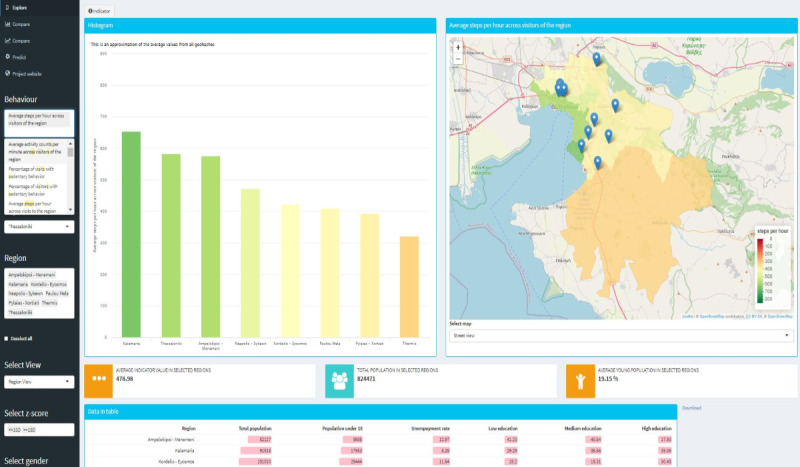
This paper introduces the Obesity Prevention dashboard (OPdashboard), implemented in the context of BigO, which offers an interactive data platform for the exploration of objective obesity-related behaviors and local environments based on the data recorded using the BigO mHealth (mobile health) app.
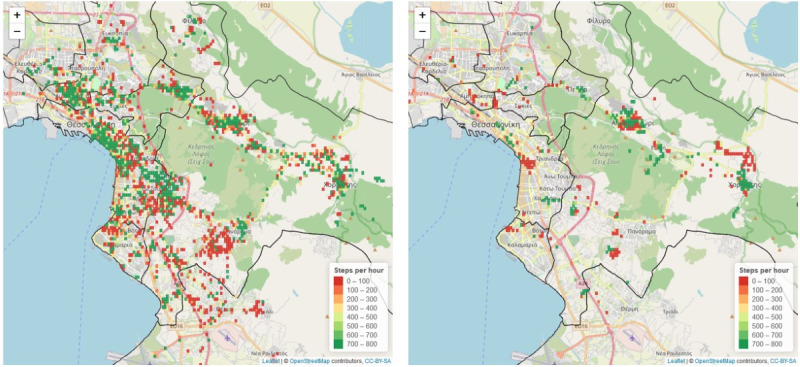
The OPdashboard, which can be accessed on the web, allows for (1) the real-time monitoring of children's obesogenic behaviors in a city area, (2) the extraction of associations between these behaviors and the local environment, and (3) the evaluation of interventions over time. More than 3700 children from 33 schools and 2 clinics in 5 European cities have been monitored using a custom-made mobile app created to extract behavioral patterns by capturing accelerometer and geolocation data. Online databases were assessed in order to obtain a description of the environment. The dashboard's functionality was evaluated during a focus group discussion with public health experts.
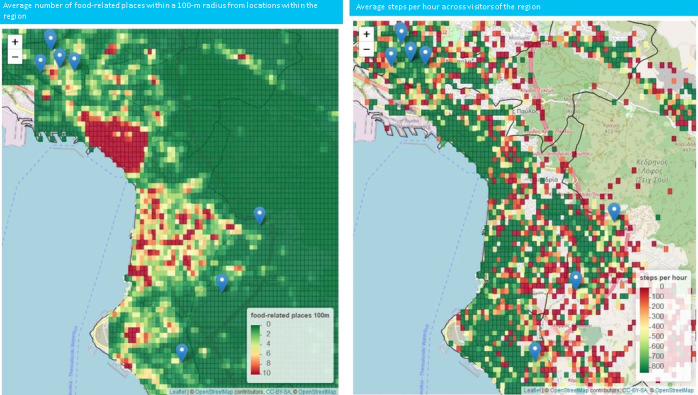
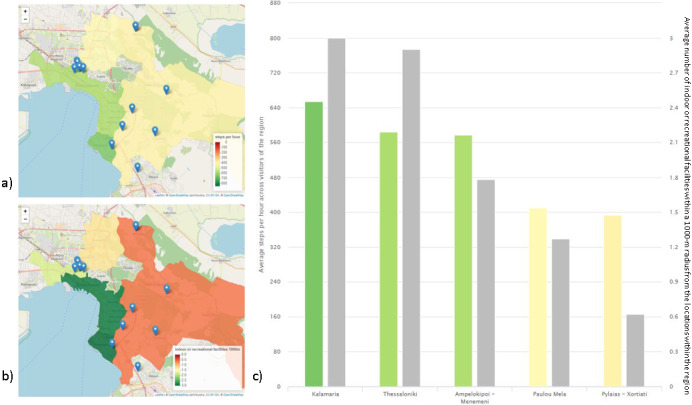
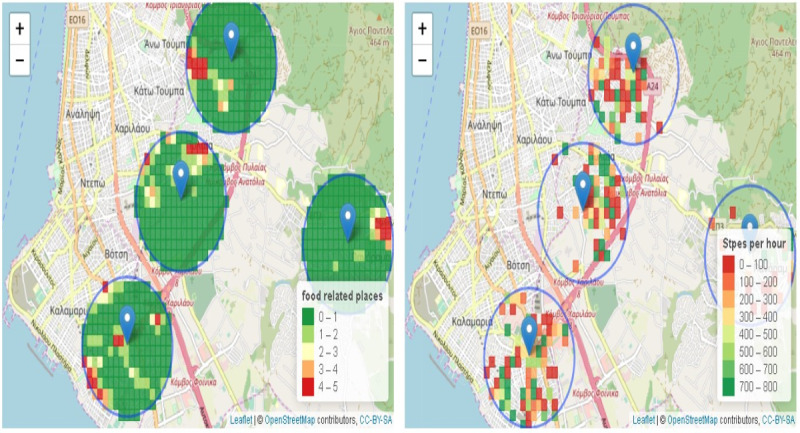
The preliminary association outcomes in 2 European cities, namely Thessaloniki, Greece, and Stockholm, Sweden, indicated a correlation between children's eating and physical activity behaviors and the availability of food-related places or sports facilities close to schools. In addition, the OPdashboard was used to assess changes to children's physical activity levels as a result of the health policies implemented to decelerate the COVID-19 outbreak. The preliminary outcomes of the analysis revealed that in urban areas the decrease in physical activity was statistically significant, while a slight increase was observed in the suburbs. These findings indicate the importance of the availability of open spaces for behavioral change in children. Discussions with public health experts outlined the dashboard's potential to aid in a better understanding of the interplay between children's obesogenic behaviors and the environment, and improvements were suggested.
Our analyses serve as an initial investigation using the OPdashboard. Additional factors must be incorporated in order to optimize its use and obtain a clearer understanding of the results. The unique big data that are available through the OPdashboard can lead to the implementation of models that are able to predict population behavior. The OPdashboard can be considered as a tool that will increase our understanding of the underlying factors in childhood obesity and inform the design of regional interventions both for prevention and treatment.
肥胖是一个全球性和欧洲范围内的主要公共卫生问题。儿童肥胖的患病率也在飙升。生活环境的几个参数对此有所影响,例如快餐店的密度,因此,预防儿童肥胖的健康政策必须关注儿童所处的环境。目前,还没有系统可以客观地衡量生活环境参数对肥胖相关行为和肥胖的影响。H2020 项目“BigO:大数据对抗儿童肥胖”旨在通过创建基于大数据的新证据来源来解决儿童肥胖问题。
本文介绍了在 BigO 背景下实施的肥胖预防仪表板(OPdashboard),它提供了一个交互式数据平台,可基于使用 BigO 移动健康(移动健康)应用程序记录的数据探索与肥胖相关的客观行为和当地环境。
OPdashboard 可通过网络访问,可用于:(1)实时监测城市地区儿童的致肥胖行为;(2)提取这些行为与当地环境之间的关联;(3)随时间评估干预措施。在 5 个欧洲城市的 33 所学校和 2 家诊所中,使用定制的移动应用程序监测了 3700 多名儿童,该应用程序通过捕获加速度计和地理位置数据来提取行为模式。评估了在线数据库以获取环境描述。仪表板的功能在与公共卫生专家的焦点小组讨论中进行了评估。
在希腊塞萨洛尼基和瑞典斯德哥尔摩这 2 个欧洲城市的初步关联结果表明,儿童的饮食和体育活动行为与学校附近的与食物相关的场所或体育设施的可用性之间存在相关性。此外,OPdashboard 还用于评估为减缓 COVID-19 爆发而实施的卫生政策对儿童体育活动水平的影响。分析的初步结果表明,在城市地区,体力活动的减少具有统计学意义,而在郊区则略有增加。这些发现表明,为儿童的行为改变提供开放空间的重要性。与公共卫生专家的讨论概述了仪表板在更好地理解儿童致肥胖行为与环境之间相互作用方面的潜力,并提出了改进建议。
我们的分析是使用 OPDashboard 进行的初步调查。为了优化其使用并更清楚地了解结果,必须纳入其他因素。通过 OPDashboard 提供的独特大数据可以实现能够预测人口行为的模型。OPdashboard 可以被视为一种工具,它将增加我们对儿童肥胖症背后潜在因素的理解,并为预防和治疗提供区域性干预措施的设计提供信息。