Department of Physiological Psychology, Otto-Friedrich-University of Bamberg, Bamberg, Germany.
Department of Neurology, MRI, Center for Interdisciplinary Pain Management-Rise-uP, Technical University of Munich, Munich, Germany.
PLoS One. 2021 May 28;16(5):e0252398. doi: 10.1371/journal.pone.0252398. eCollection 2021.
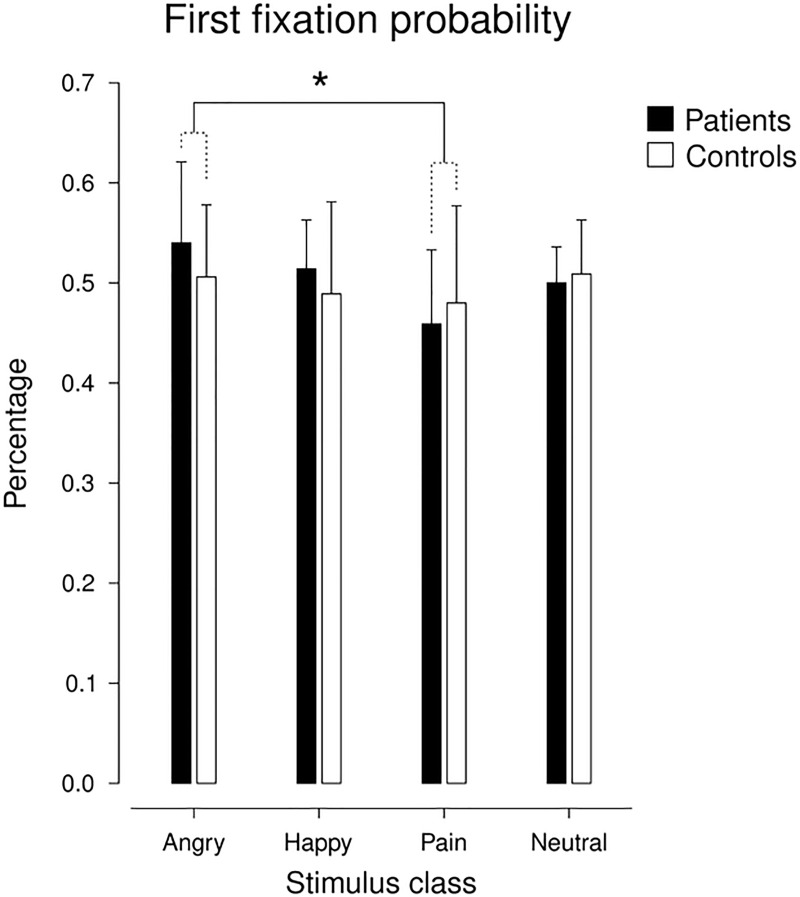
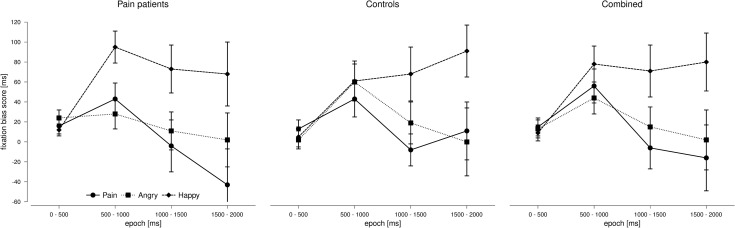
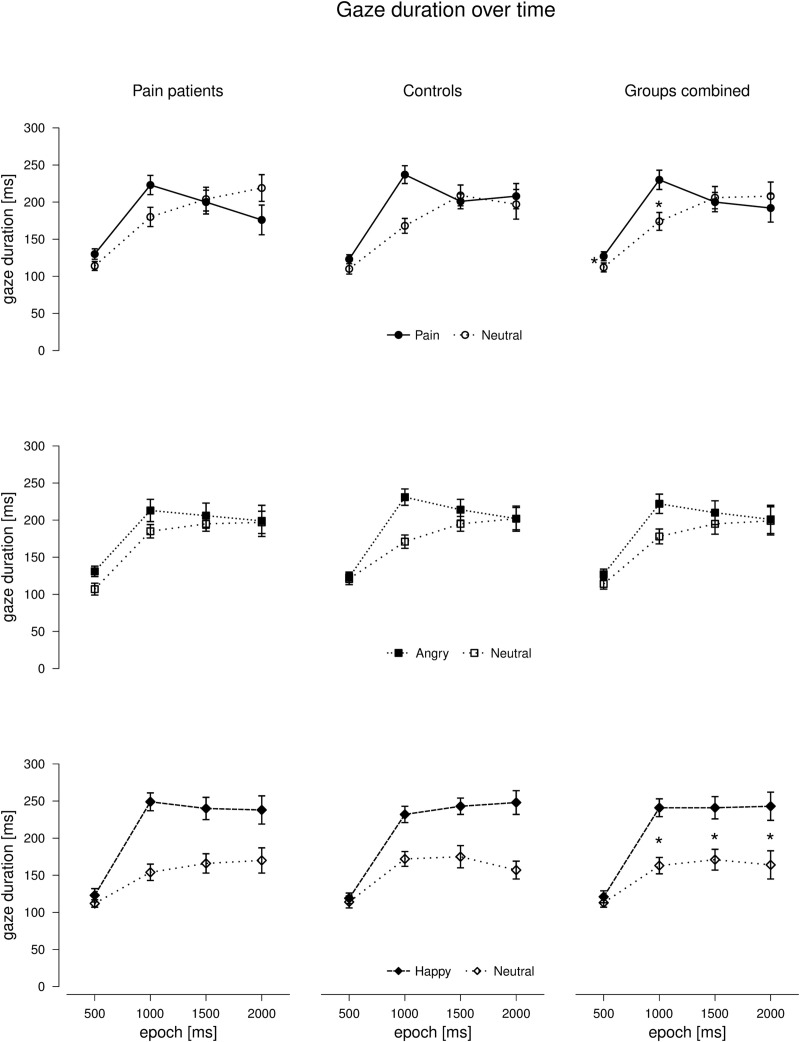
Altered attentional processing of pain-associated stimuli-which might take the form of either avoidance or enhanced vigilance-is thought to be implicated in the development and maintenance of chronic pain. In contrast to reaction time tasks like the dot probe, eye tracking allows for tracking the time course of visual attention and thus differentiating early and late attentional processes. Our study aimed at investigating visual attention to emotional faces in patients with chronic musculoskeletal pain (N = 20) and matched pain-free controls (N = 20). Emotional faces (pain, angry, happy) were presented in pairs with a neutral face for 2000 ms each. Three parameters were determined: First fixation probabilities, fixation durations (overall and divided in four 500 ms intervals) and a fixation bias score as the relative fixation duration of emotional faces compared to neutral faces. There were no group differences in any of the parameters. First fixation probabilities were lower for pain faces than for angry faces. Overall, we found longer fixation duration on emotional compared to neutral faces ('emotionality bias'), which is in accord with previous research. However, significant longer fixation duration compared to the neutral face was detected only for happy and angry but not for pain faces. In addition, fixation durations as well as bias scores yielded evidence for vigilant-avoidant processing of pain faces in both groups. These results suggest that attentional bias towards pain-associated stimuli might not generally differentiate between healthy individuals and chronic pain patients. Exaggerated attentional bias in patients might occur only under specific circumstances, e.g., towards stimulus material specifically relating to the specific pain of the patients under study or under high emotional distress.
对与疼痛相关的刺激的注意力处理发生改变——其表现形式可能是回避或增强警觉——被认为与慢性疼痛的发生和维持有关。与点探测等反应时间任务不同,眼动追踪可以跟踪视觉注意力的时间进程,从而区分早期和晚期的注意力过程。我们的研究旨在调查慢性肌肉骨骼疼痛患者(N=20)和匹配的无痛对照组(N=20)对情绪面孔的视觉注意力。情绪面孔(疼痛、愤怒、快乐)与中性面孔成对呈现,每个呈现 2000 毫秒。确定了三个参数:首次注视概率、注视持续时间(整体和分为四个 500 毫秒间隔)和注视偏差得分,即情绪面孔相对于中性面孔的相对注视持续时间。在任何参数中,两组之间均无差异。疼痛面孔的首次注视概率低于愤怒面孔。总的来说,我们发现与中性面孔相比,情绪面孔的注视持续时间更长(“情绪性偏差”),这与先前的研究一致。然而,仅在快乐和愤怒面孔上检测到与中性面孔相比显著更长的注视持续时间,而在疼痛面孔上则没有。此外,注视持续时间和偏差得分都为两组中对疼痛相关刺激的警惕回避处理提供了证据。这些结果表明,对与疼痛相关的刺激的注意力偏向可能不能将健康个体与慢性疼痛患者区分开来。只有在特定情况下,例如,对特定于研究中患者的特定疼痛或高度情绪困扰的刺激材料,患者的注意力偏向才会夸大。