Department of Molecular Physiology and Biophysics, Vanderbilt University, Nashville, TN, USA.
Department of Microbiology and Immunology, University of Iowa, Iowa City, IA, USA.
Pathog Dis. 2021 Jun 3;79(5). doi: 10.1093/femspd/ftab027.
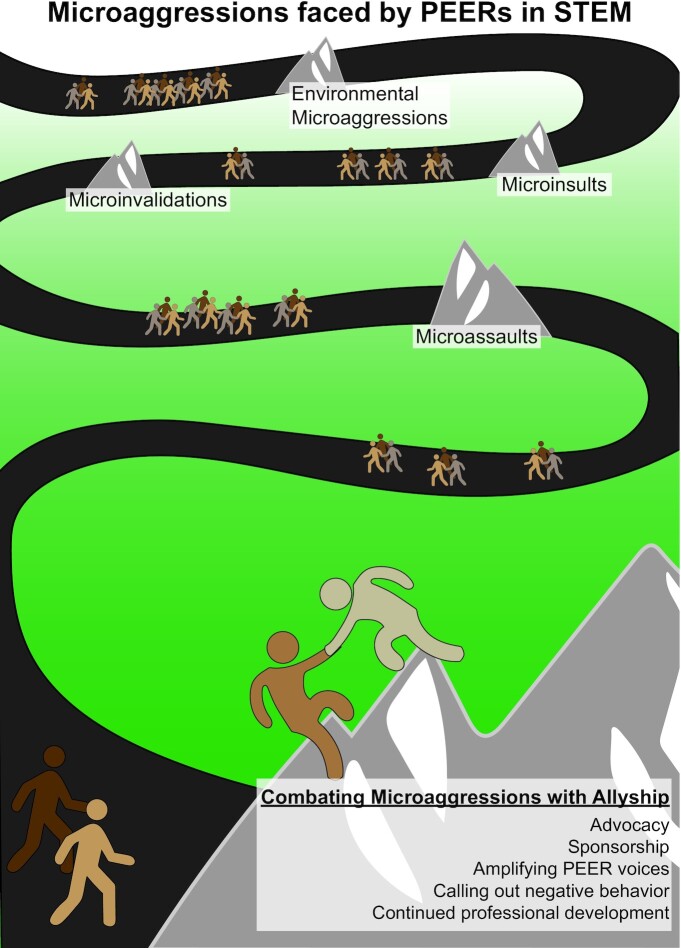
While it is commonly thought that microaggressions are isolated incidents, microaggressions are ingrained throughout the academic research institution (Young, Anderson and Stewart 2015; Lee et al. 2020). Persons Excluded from science because of Ethnicity and Race (PEERs) frequently experience microaggressions from various academicians, including graduate students, postdocs and faculty (Asai 2020; Lee et al. 2020). Here, we elaborate on a rationale for concrete actions to cope with and diminish acts of microaggressions that may otherwise hinder the inclusion of PEERs. We encourage Science, Technology, Engineering and Mathematics (STEM) departments and leadership to affirm PEER scholar identities and promote allyship by infusing sensitivity, responsiveness and anti-bias awareness.
虽然人们普遍认为微侵犯是孤立的事件,但微侵犯已经深深扎根于整个学术研究机构(Young、Anderson 和 Stewart 2015;Lee 等人,2020)。由于种族和民族而被排除在科学之外的人(PEERs)经常受到包括研究生、博士后和教师在内的各种学者的微侵犯(Asai 2020;Lee 等人,2020)。在这里,我们详细阐述了应对和减少微侵犯行为的具体行动的理由,否则这些行为可能会阻碍 PEERs 的参与。我们鼓励科学、技术、工程和数学(STEM)部门和领导层通过注入敏感性、响应性和反偏见意识来肯定 PEER 学者的身份并促进盟友关系。