Zhou Yusheng, von Lengerke Thomas, Dreier Maren
Hannover Medical School, Institute for Epidemiology, Social Medicine and Health Systems Research, Carl-Neuberg Str. 1, 30625, Hannover, Germany.
Department of Medical Psychology, Hannover Medical School, Centre for Public Health and Healthcare, Carl-Neuberg Str. 1, 30625, Hannover, Germany.
Int J Health Geogr. 2021 May 28;20(1):24. doi: 10.1186/s12942-021-00278-w.
Studies on the association between surrounding greenspace and being overweight in childhood show inconsistent results, possibly because they differ widely in their definition and measurement of surrounding greenspace. Our aim was to evaluate whether the association of greenspace with being overweight depends on the measurement of greenspace in different data sources.
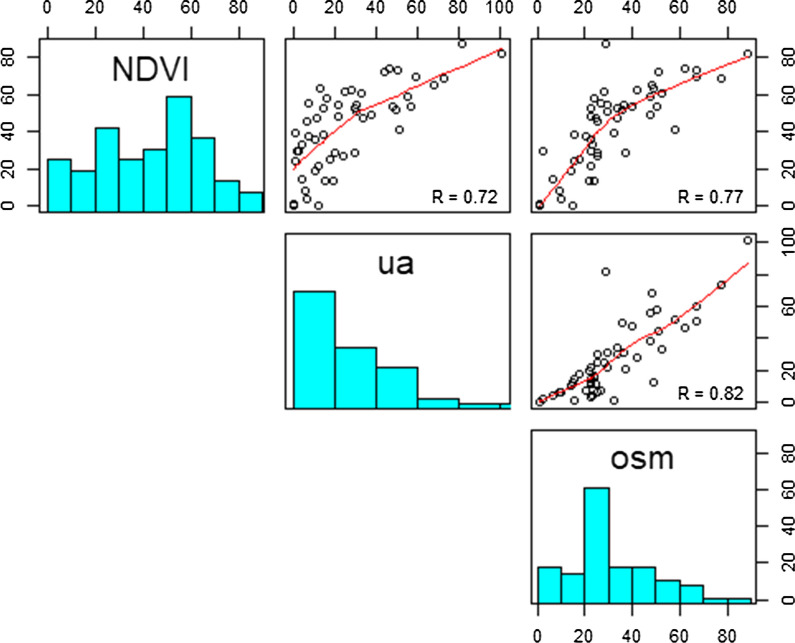
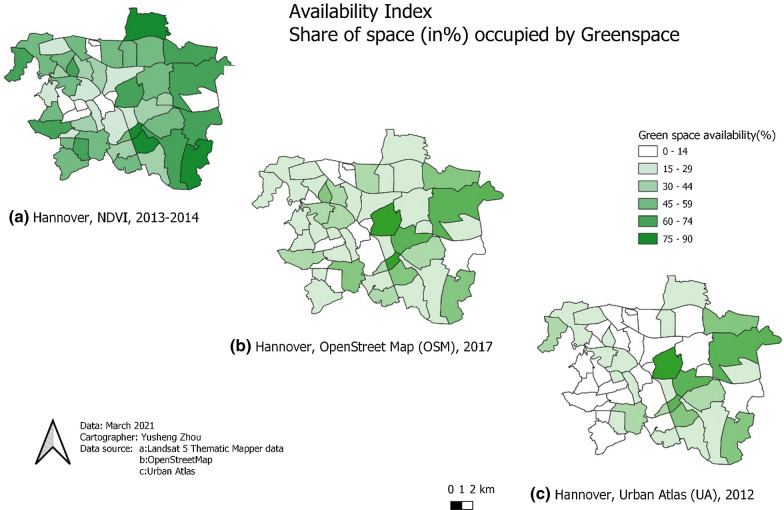
Based on data from the school entry examinations of 22,678 children in the city of Hannover, Germany, from 2010 to 14, the association between greenspace availability and overweight was examined. Three different sources of greenspace availability were derived for a set of 51 areas of the city: The Normalized Difference Vegetation Index (NDVI), the OpenStreetMap (OSM) dataset, and the European Urban Atlas (UA) dataset. Agreement between the indicators on the quantity of greenspace coverage was compared. The association with children's BMI z-score, including potential interaction terms, was assessed using multilevel regression analysis.
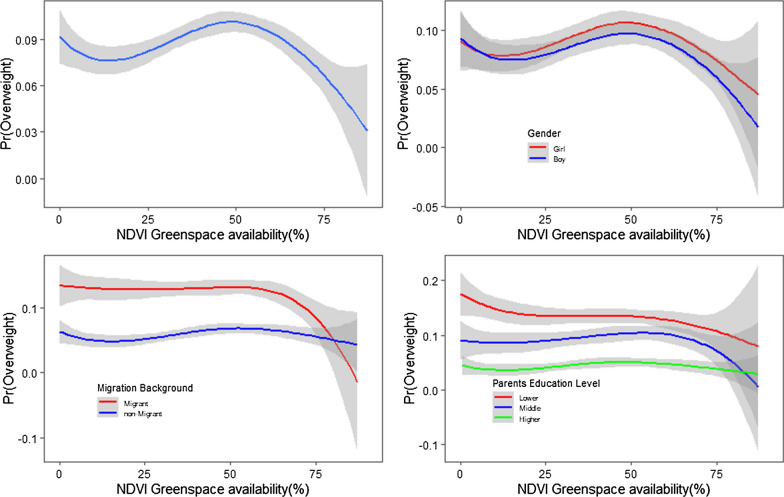
Greenspace availability per district area derived by NDVI was on average 42%, by OSM 29% and UA 22%, with OSM and UA being strongly correlated. Only the greenspace availability derived by NDVI showed an association with children's BMI z-score: The higher the greenspace availability was, the lower the BMI. The trend of association was higher for boys and migrant children than for girls and non-migrants and was restricted to the highest levels of greenspace availability.
Associations of greenspace with children's weight status depend on the greenspace measurement chosen. Surrounding greenspace was measured more comprehensively by NDVI. Data sources based on land use categories such as UA and OSM may be less suitable to reflect surrounding greenspace relevant for health outcomes. Potential mechanisms warrant further analysis and investigation.
关于儿童周围绿地空间与超重之间关联的研究结果并不一致,这可能是因为它们在周围绿地空间的定义和测量方法上存在很大差异。我们的目的是评估绿地空间与超重之间的关联是否取决于不同数据源中绿地空间的测量方法。
基于2010年至2014年德国汉诺威市22678名儿童入学考试的数据,研究了绿地空间可及性与超重之间的关联。从该市51个区域得出了三种不同的绿地空间可及性数据源:归一化植被指数(NDVI)、开放街道地图(OSM)数据集和欧洲城市地图集(UA)数据集。比较了绿地覆盖量指标之间的一致性。使用多水平回归分析评估了与儿童BMI z评分的关联,包括潜在的交互项。
按NDVI得出的每个区面积的绿地空间可及性平均为42%,按OSM为29%,按UA为22%,OSM和UA高度相关。只有按NDVI得出的绿地空间可及性与儿童BMI z评分存在关联:绿地空间可及性越高,BMI越低。男孩和移民儿童的关联趋势高于女孩和非移民儿童,且仅限于绿地空间可及性最高的水平。
绿地空间与儿童体重状况的关联取决于所选择的绿地空间测量方法。NDVI对周围绿地空间的测量更全面。基于土地利用类别(如UA和OSM)的数据源可能不太适合反映与健康结果相关的周围绿地空间。潜在机制值得进一步分析和研究。