From the Preventive Neurology Unit, Wolfson Institute of Preventive Medicine, Barts and Queen Mary University of London; and Royal London Hospital, Barts Health NHS Trust.
Neurol Neuroimmunol Neuroinflamm. 2021 May 28;8(4). doi: 10.1212/NXI.0000000000001007. Print 2021 Jul.
We sought to determine whether genetic risk modifies the effect of environmental risk factors for multiple sclerosis (MS). To test this hypothesis, we tested for statistical interaction between polygenic risk scores (PRS) capturing genetic susceptibility to MS and environmental risk factors for MS in UK Biobank.
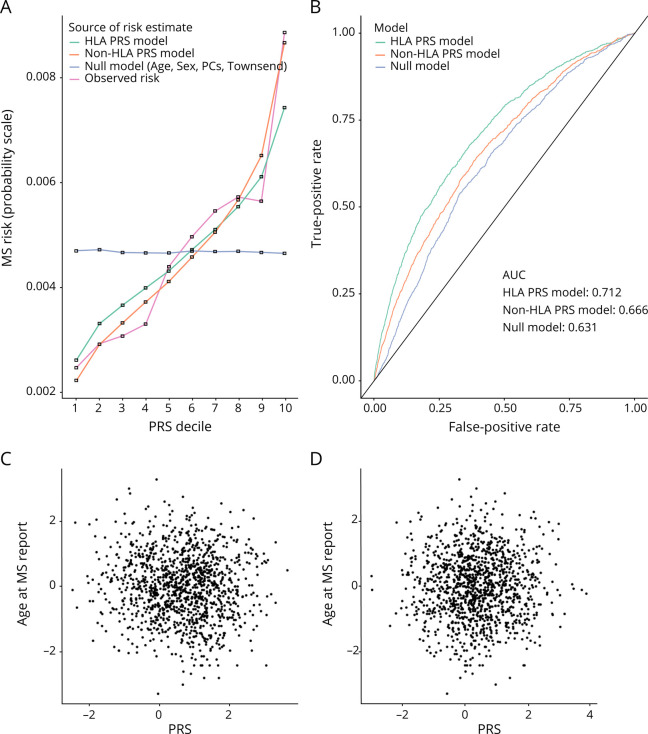
People with MS were identified within UK Biobank using -coded MS or self-report. Associations between environmental risk factors and MS risk were quantified with a case-control design using multivariable logistic regression. PRS were derived using the clumping-and-thresholding approach with external weights from the largest genome-wide association study of MS. Separate scores were created including major histocompatibility complex (MHC) (PRS) and excluding (PRS) the MHC locus. The best-performing PRS were identified in 30% of the cohort and validated in the remaining 70%. Interaction between environmental and genetic risk factors was quantified using the attributable proportion due to interaction (AP) and multiplicative interaction.
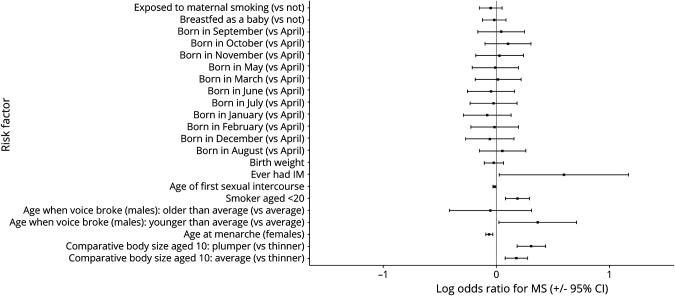
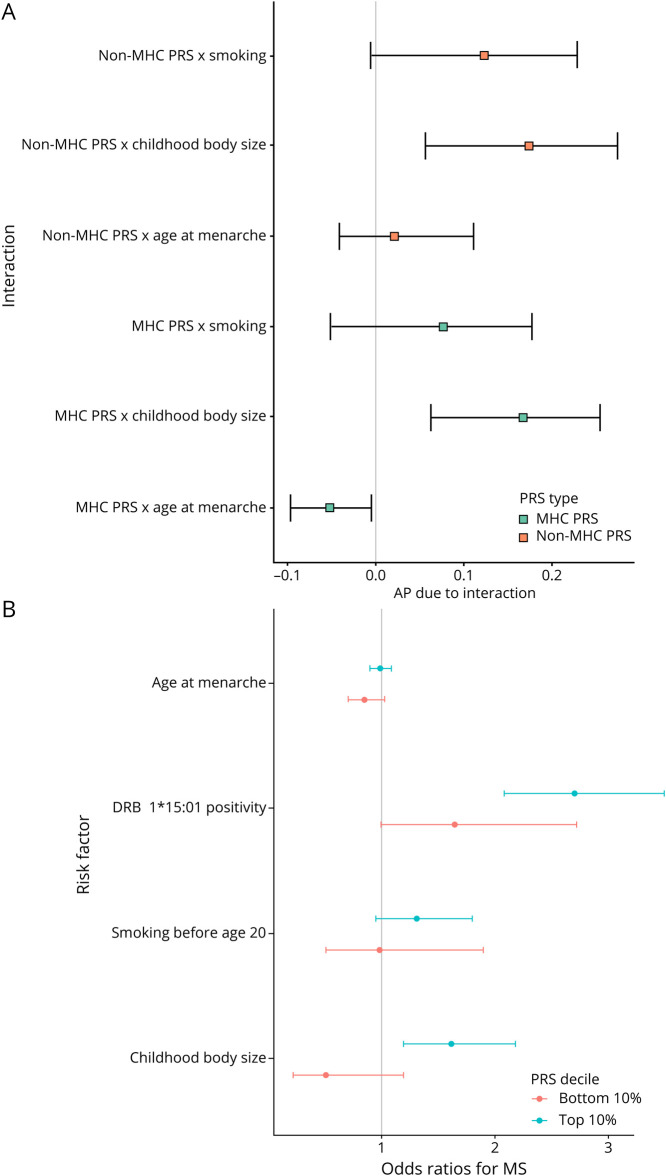
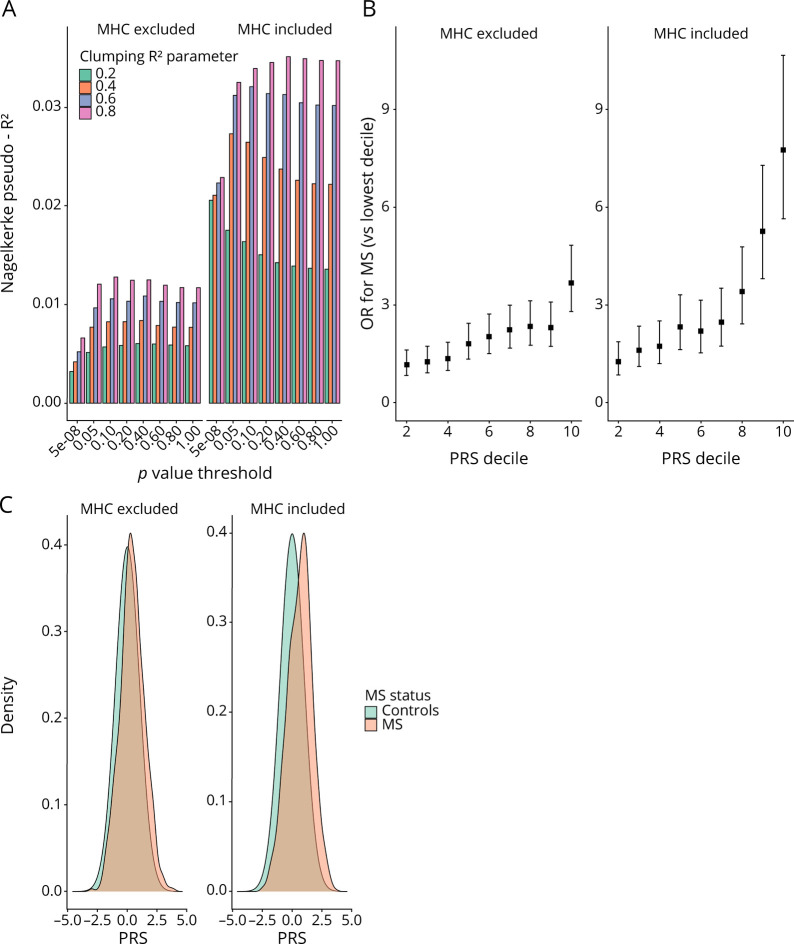
Data were available for 2,250 people with MS and 486,000 controls. Childhood obesity, earlier age at menarche, and smoking were associated with MS. The optimal PRS were strongly associated with MS in the validation cohort (PRS: Nagelkerke's pseudo-R 0.033, = 3.92 × 10; PRS: Nagelkerke's pseudo-R 0.013, = 3.73 × 10). There was strong evidence of interaction between polygenic risk for MS and childhood obesity (PRS: AP = 0.17, 95% CI 0.06-0.25, = 0.004; PRS: AP = 0.17, 95% CI 0.06-0.27, = 0.006).
This study provides novel evidence for an interaction between childhood obesity and a high burden of autosomal genetic risk. These findings may have significant implications for our understanding of MS biology and inform targeted prevention strategies.
我们旨在确定遗传风险是否会改变多发性硬化症(MS)的环境风险因素的影响。为了检验这一假设,我们在英国生物库中检测了多基因风险评分(PRS)与 MS 的环境风险因素之间的统计学相互作用。
在英国生物库中,使用-MS 或自我报告对 MS 患者进行了识别。使用多变量逻辑回归的病例对照设计,定量评估了环境风险因素与 MS 风险之间的关联。PRS 是使用聚类和阈值方法,以及来自最大的 MS 全基因组关联研究的外部权重推导出来的。创建了单独的评分,包括主要组织相容性复合体(MHC)(PRS)和不包括(PRS)MHC 基因座。在队列的 30%中确定了表现最佳的 PRS,并在其余 70%中进行了验证。使用归因于相互作用的比例(AP)和乘法相互作用来量化环境和遗传风险因素之间的相互作用。
数据可用于 2250 名 MS 患者和 486000 名对照者。儿童肥胖、初潮年龄较早和吸烟与 MS 相关。最佳 PRS 在验证队列中与 MS 高度相关(PRS:Nagelkerke 的伪 R 0.033, = 3.92×10;PRS:Nagelkerke 的伪 R 0.013, = 3.73×10)。MS 的多基因风险与儿童肥胖之间存在强烈的相互作用证据(PRS:AP = 0.17,95%CI 0.06-0.25, = 0.004;PRS:AP = 0.17,95%CI 0.06-0.27, = 0.006)。
本研究提供了多基因风险与儿童肥胖之间相互作用的新证据。这些发现可能对我们理解 MS 生物学具有重要意义,并为有针对性的预防策略提供信息。