From the Department of Clinical Neuroscience and Institute of Environmental Medicine (A.K.H., L.A.), and Department of Clinical Neuroscience and Center for Molecular Medicine (I.K., T.O.), Karolinska Institutet, Stockholm; Mathematical Statistics (O.H.), Stockholm University, Sweden; UCL/Farr Institute of Health Informatics Research (M.K.), London, UK; and Centre for Occupational and Environmental Medicine (L.A.), Stockholm County Council, Sweden.
Neurology. 2018 Jul 31;91(5):e455-e462. doi: 10.1212/WNL.0000000000005906. Epub 2018 Jul 3.
We hypothesize that different sources of lung irritation may contribute to elicit an immune reaction in the lungs and subsequently lead to multiple sclerosis (MS) in people with a genetic susceptibility to the disease. We aimed to investigate the influence of exposure to organic solvents on MS risk, and a potential interaction between organic solvents and MS risk human leukocyte antigen (HLA) genes.
Using a Swedish population-based case-control study (2,042 incident cases of MS and 2,947 controls), participants with different genotypes, smoking habits, and exposures to organic solvents were compared regarding occurrence of MS, by calculating odds ratios with 95% confidence intervals using logistic regression. A potential interaction between exposure to organic solvents and MS risk HLA genes was evaluated by calculating the attributable proportion due to interaction.
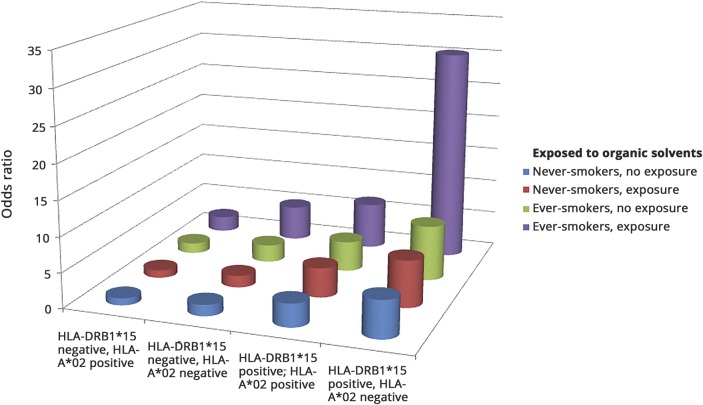
Overall, exposure to organic solvents increased the risk of MS (odds ratio 1.5, 95% confidence interval 1.2-1.8, = 0.0004). Among both ever and never smokers, an interaction between organic solvents, carriage of HLA-DRB115, and absence of HLA-A02 was observed with regard to MS risk, similar to the previously reported gene-environment interaction involving the same MS risk HLA genes and smoke exposure.
The mechanism linking both smoking and exposure to organic solvents to MS risk may involve lung inflammation with a proinflammatory profile. Their interaction with MS risk HLA genes argues for an action of these environmental factors on adaptive immunity, perhaps through activation of autoaggressive cells resident in the lungs subsequently attacking the CNS.
我们假设不同的肺部刺激源可能会引发肺部免疫反应,从而导致具有疾病遗传易感性的人群患上多发性硬化症(MS)。我们旨在研究接触有机溶剂对 MS 风险的影响,以及有机溶剂与 MS 风险人类白细胞抗原(HLA)基因之间的潜在相互作用。
使用瑞典基于人群的病例对照研究(2042 例 MS 新发病例和 2947 例对照),通过计算 logistic 回归的优势比及其 95%置信区间,比较不同基因型、吸烟习惯和有机溶剂暴露的参与者发生 MS 的情况。通过计算交互归因比例来评估有机溶剂暴露与 MS 风险 HLA 基因之间的潜在相互作用。
总体而言,接触有机溶剂会增加 MS 的风险(比值比 1.5,95%置信区间 1.2-1.8, = 0.0004)。在所有吸烟者和不吸烟者中,均观察到有机溶剂、HLA-DRB115 携带和 HLA-A02 缺失与 MS 风险之间的相互作用,与先前报道的涉及相同 MS 风险 HLA 基因和吸烟暴露的基因-环境相互作用相似。
将吸烟和接触有机溶剂与 MS 风险联系起来的机制可能涉及具有促炎特征的肺部炎症。它们与 MS 风险 HLA 基因的相互作用表明这些环境因素对适应性免疫有作用,可能是通过激活肺部中随后攻击中枢神经系统的自身反应性细胞来实现的。