Department of Pathology, Stanford University School of Medicine, Stanford, CA, USA.
Department of Human Genetics, David Geffen School of Medicine, University of California Los Angeles, Los Angeles, CA, USA.
Aging Cell. 2021 Jun;20(6):e13366. doi: 10.1111/acel.13366. Epub 2021 May 29.
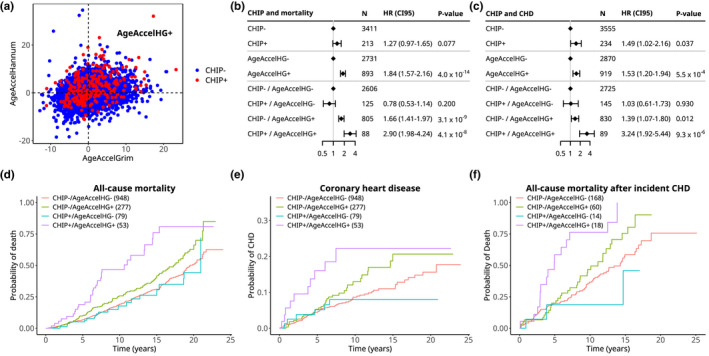
Clonal hematopoiesis of indeterminate potential (CHIP) is a common precursor state for blood cancers that most frequently occurs due to mutations in the DNA-methylation modifying enzymes DNMT3A or TET2. We used DNA-methylation array and whole-genome sequencing data from four cohorts together comprising 5522 persons to study the association between CHIP, epigenetic clocks, and health outcomes. CHIP was strongly associated with epigenetic age acceleration, defined as the residual after regressing epigenetic clock age on chronological age, in several clocks, ranging from 1.31 years (GrimAge, p < 8.6 × 10 ) to 3.08 years (EEAA, p < 3.7 × 10 ). Mutations in most CHIP genes except DNA-damage response genes were associated with increases in several measures of age acceleration. CHIP carriers with mutations in multiple genes had the largest increases in age acceleration and decrease in estimated telomere length. Finally, we found that ~40% of CHIP carriers had acceleration >0 in both Hannum and GrimAge (referred to as AgeAccelHG+). This group was at high risk of all-cause mortality (hazard ratio 2.90, p < 4.1 × 10 ) and coronary heart disease (CHD) (hazard ratio 3.24, p < 9.3 × 10 ) compared to those who were CHIP-/AgeAccelHG-. In contrast, the other ~60% of CHIP carriers who were AgeAccelHG- were not at increased risk of these outcomes. In summary, CHIP is strongly linked to age acceleration in multiple clocks, and the combination of CHIP and epigenetic aging may be used to identify a population at high risk for adverse outcomes and who may be a target for clinical interventions.
克隆性造血(CHIP)是血液癌症的常见前体状态,大多数情况下是由于 DNA 甲基化修饰酶 DNMT3A 或 TET2 的突变引起的。我们使用来自四个队列的 DNA 甲基化阵列和全基因组测序数据,对 CHIP、表观遗传时钟和健康结果之间的关联进行了研究,这四个队列共有 5522 人。在几个时钟中,CHIP 与表观遗传年龄加速(定义为将表观遗传时钟年龄回归到实际年龄后的剩余年龄)强烈相关,范围从 1.31 岁(GrimAge,p<8.6×10)到 3.08 岁(EEAA,p<3.7×10)。除 DNA 损伤反应基因外,大多数 CHIP 基因的突变与多种加速老化的指标增加有关。多个基因发生突变的 CHIP 携带者,其年龄加速幅度最大,端粒长度估计值降低最大。最后,我们发现约 40%的 CHIP 携带者在 Hannum 和 GrimAge 中都有加速>0(称为 AgeAccelHG+)。与 CHIP-/AgeAccelHG-相比,该组发生全因死亡率(危险比 2.90,p<4.1×10)和冠心病(CHD)(危险比 3.24,p<9.3×10)的风险很高。相比之下,其余约 60%的 CHIP 携带者 AgeAccelHG-的这些结果没有增加的风险。总之,CHIP 与多个时钟中的年龄加速密切相关,CHIP 和表观遗传衰老的组合可用于识别发生不良结果风险较高的人群,这些人群可能是临床干预的目标。