Brain Health Imaging Centre and Campbell Family Mental Health Research Institute at the Centre for Addiction and Mental Health, 250 College Street, Toronto, ON, M5T 1R8, Canada.
Department of Pharmacology and Toxicology, University of Toronto, 1 King's College Circle, Toronto, ON, M5S 1A8, Canada.
Transl Psychiatry. 2021 May 29;11(1):334. doi: 10.1038/s41398-021-01450-3.
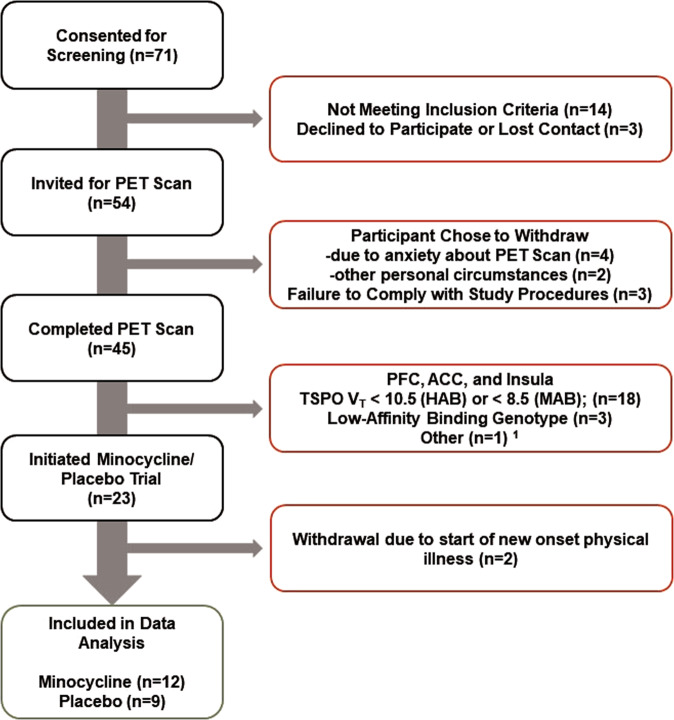
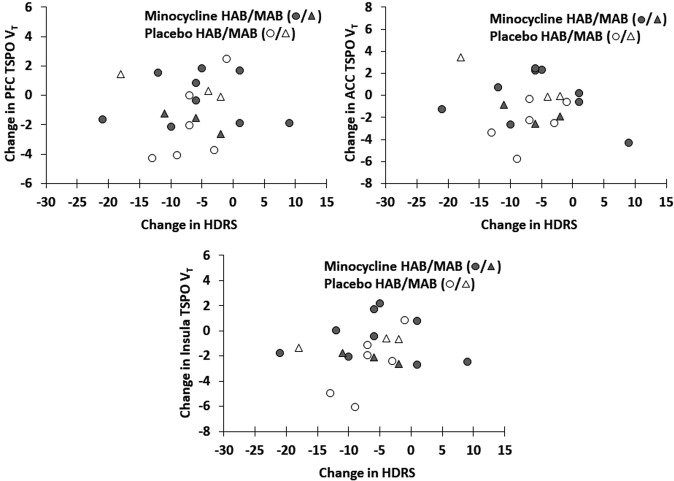
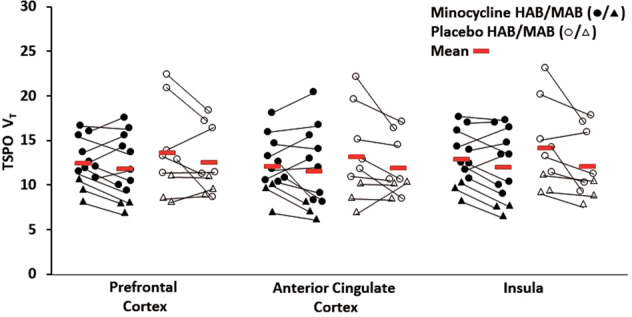
Gliosis is implicated in the pathophysiology of many neuropsychiatric diseases, including treatment-resistant major depressive disorder (TRD). Translocator protein total distribution volume (TSPO V), a brain marker mainly reflective of gliosis in disease, can be measured using positron emission tomography (PET). Minocycline reduces gliosis and translocator protein binding in rodents, but this is not established in humans. Here, the ability of oral minocycline to reduce TSPO V was assessed in TRD. To determine whether oral minocycline, as compared to placebo, can reduce prefrontal cortex (PFC), anterior cingulate cortex (ACC), and insula TSPO V in TRD, twenty-one TRD participants underwent two [F]FEPPA PET scans to measure TSPO V. These were completed before and after either oral minocycline 100 mg bid or placebo which was administered in a randomized double-blinded fashion for 8 weeks. There was no significant difference between the minocycline and placebo groups on change in TSPO V within the PFC, ACC, and insula (repeated measures ANOVA, effect of group interaction, PFC: F = 0.28, P = 0.60; ACC: F = 0.54, P = 0.47; insula F = 1.6, P = 0.22). Oral minocycline had no significant effect on TSPO V which suggests that this dosage is insufficient to reduce gliosis in TRD. To target gliosis in TRD either alternative therapeutics or intravenous formulations of minocycline should be investigated. These results also suggest that across neuropsychiatric diseases in humans, it should be assumed that oral minocycline will not reduce TSPO V or gliosis unless empirically demonstrated.
神经胶质增生与许多神经精神疾病的病理生理学有关,包括治疗抵抗性重度抑郁症(TRD)。转位蛋白总分布容积(TSPO V)是一种主要反映疾病中神经胶质增生的脑标志物,可通过正电子发射断层扫描(PET)进行测量。米诺环素可减少啮齿动物的神经胶质增生和转位蛋白结合,但在人类中尚未确定。在这里,评估了口服米诺环素在 TRD 中减少 TSPO V 的能力。为了确定与安慰剂相比,口服米诺环素是否可以减少 TRD 患者的前额叶皮层(PFC)、前扣带皮层(ACC)和岛叶 TSPO V,21 名 TRD 参与者接受了两次[F]FEPPA PET 扫描以测量 TSPO V。这些扫描分别在口服米诺环素 100mg bid 或安慰剂治疗前后完成,8 周内以随机双盲方式给药。在 PFC、ACC 和岛叶中,米诺环素组和安慰剂组在 TSPO V 变化方面没有显著差异(重复测量方差分析,组间效应的影响,PFC:F=0.28,P=0.60;ACC:F=0.54,P=0.47;岛叶 F=1.6,P=0.22)。口服米诺环素对 TSPO V 没有显著影响,这表明该剂量不足以减少 TRD 中的神经胶质增生。为了针对 TRD 中的神经胶质增生,应研究替代疗法或米诺环素的静脉制剂。这些结果还表明,在人类的神经精神疾病中,除非经过经验证明,否则应假设口服米诺环素不会减少 TSPO V 或神经胶质增生。