Brain Health Imaging Centre, Campbell Family Mental Health Research Institute, The Centre for Addiction and Mental Health, Toronto, Ontario, Canada.
Azrieli Centre for Neuro-Radiochemistry, Campbell Family Mental Health Research Institute, The Centre for Addiction and Mental Health Toronto, Ontario, Canada.
JAMA Psychiatry. 2023 Aug 1;80(8):787-795. doi: 10.1001/jamapsychiatry.2023.1321.
Persistent depressive symptoms, often accompanied by cognitive symptoms, commonly occur after COVID-19 illness (hereinafter termed COVID-DC, DC for depressive and/or cognitive symptoms). In patients with COVID-DC, gliosis, an inflammatory change, was suspected, but measurements of gliosis had not been studied in the brain for this condition.
To determine whether translocator protein total distribution volume (TSPO VT), a marker of gliosis that is quantifiable with positron emission tomography (PET), is elevated in the dorsal putamen, ventral striatum, prefrontal cortex, anterior cingulate cortex, and hippocampus of persons with COVID-DC.
DESIGN, SETTING, AND PARTICIPANTS: This case-control study conducted at a tertiary care psychiatric hospital in Canada from April 1, 2021, to June 30, 2022, compared TSPO VT of specific brain regions in 20 participants with COVID-DC with that in 20 healthy controls. The TSPO VT was measured with fluorine F 18-labeled N-(2-(2-fluoroethoxy)benzyl)-N-(4-phenoxypyridin-3-yl)acetamide ([18F]FEPPA) PET.
The TSPO VT was measured in the dorsal putamen, ventral striatum, prefrontal cortex, anterior cingulate cortex, and hippocampus. Symptoms were measured with neuropsychological and psychological tests, prioritizing outcomes related to striatal function.
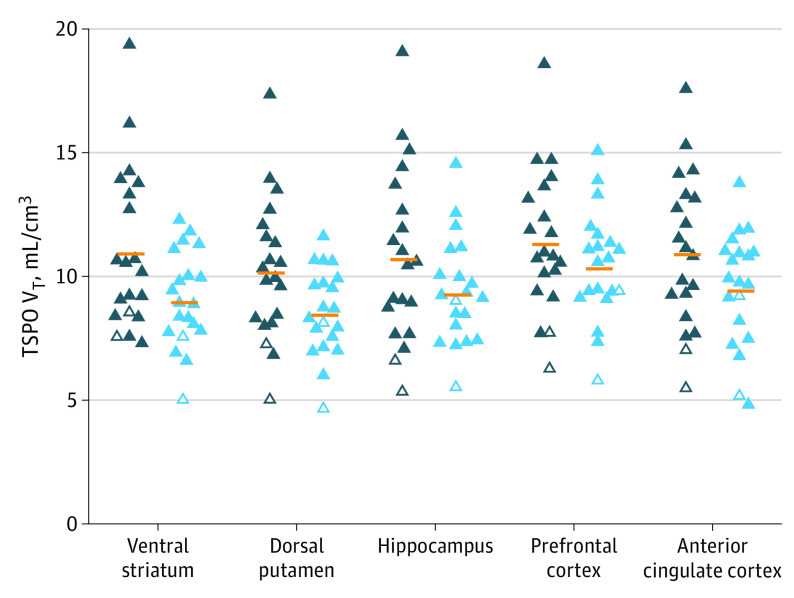
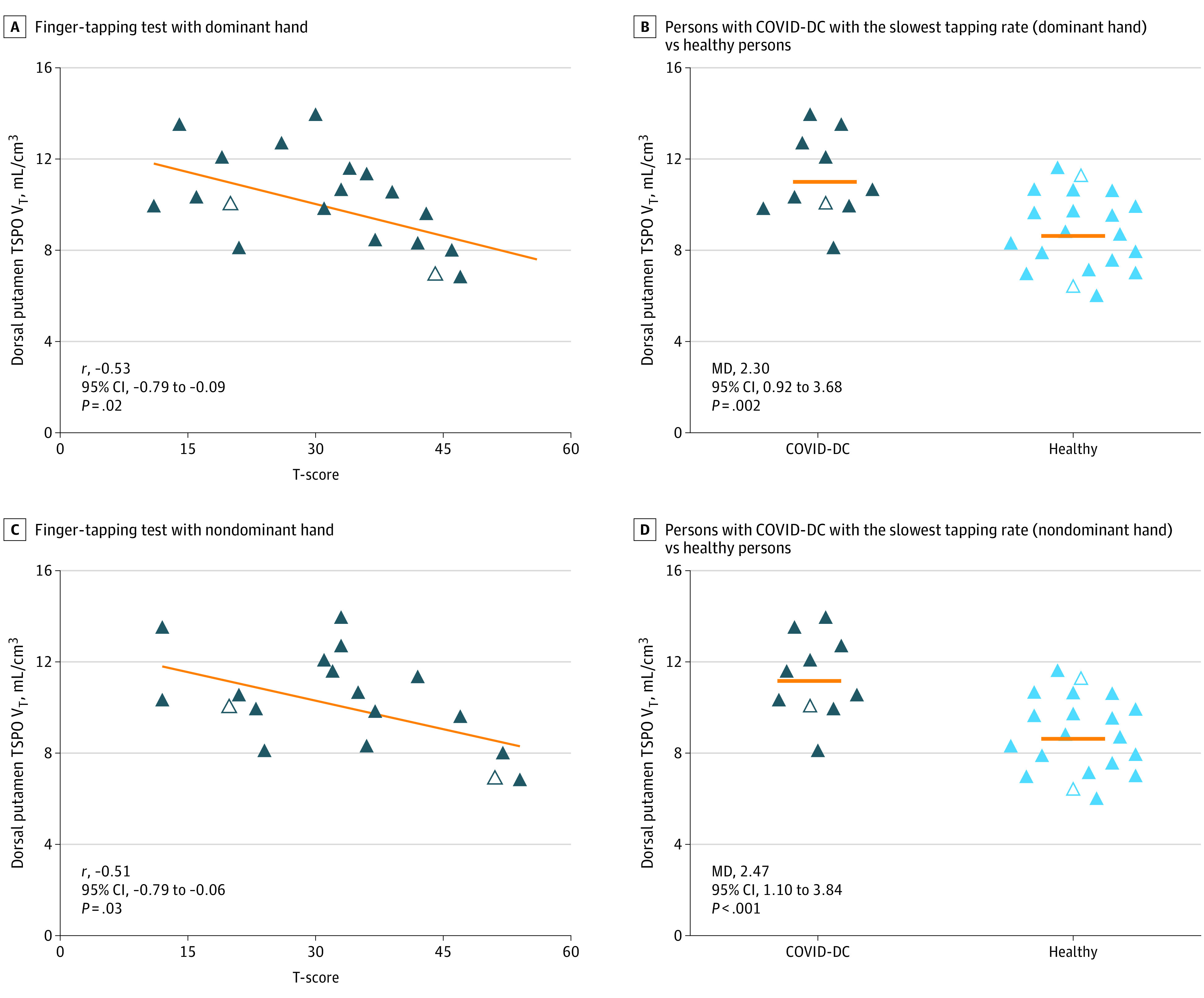
The study population included 40 participants (mean [SD] age, 32.9 [12.3] years). The TSPO VT across the regions of interest was greater in persons with COVID-DC (mean [SD] age, 32.7 [11.4] years; 12 [60%] women) compared with healthy control participants (mean [SD] age, 33.3 [13.9] years; 11 [55%] women): mean (SD) difference, 1.51 (4.47); 95% CI, 0.04-2.98; 1.51 divided by 9.20 (17%). The difference was most prominent in the ventral striatum (mean [SD] difference, 1.97 [4.88]; 95% CI, 0.36-3.58; 1.97 divided by 8.87 [22%]) and dorsal putamen (mean difference, 1.70 [4.25]; 95% CI, 0.34-3.06; 1.70 divided by 8.37 [20%]). Motor speed on the finger-tapping test negatively correlated with dorsal putamen TSPO VT (r, -0.53; 95% CI, -0.79 to -0.09), and the 10 persons with the slowest speed among those with COVID-DC had higher dorsal putamen TSPO VT than healthy persons by 2.3 (2.30 divided by 8.37 [27%]; SD, 2.46; 95% CI, 0.92-3.68).
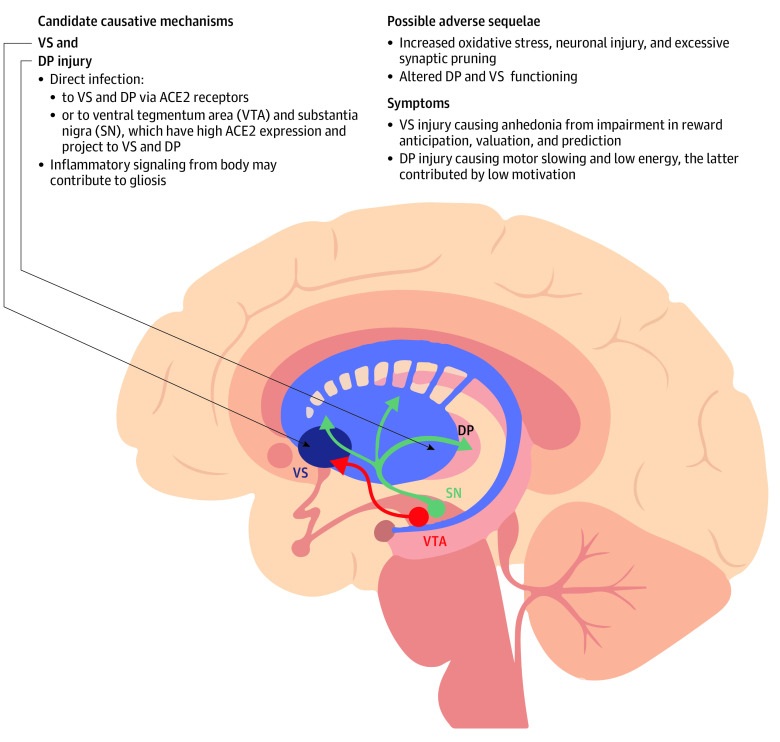
In this case-control study, TSPO VT was higher in patients with COVID-DC. Greater TSPO VT is evidence for an inflammatory change of elevated gliosis in the brain of an individual with COVID-DC. Gliosis may be consequent to inflammation, injury, or both, particularly in the ventral striatum and dorsal putamen, which may explain some persistent depressive and cognitive symptoms, including slowed motor speed, low motivation or energy, and anhedonia, after initially mild to moderate COVID-19 illness.
重要性:持续性抑郁症状,常伴有认知症状,在 COVID-19 疾病后很常见(以下称为 COVID-DC,DC 为抑郁和/或认知症状)。在 COVID-DC 患者中,怀疑存在神经胶质增生,一种炎症变化,但尚未对大脑中这种疾病的神经胶质增生进行测量。
目的:确定 COVID-DC 患者的背侧壳核、腹侧纹状体、前额叶皮层、前扣带回和海马体中,作为神经胶质增生标志物的转位蛋白总分布容积(TSPO VT)是否升高。
设计、地点和参与者:这项在加拿大一家三级精神保健医院进行的病例对照研究于 2021 年 4 月 1 日至 2022 年 6 月 30 日进行,比较了 20 名 COVID-DC 患者和 20 名健康对照者特定脑区的 TSPO VT。TSPO VT 是用氟 F18 标记的 N-(2-(2-乙氧基)苄基)-N-(4-苯氧基吡啶-3-基)乙酰胺([18F]FEPPA) PET 测量的。
主要结果和测量:测量了背侧壳核、腹侧纹状体、前额叶皮层、前扣带回和海马体的 TSPO VT。通过神经心理学和心理测试来衡量症状,优先考虑与纹状体功能相关的结果。
结果:研究人群包括 40 名参与者(平均[标准差]年龄,32.9[12.3]岁)。与健康对照组参与者(平均[标准差]年龄,33.3[13.9]岁;11[55%]女性)相比,COVID-DC 患者(平均[标准差]年龄,32.7[11.4]岁;12[60%]女性)的各感兴趣区域的 TSPO VT 更高:平均(标准差)差异,1.51(4.47);95%CI,0.04-2.98;1.51 除以 9.20(17%)。差异在腹侧纹状体最为明显(平均[标准差]差异,1.97(4.88);95%CI,0.36-3.58;1.97 除以 8.87(22%))和背侧壳核(平均差异,1.70(4.25);95%CI,0.34-3.06;1.70 除以 8.37(20%))。手指敲击测试的运动速度与背侧壳核 TSPO VT 呈负相关(r,-0.53;95%CI,-0.79 至-0.09),在 COVID-DC 患者中,10 名运动速度最慢的患者的背侧壳核 TSPO VT 比健康人高 2.3(2.30 除以 8.37(27%);SD,2.46;95%CI,0.92-3.68)。
结论和相关性:在这项病例对照研究中,COVID-DC 患者的 TSPO VT 较高。TSPO VT 升高表明 COVID-DC 患者大脑存在炎症变化的神经胶质增生。神经胶质增生可能是炎症、损伤或两者共同作用的结果,特别是在腹侧纹状体和背侧壳核,这可能解释了一些持续的抑郁和认知症状,包括最初轻度至中度 COVID-19 疾病后运动速度减慢、动机或能量低下以及快感缺失。