Iliopoulou Sotiria Maria, Tsartsalis Stergios, Kaiser Stefan, Millet Philippe, Tournier Benjamin B
Adult Psychiatry Division, Department of Psychiatry, Geneva University Hospitals (HUG), Geneva, 1225, Switzerland.
Faculty of Medicine, University of Geneva, Geneva, 1204, Switzerland.
Neuropsychiatr Dis Treat. 2021 Nov 18;17:3345-3357. doi: 10.2147/NDT.S334027. eCollection 2021.
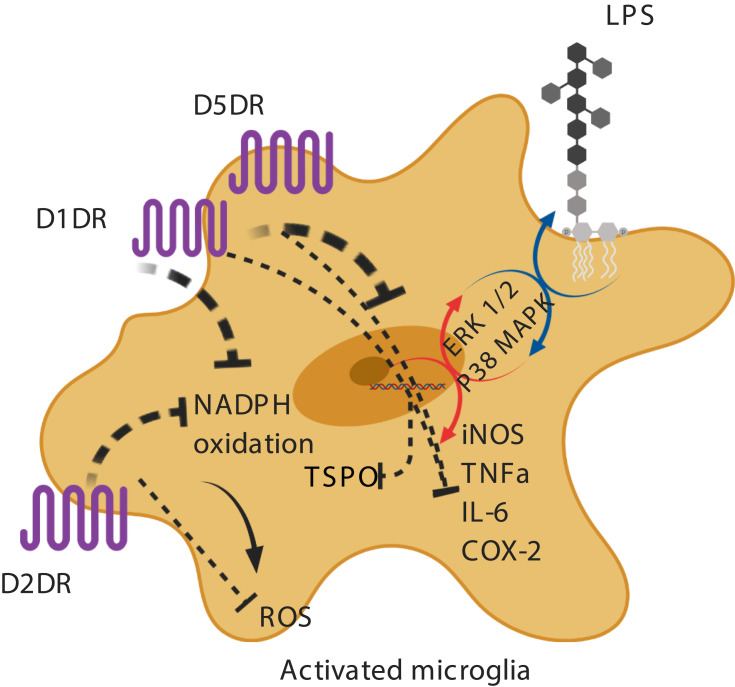
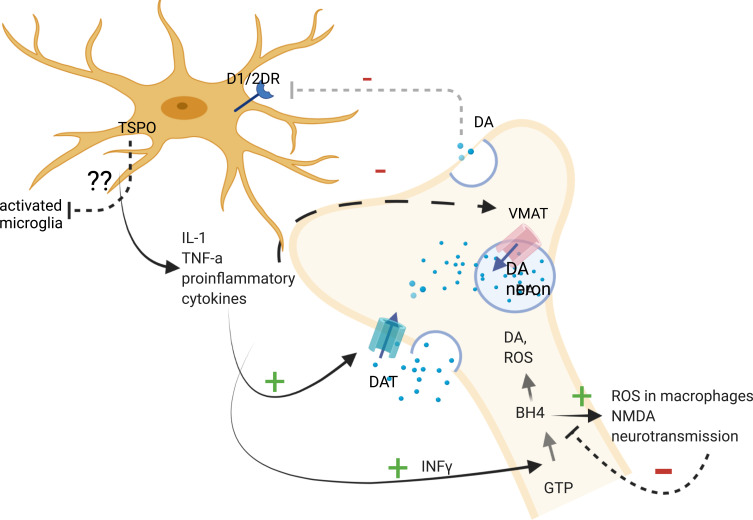
Schizophrenia is a complex disease whose pathophysiology is not yet fully understood. In addition to the long prevailing dopaminergic hypothesis, the evidence suggests that neuroinflammation plays a role in the pathophysiology of the disease. Recent studies using positron emission tomography (PET) that target a 18kDa translocator protein (TSPO) in activated microglial cells in an attempt to measure neuroinflammation in patients have shown a decrease or a lack of an increase in TSPO binding. Many biological and methodological considerations have been formulated to explain these findings. Although dopamine has been described as an immunomodulatory molecule, its potential role in neuroinflammation has not been explored in the aforementioned studies. In this review, we discuss the interactions between dopamine and neuroinflammation in psychotic states. Dopamine may inhibit neuroinflammation in activated microglia. Proinflammatory molecules released from microglia may decrease dopaminergic transmission. This could potentially explain why the levels of neuroinflammation in the brain of patients with schizophrenia seem to be unchanged or decreased compared to those in healthy subjects. However, most data are indirect and are derived from animal studies or from studies performed outside the field of schizophrenia. Further studies are needed to combine TSPO and dopamine imaging to study the association between microglial activation and dopamine system function.
精神分裂症是一种复杂的疾病,其病理生理学尚未完全明确。除了长期流行的多巴胺能假说外,有证据表明神经炎症在该疾病的病理生理学中起作用。最近使用正电子发射断层扫描(PET)针对活化小胶质细胞中的18kDa转位蛋白(TSPO)来测量患者神经炎症的研究显示,TSPO结合减少或未增加。人们已经提出了许多生物学和方法学上的考虑因素来解释这些发现。尽管多巴胺已被描述为一种免疫调节分子,但其在神经炎症中的潜在作用在上述研究中尚未得到探讨。在本综述中,我们讨论了多巴胺与精神病状态下神经炎症之间的相互作用。多巴胺可能抑制活化小胶质细胞中的神经炎症。小胶质细胞释放的促炎分子可能会降低多巴胺能传递。这可能潜在地解释了为什么与健康受试者相比,精神分裂症患者大脑中的神经炎症水平似乎没有变化或有所降低。然而,大多数数据是间接的,来自动物研究或精神分裂症领域之外进行的研究。需要进一步的研究将TSPO和多巴胺成像结合起来,以研究小胶质细胞活化与多巴胺系统功能之间的关联。