He Wenbo, Li Meixuan, Han Xuemei, Zhang Wei
Institute of Hospital Management, West China Hospital, Sichuan University, Chengdu, China.
Evidence Based Medicine Center, School of Basic Medical Sciences, Lanzhou University, Lanzhou, China.
Front Aging Neurosci. 2021 May 14;13:647629. doi: 10.3389/fnagi.2021.647629. eCollection 2021.
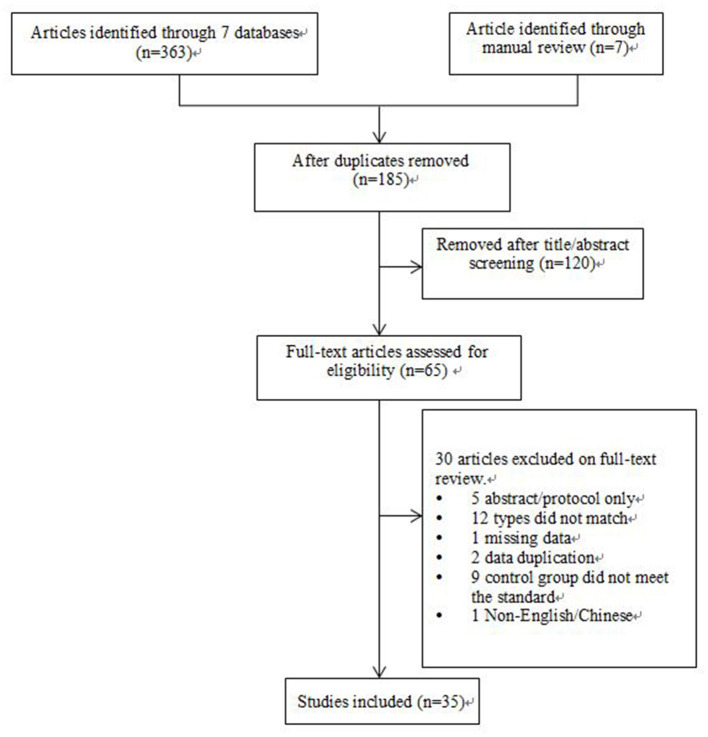
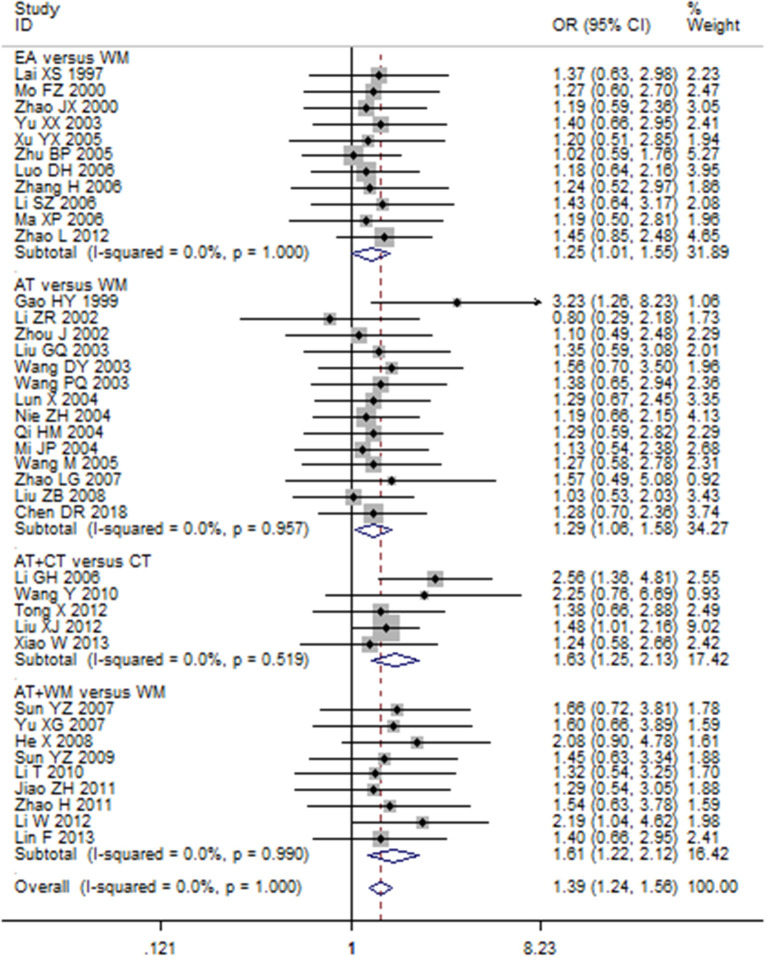
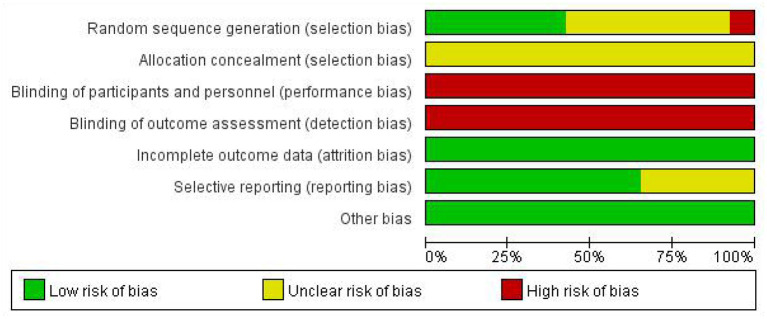
Dementia is a gradual decline in cognitive ability and is becoming more common in our elderly population. Mild cognitive impairment (MCI) is defined as a slight clinical deterioration of memory capacity, below the level of normal aging, but does not constitute a clinical diagnosis of dementia. To date, no interventions have been proven to cure MCI and dementia fully. To evaluate the potential effectiveness and safety of acupuncture for mild cognitive impairment (MCI) and dementia and evaluate the methodological quality of systematic reviews (SRs). We conducted a literature search for SRs with meta-analyses in seven Chinese and international databases through October 1, 2020. The basic characteristics of the included SRs/meta-analyses and the basic information of the original included randomized controlled trials were extracted by three reviewers independently. A meta-analysis of the original randomized controlled trials from the included SRs/meta-analyses was performed using Stata 12.0 software. The Assessing the Methodological Quality of Systematic Reviews 2 was used to assess the methodological quality of the included SRs/meta-analyses, and the Grading of Recommendations, Assessment, Development, and Evaluation was used to rate the quality of evidence. A total of 35 SRs/meta-analyses were included, and the majority showed that acupuncture was more effective than western medicine or conventional therapy for MCI and dementia [odds ratio =1.39; 95% confidence interval (CI): 1.24, 1.56]. There was a statistically significant difference in the Mini-Mental State Examination score (weighted mean difference = 1.23; 95% CI: 0.78, 1.68; < 0.00001), and there was no significant improvement in the activities of daily living score (weighted mean difference = 1.58; 95% CI: -0.02, 3.18; = 0.053). The assessment results of Assessing the Methodological Quality of Systematic Reviews 2 showed that the methodological quality of most included SRs/meta-analyses was critically low; the lowest scores were items 2, 7, and 10. For Grading of Recommendations, Assessment, Development, and Evaluation, of the 73 outcomes, 50 (68.5%) outcomes were low or very low quality, and 23 (31.5%) outcomes were moderate quality. Acupuncture can be considered as an alternative for the treatment of MCI and dementia when western medicine or other therapies are contraindicated. More high-quality evidence is needed to determine further the effectiveness of acupuncture.
痴呆症是认知能力的逐渐衰退,在老年人群中越来越普遍。轻度认知障碍(MCI)被定义为记忆能力的轻微临床衰退,低于正常衰老水平,但不构成痴呆症的临床诊断。迄今为止,尚无干预措施被证明能完全治愈MCI和痴呆症。为评估针刺治疗轻度认知障碍(MCI)和痴呆症的潜在有效性和安全性,并评估系统评价(SRs)的方法学质量。我们在7个中国和国际数据库中进行了文献检索,截至2020年10月1日,查找带有荟萃分析的SRs。由三位评审员独立提取纳入的SRs/荟萃分析的基本特征以及原始纳入的随机对照试验的基本信息。使用Stata 12.0软件对纳入的SRs/荟萃分析中的原始随机对照试验进行荟萃分析。使用《系统评价方法学质量评估2》评估纳入的SRs/荟萃分析的方法学质量,并使用《推荐分级、评估、制定与评价》对证据质量进行评级。共纳入35项SRs/荟萃分析,大多数结果表明,针刺治疗MCI和痴呆症比西药或传统疗法更有效[优势比=1.39;95%置信区间(CI):1.24,1.56]。简易精神状态检查表评分存在统计学显著差异(加权平均差=1.23;95%CI:0.78,1.68;P<0.00001),日常生活活动评分无显著改善(加权平均差=1.58;95%CI:-0.02,3.18;P=0.053)。《系统评价方法学质量评估2》的评估结果显示,大多数纳入的SRs/荟萃分析的方法学质量极低;得分最低的是第2、7和10项。对于《推荐分级、评估、制定与评价》,在73项结果中,50项(68.5%)结果的质量为低或极低,23项(31.5%)结果的质量为中等。当西药或其他疗法禁忌时,针刺可被视为治疗MCI和痴呆症的一种替代方法。需要更多高质量证据来进一步确定针刺的有效性。