Li Yu-Xi, Xiao Xi-Li, Zhong Dong-Ling, Luo Liao-Jun, Yang Han, Zhou Jun, He Ming-Xing, Shi Li-Hong, Li Juan, Zheng Hui, Jin Rong-Jiang
School of Acupuncture-Moxibustion and Tuina/The Third Affiliated Hospital, Chengdu University of Traditional Chinese Medicine, Sichuan, China.
Hospital of Chengdu University of Traditional Chinese Medicine, Sichuan, China.
Pain Res Manag. 2020 Mar 23;2020:3825617. doi: 10.1155/2020/3825617. eCollection 2020.
Migraine is a common neurological disease, which burdens individuals and society all over the world. Acupuncture, an important method in Traditional Chinese Medicine, is widely used in clinical practice as a treatment for migraine. Several systematic reviews (SRs) have investigated the effectiveness and safety of acupuncture for migraine.
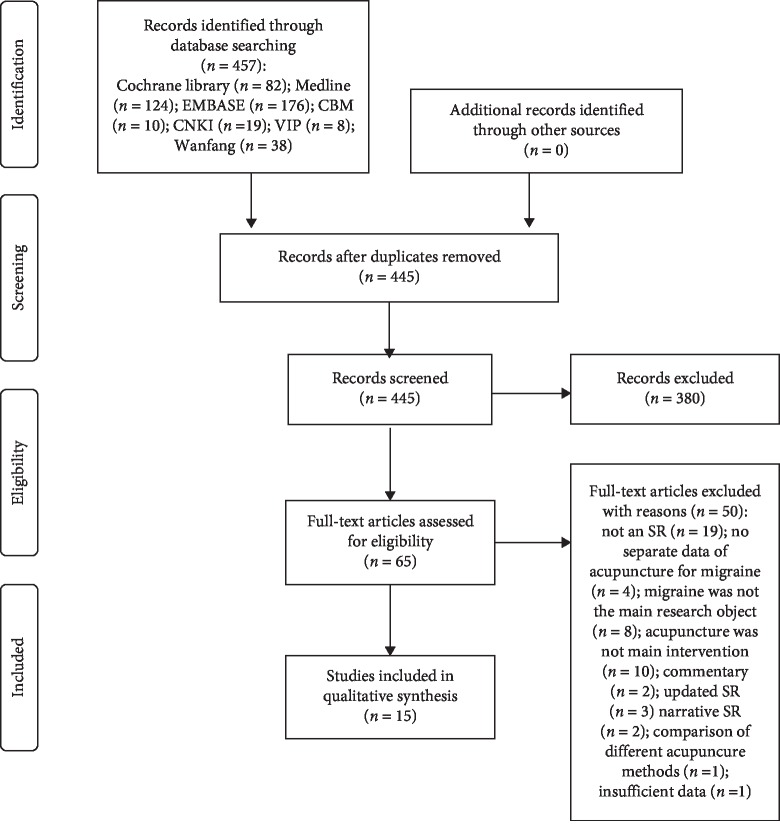
To summarize and critically assess the quality of relevant SRs and present an objective and comprehensive evidence on the effectiveness and safety of acupuncture for migraine. . MEDLINE, Embase, Cochrane Library, PROSPERO database, Chinese National Knowledge Infrastructure (CNKI), Chinese Biological Medicine (CBM), China Science and Technology Journal (SCTJ), and WanFang database (WF) were searched from inception to December 2019 and grey literatures were manually searched. . SRs which meet the criteria were independently selected by 2 reviewers according to a predetermined protocol. . Characteristics of included SRs were independently extracted by 2 reviewers following a predefined data extraction form. . The methodological quality, risk of bias, and reporting quality of included SRs were assessed, respectively, by a Measurement Tool to Assess Systematic Reviews (AMSTAR) 2, the Risk of Bias in Systematic reviews (ROBIS) tool, and the Preferred Reporting Item for Systematic Review and Meta-analysis-Acupuncture (PRISMA-A) statement. The quality of outcomes was evaluated by the Grading of Recommendations Assessment, Development, and Evaluation (GRADE).
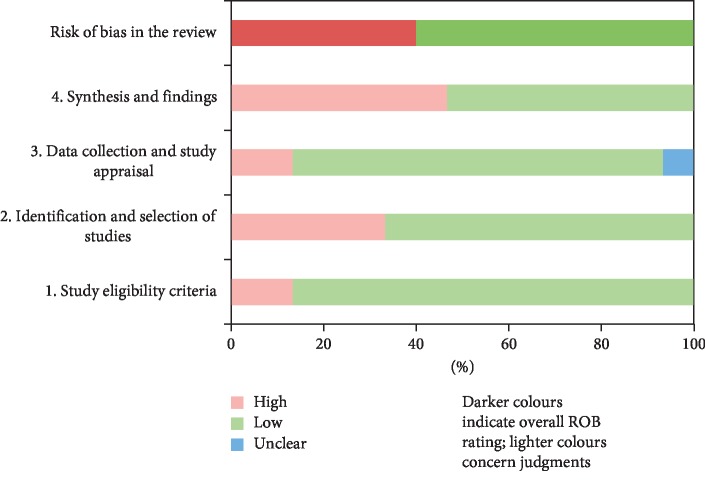
A total of 15 SRs were included. All the SRs were published between 2011-2019. Based on AMSTAR 2, 14 out of 15 SRs were rated critically low quality and 1 was rated low quality. According to ROBIS tool, 9 SRs (60%) were low risk of bias. With the PRISMA-A checklist, we found 11 out of 15 SRs were found adequately reported over 70%. With the GRADE tool, we found high quality of evidence indicated that the effective rate of acupuncture was superior to western medicine in treatment of migraine. Besides, acupuncture reduced more headache days and the times of using painkiller and was more effective in reducing the frequency and degree of headache than western medicine and sham acupuncture. . There might be some missing information. The accuracy of the conclusions may be decreased reduced since we were unable to synthesis all the evidence.
Based on high quality of evidence, we concluded that acupuncture may be an effective and safe therapy for migraine. However, the quality of SRs in acupuncture for migraine still needs more improvement.
偏头痛是一种常见的神经系统疾病,给全球个人和社会带来负担。针灸作为中医的一种重要方法,在临床实践中被广泛用于治疗偏头痛。多项系统评价(SRs)已对针灸治疗偏头痛的有效性和安全性进行了研究。
总结并严格评估相关SRs的质量,提供关于针灸治疗偏头痛有效性和安全性的客观、全面证据。从建库至2019年12月检索了MEDLINE、Embase、Cochrane图书馆、PROSPERO数据库、中国知网(CNKI)、中国生物医学文献数据库(CBM)、中国科技期刊数据库(SCTJ)和万方数据库(WF),并手工检索了灰色文献。符合标准的SRs由2名评价员根据预定方案独立选择。纳入的SRs的特征由2名评价员按照预定义的数据提取表独立提取。分别使用系统评价评估测量工具(AMSTAR)2、系统评价中的偏倚风险(ROBIS)工具和系统评价与Meta分析-针灸的首选报告项目(PRISMA-A)声明对纳入的SRs的方法学质量、偏倚风险和报告质量进行评估。通过推荐分级的评估、制定和评价(GRADE)对结果质量进行评价。
共纳入15项SRs。所有SRs均发表于2011 - 2019年。基于AMSTAR 2,15项SRs中有14项被评为极低质量等级,1项被评为低质量等级。根据ROBIS工具,9项SRs(60%)偏倚风险较低。根据PRISMA-A清单,我们发现15项SRs中有11项(超过70%)报告充分。使用GRADE工具,我们发现高质量证据表明针灸治疗偏头痛的有效率优于西药。此外,针灸减少了更多的头痛天数和止痛药使用次数,在减少头痛频率和程度方面比西药和假针灸更有效。可能存在一些信息缺失。由于我们无法综合所有证据,结论的准确性可能会降低。
基于高质量证据,我们得出结论,针灸可能是一种治疗偏头痛有效且安全的疗法。然而,针灸治疗偏头痛的SRs质量仍需进一步提高。