Hwang Inseok, Jin Ze, Park Je-Wook, Kwon Oh-Seok, Lim Byounghyun, Hong Myunghee, Kim Min, Yu Hee-Tae, Kim Tae-Hoon, Uhm Jae-Sun, Joung Boyoung, Lee Moon-Hyoung, Pak Hui-Nam
Yonsei University Health System, Seoul, South Korea.
Front Physiol. 2021 May 13;12:650449. doi: 10.3389/fphys.2021.650449. eCollection 2021.
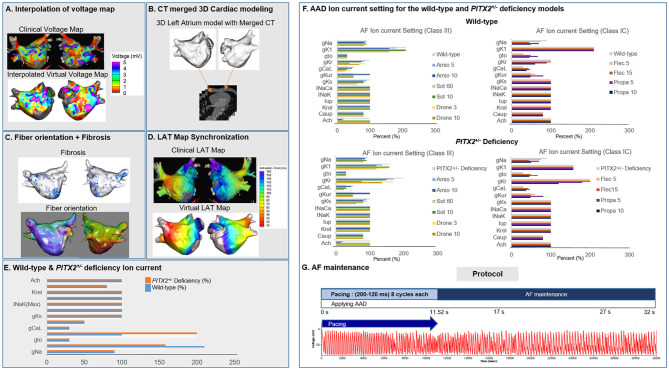
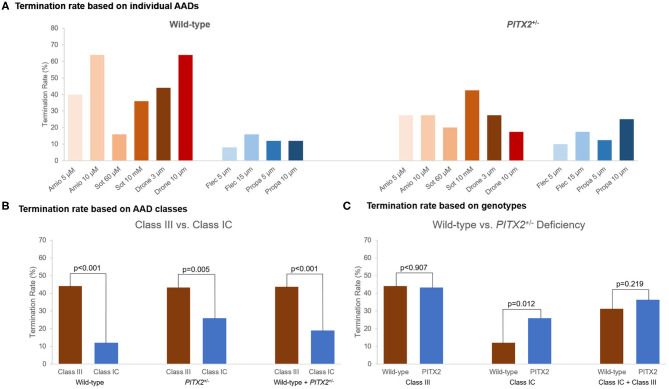
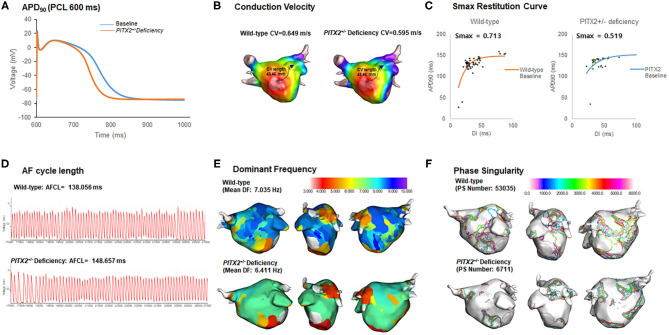
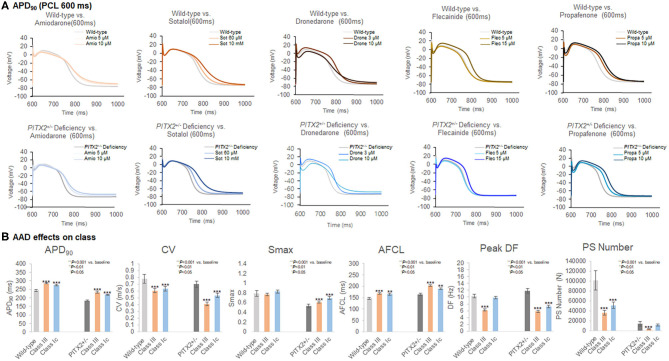
The efficacy of antiarrhythmic drugs (AAD) can vary in patients with atrial fibrillation (AF), and the gene affects the responsiveness of AADs. We explored the virtual AAD (V-AAD) responses between wild-type and -deficient AF conditions by realistic AF modeling. We tested the V-AADs in AF modeling integrated with patients' 3D-computed tomography and 3D-electroanatomical mapping, acquired in 25 patients (68% male, 59.8 ± 9.8 years old, 32.0% paroxysmal type). The ion currents for the deficiency and each AAD (amiodarone, sotalol, dronedarone, flecainide, and propafenone) were defined based on previous publications. We compared the wild-type and deficiency in terms of the action potential duration (APD), conduction velocity (CV), maximal slope of restitution (Smax), and wave-dynamic parameters, such as the dominant frequency (DF), phase singularities (PS), and AF termination rates according to the V-AADs. The -deficient model exhibited a shorter APD ( < 0.001), a lower Smax ( < 0.001), mean DF ( = 0.012), PS number ( < 0.001), and a longer AF cycle length (AFCL, = 0.011). Five V-AADs changed the electrophysiology in a dose-dependent manner. AAD-induced AFCL lengthening ( < 0.001) and reductions in the CV ( = 0.033), peak DF ( < 0.001), and PS number ( < 0.001) were more significant in -deficient than wild-type AF. -deficient AF was easier to terminate with class IC AADs than the wild-type AF ( = 0.018). The computational modeling-guided AAD test was feasible for evaluating the efficacy of multiple AADs in patients with AF. AF wave-dynamic and electrophysiological characteristics are different among the -deficient and the wild-type genotype models.
抗心律失常药物(AAD)在心房颤动(AF)患者中的疗效可能会有所不同,并且基因会影响AAD的反应性。我们通过逼真的AF建模探索了野生型和缺乏型AF条件下的虚拟AAD(V-AAD)反应。我们在25例患者(68%为男性,年龄59.8±9.8岁,32.0%为阵发性类型)中,对结合患者三维计算机断层扫描和三维电解剖标测的AF建模中的V-AAD进行了测试。基于先前的出版物定义了缺乏型和每种AAD(胺碘酮、索他洛尔、决奈达隆、氟卡尼和普罗帕酮)的离子电流。我们根据V-AAD比较了野生型和缺乏型在动作电位持续时间(APD)、传导速度(CV)、最大恢复斜率(Smax)以及波动态参数(如主导频率(DF)、相位奇点(PS)和AF终止率)方面的差异。缺乏型模型表现出较短的APD(P<0.001)、较低的Smax(P<0.001)、平均DF(P = 0.012)、PS数量(P<0.001)以及较长的AF周期长度(AFCL,P = 0.011)。五种V-AAD以剂量依赖的方式改变了电生理。AAD诱导的AFCL延长(P<0.001)以及CV降低(P = 0.033)、峰值DF降低(P<0.001)和PS数量降低(P<0.001)在缺乏型AF中比野生型AF更显著。与野生型AF相比,缺乏型AF更容易被IC类AAD终止(P = 0.018)。计算建模指导的AAD测试对于评估多种AAD在AF患者中的疗效是可行的。缺乏型和野生型基因型模型之间的AF波动态和电生理特征不同。