Yonsei University Health System, Seoul, Republic of Korea.
Sci Rep. 2020 Feb 12;10(1):2417. doi: 10.1038/s41598-020-59372-x.
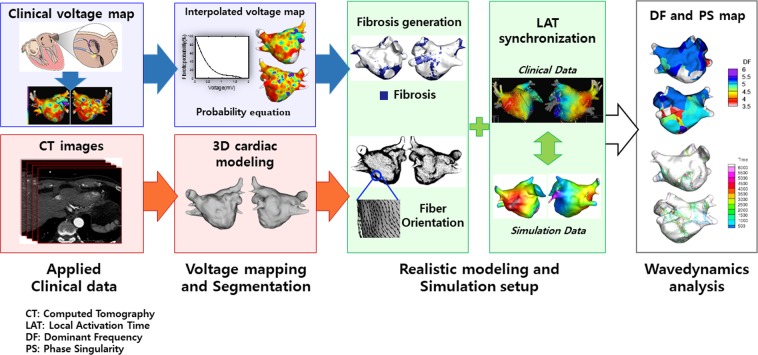
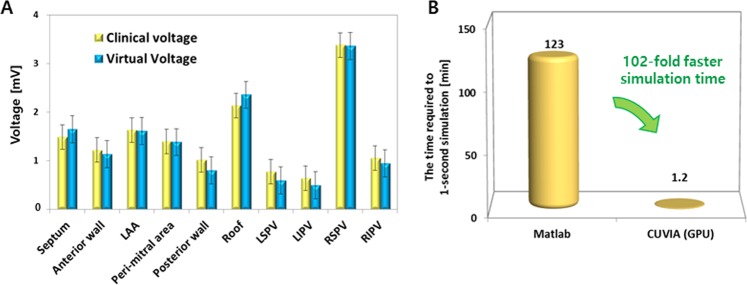
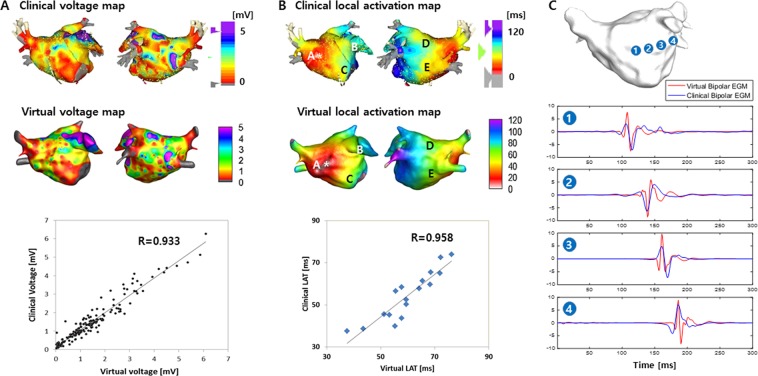
We previously reported the feasibility and efficacy of a simulation-guided clinical catheter ablation of atrial fibrillation (AF) in an in-silico AF model. We developed a highly efficient realistic AF model reflecting the patient endocardial voltage and local conduction and tested its clinical feasibility. We acquired > 500 endocardial bipolar electrograms during right atrial pacing at the beginning of the AF ablation procedures. Based on the clinical bipolar electrograms, we generated simulated voltage maps by applying fibrosis and local activation maps adjusted for the fiber orientation. The software's accuracy (CUVIA2.5) was retrospectively tested in 17 patients and feasibility prospectively in 10 during clinical AF ablation. Results: We found excellent correlations between the clinical and simulated voltage maps (R = 0.933, p < 0.001) and clinical and virtual local conduction (R = 0.958, p < 0.001). The proportion of virtual local fibrosis was 15.4, 22.2, and 36.9% in the paroxysmal AF, persistent AF, and post-pulmonary vein isolation (PVI) states, respectively. The reconstructed virtual bipolar electrogram exhibited a relatively good similarities of morphology to the local clinical bipolar electrogram (R = 0.60 ± 0.08, p < 0.001). Feasibility testing revealed an in situ procedural computing time from the clinical data acquisition to wave-dynamics analyses of 48.2 ± 4.9 min. All virtual analyses were successfully achieved during clinical PVI procedures. We developed a highly efficient, realistic, in situ procedural simulation model reflective of individual anatomy, fiber orientation, fibrosis, and electrophysiology that can be applied during AF ablation.
我们之前报道了在计算机模拟房颤(AF)模型中指导临床导管消融房颤的可行性和疗效。我们开发了一种高效的真实 AF 模型,反映了患者心内膜电压和局部传导,并测试了其临床可行性。我们在 AF 消融程序开始时在右心房起搏期间获取了超过 500 个心内膜双极电图。基于临床双极电图,我们通过应用纤维化和针对纤维方向调整的局部激活图来生成模拟电压图。该软件的准确性(CUVIA2.5)在 17 名患者中进行了回顾性测试,并在 10 名患者中进行了前瞻性可行性测试。结果:我们发现临床和模拟电压图之间存在极好的相关性(R=0.933,p<0.001)和临床与虚拟局部传导之间的相关性(R=0.958,p<0.001)。阵发性 AF、持续性 AF 和肺静脉隔离(PVI)后分别有 15.4%、22.2%和 36.9%的虚拟局部纤维化。重建的虚拟双极电图在形态上与局部临床双极电图具有较好的相似性(R=0.60±0.08,p<0.001)。可行性测试显示,从临床数据采集到波动力学分析的现场程序计算时间为 48.2±4.9 分钟。所有虚拟分析都在临床 PVI 过程中成功完成。我们开发了一种高效、真实的原位程序模拟模型,反映了个体解剖结构、纤维方向、纤维化和电生理学,可应用于 AF 消融。