Faculty of Medicine, Imperial College London, London, United Kingdom.
Front Immunol. 2021 May 14;12:661875. doi: 10.3389/fimmu.2021.661875. eCollection 2021.
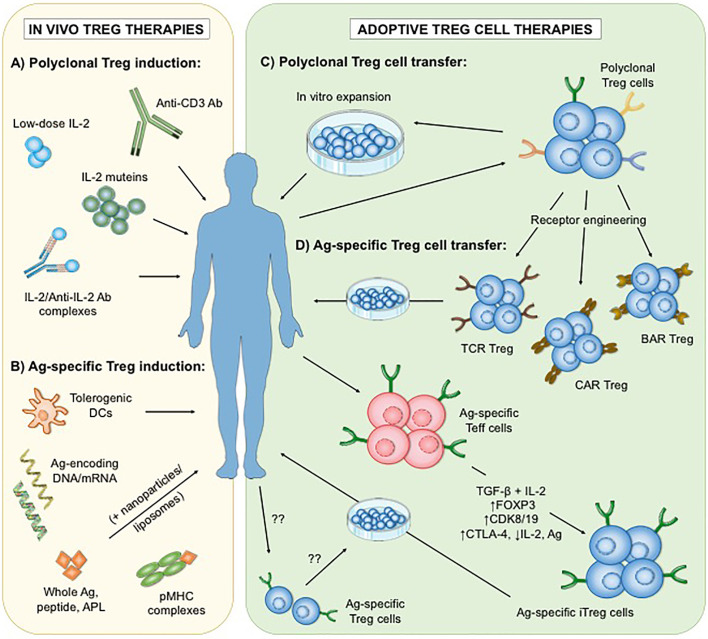
Regulatory T (Treg) cells are a heterogenous population of immunosuppressive T cells whose therapeutic potential for the treatment of autoimmune diseases and graft rejection is currently being explored. While clinical trial results thus far support the safety and efficacy of adoptive therapies using polyclonal Treg cells, some studies suggest that antigen-specific Treg cells are more potent in regulating and improving immune tolerance in a disease-specific manner. Hence, several approaches to generate and/or expand antigen-specific Treg cells or are currently under investigation. However, antigen-specific Treg cell therapies face additional challenges that require further consideration, including the identification of disease-relevant antigens as well as the stability and migratory behavior of Treg cells following transfer. In this review, we discuss these approaches and the potential limitations and describe prospective strategies to enhance the efficacy of antigen-specific Treg cell treatments in autoimmunity and transplantation.
调节性 T(Treg)细胞是一群具有免疫抑制功能的异质性 T 细胞,其在治疗自身免疫性疾病和移植物排斥反应方面的治疗潜力正在被探索。虽然迄今为止的临床试验结果支持使用多克隆 Treg 细胞的过继治疗的安全性和有效性,但一些研究表明,抗原特异性 Treg 细胞在以疾病特异性方式调节和改善免疫耐受方面更有效。因此,目前正在研究几种生成和/或扩增抗原特异性 Treg 细胞的方法。然而,抗原特异性 Treg 细胞疗法面临着需要进一步考虑的额外挑战,包括鉴定与疾病相关的抗原以及 Treg 细胞在转移后的稳定性和迁移行为。在这篇综述中,我们讨论了这些方法以及潜在的局限性,并描述了增强抗原特异性 Treg 细胞治疗自身免疫和移植的疗效的前瞻性策略。