Williamson Hannah C, Lavner Justin A
The University of Texas at Austin.
University of Georgia.
Soc Psychol Personal Sci. 2020 Jul;11(5):597-604. doi: 10.1177/1948550619865056. Epub 2019 Aug 29.
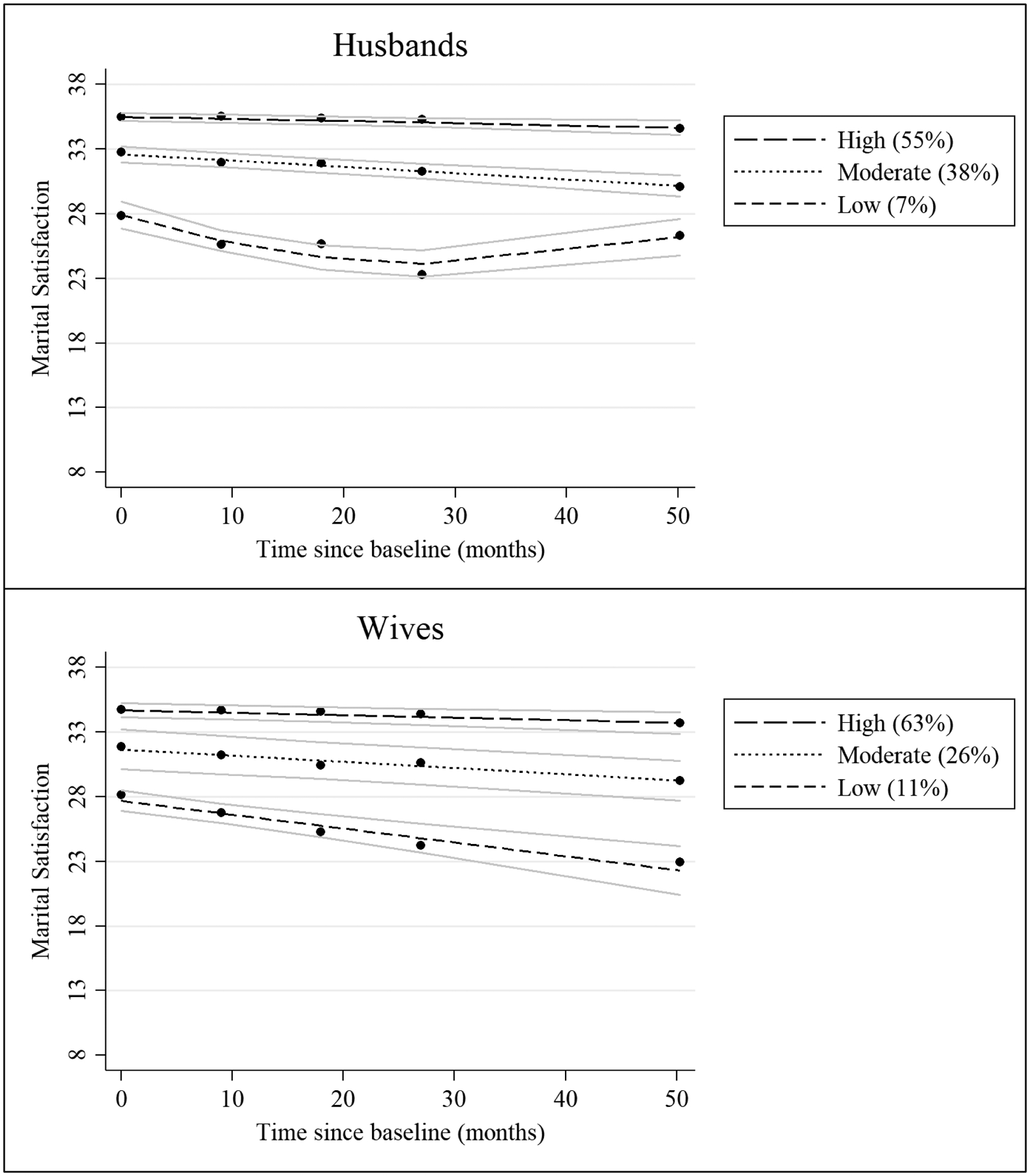
Couples' marital satisfaction is thought to decline over the newlywed years, but recent research indicates that the majority of spouses have high, stable trajectories during this period and significant declines occur only among initially dissatisfied spouses. These findings are drawn from predominantly White, middle-class samples, however, which may over-estimate marital stability compared to samples with higher levels of sociodemographic risk. Accordingly, the current study tested the generalizability of newlyweds' marital stability by examining satisfaction trajectories among 431 ethnically diverse newlywed couples living in low-income neighborhoods. Consistent with previous work, most spouses had high levels of satisfaction, substantial declines were limited to spouses with lower initial levels of satisfaction, and divorce significantly differed between groups. Wives with higher levels of sociodemographic risk started marriage less satisfied and declined more in satisfaction. Overall, these findings reveal risky and resilient relationships among disadvantaged couples, with considerable stability during the newlywed years.
夫妻的婚姻满意度被认为会在新婚几年中下降,但最近的研究表明,在此期间,大多数配偶的婚姻满意度呈高且稳定的轨迹,只有最初不满意的配偶的满意度才会大幅下降。然而,这些发现主要来自白人中产阶级样本,与具有较高社会人口风险水平的样本相比,这可能高估了婚姻稳定性。因此,本研究通过调查431对居住在低收入社区的不同种族新婚夫妇的满意度轨迹,检验了新婚夫妇婚姻稳定性的普遍性。与之前的研究一致,大多数配偶的满意度较高,大幅下降仅限于初始满意度较低的配偶,且不同群体间的离婚率存在显著差异。社会人口风险较高的妻子在婚姻开始时满意度较低,且满意度下降幅度更大。总体而言,这些发现揭示了弱势夫妻间有风险和有韧性的关系,在新婚期间具有相当的稳定性。