Wang Xinghao, Wu Ke, Li Xiaoran, Jin Junjie, Yu Yang, Sun Hongzan
Department of Radiology, Shengjing Hospital of China Medical University, Shenyang, China.
Liaoning Provincial Key Laboratory of Medical Imaging Department of Radiology, Shenyang, China.
Front Oncol. 2021 May 12;11:595430. doi: 10.3389/fonc.2021.595430. eCollection 2021.
We aim to compare the radiomic features and parameters on 2-deoxy-2-[fluorine-] fluoro-D-glucose (18F-FDG) positron emission tomography/computed tomography (PET/CT) between patients with endometrial cancer with Lynch syndrome and those with endometrial cancer without Lynch syndrome. We also hope to explore the biologic significance of selected radiomic features.
We conducted a retrospective cohort study, first using the 18F-FDG PET/CT images and clinical data from 100 patients with endometrial cancer to construct a training group (70 patients) and a test group (30 patients). The metabolic parameters and radiomic features of each tumor were compared between patients with and without Lynch syndrome. An independent cohort of 23 patients with solid tumors was used to evaluate the value of selected radiomic features in predicting the expression of the programmed cell death 1 (PD1), using 18F-FDG PET/CT images and RNA-seq genomic data.
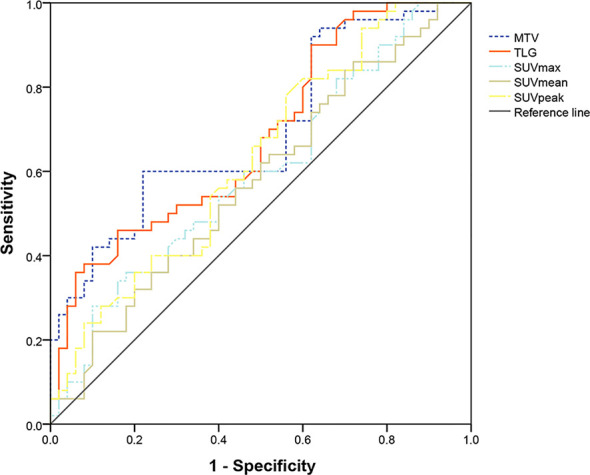
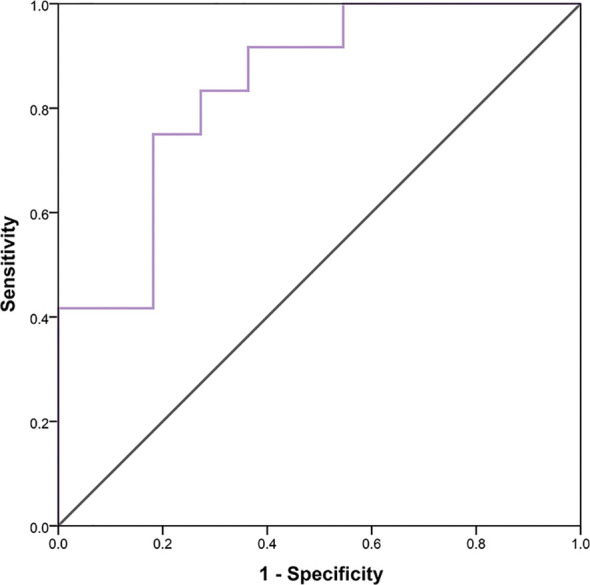
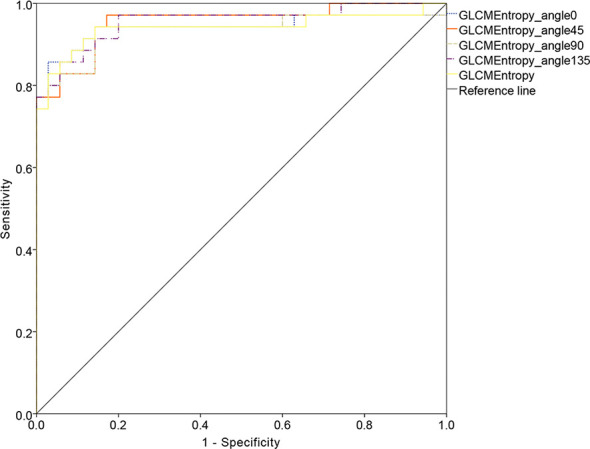
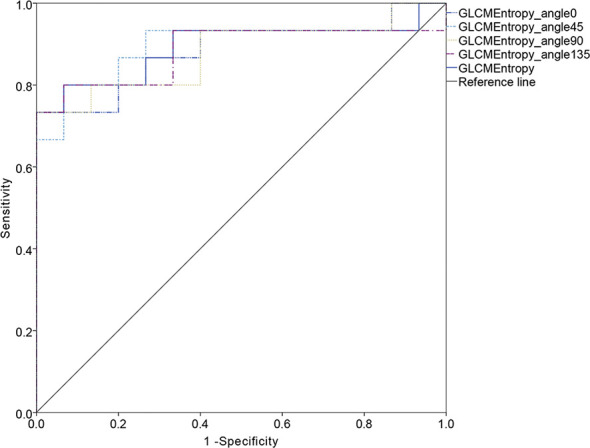
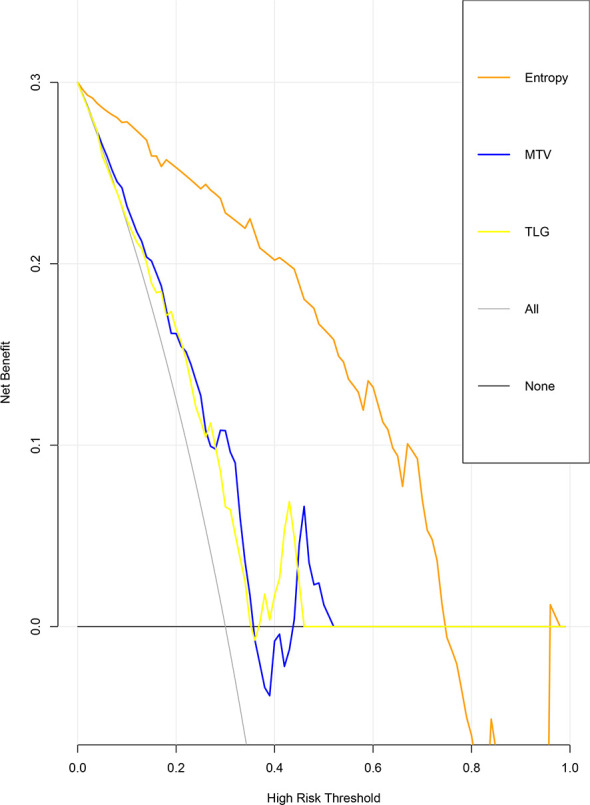
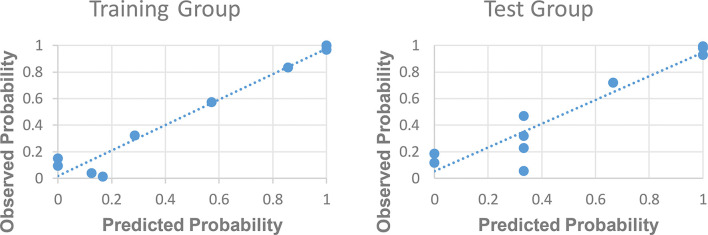
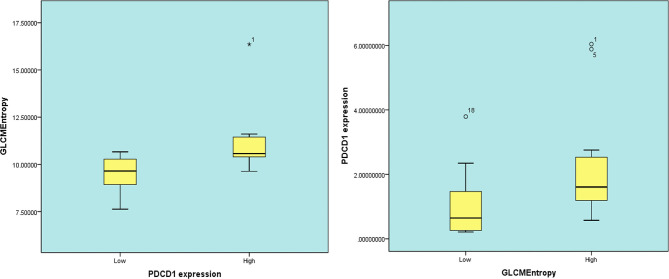
There was no statistically significant difference in the standardized uptake values on PET between patients with endometrial cancer with Lynch syndrome and those with endometrial cancer without Lynch syndrome. However, there were significant differences between the 2 groups in metabolic tumor volume and total lesion glycolysis ( < 0.005). There was a difference in the radiomic feature of gray level co-occurrence matrix entropy (GLCMEntropy; < 0.001) between the groups: the area under the curve was 0.94 in the training group (sensitivity, 82.86%; specificity, 97.14%) and 0.893 in the test group (sensitivity, 80%; specificity, 93.33%). In the independent cohort of 23 patients, differences in GLCMEntropy were related to the expression of PD1 (r =0.577; < 0.001).
In patients with endometrial cancer, higher metabolic tumor volumes, total lesion glycolysis values, and GLCMEntropy values on 18F-FDG PET/CT could suggest a higher risk for Lynch syndrome. The radiomic feature of GLCMEntropy for tumors is a potential predictor of PD1 expression.
我们旨在比较林奇综合征子宫内膜癌患者与非林奇综合征子宫内膜癌患者在2-脱氧-2-[氟-]氟-D-葡萄糖(18F-FDG)正电子发射断层扫描/计算机断层扫描(PET/CT)上的放射组学特征和参数。我们还希望探索所选放射组学特征的生物学意义。
我们进行了一项回顾性队列研究,首先使用100例子宫内膜癌患者的18F-FDG PET/CT图像和临床数据构建一个训练组(70例患者)和一个测试组(30例患者)。比较有和没有林奇综合征患者的每个肿瘤的代谢参数和放射组学特征。使用18F-FDG PET/CT图像和RNA测序基因组数据,以一个由23例实体瘤患者组成的独立队列来评估所选放射组学特征在预测程序性细胞死亡蛋白1(PD1)表达方面的价值。
林奇综合征子宫内膜癌患者与非林奇综合征子宫内膜癌患者在PET上的标准化摄取值无统计学显著差异。然而,两组在代谢肿瘤体积和总病灶糖酵解方面存在显著差异(<0.005)。两组之间在灰度共生矩阵熵(GLCMEntropy)的放射组学特征上存在差异(<0.001):训练组曲线下面积为0.94(敏感性,82.86%;特异性,97.14%),测试组为0.893(敏感性,80%;特异性,93.33%)。在23例患者的独立队列中,GLCMEntropy的差异与PD1的表达相关(r =0.577;<0.001)。
在子宫内膜癌患者中,18F-FDG PET/CT上较高的代谢肿瘤体积、总病灶糖酵解值和GLCMEntropy值可能提示林奇综合征风险较高。肿瘤的GLCMEntropy放射组学特征是PD1表达的潜在预测指标。