Vandeborne Liese, Pantziarka Pan, Van Nuffel An M T, Bouche Gauthier
The Anticancer Fund, Strombeek-Bever, Belgium.
Front Oncol. 2021 May 13;11:688755. doi: 10.3389/fonc.2021.688755. eCollection 2021.
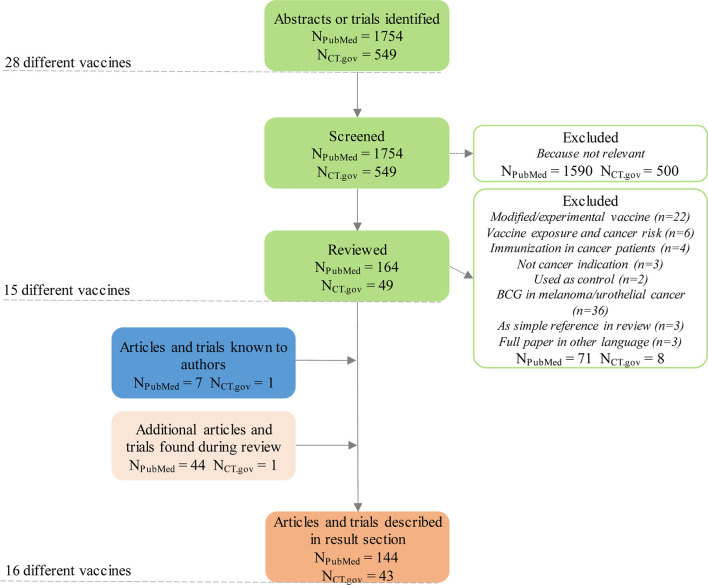
Vaccines used to prevent infections have long been known to stimulate immune responses to cancer as illustrated by the approval of the Bacillus Calmette-Guérin (BCG) vaccine to treat bladder cancer since the 1970s. The recent approval of immunotherapies has rejuvenated this research area with reports of anti-tumor responses with existing infectious diseases vaccines used as such, either alone or in combination with immune checkpoint inhibitors. Here, we have reviewed and summarized research activities using approved vaccines to treat cancer. Data supporting a cancer therapeutic use was found for 16 vaccines. For 10 (BCG, diphtheria, tetanus, human papillomavirus, influenza, measles, pneumococcus, smallpox, typhoid and varicella-zoster), clinical trials have been conducted or are ongoing. Within the remaining 6, preclinical evidence supports further evaluation of the rotavirus, yellow fever and pertussis vaccine in carefully designed clinical trials. The mechanistic evidence for the cholera vaccine, combined with the observational data in colorectal cancer, is also supportive of clinical translation. There is limited data for the hepatitis B and mumps vaccine (without measles vaccine). Four findings are worth highlighting: the superiority of intravesical typhoid vaccine instillations over BCG in a preclinical bladder cancer model, which is now the subject of a phase I trial; the perioperative use of the influenza vaccine to limit and prevent the natural killer cell dysfunction induced by cancer surgery; objective responses following intratumoral injections of measles vaccine in cutaneous T-cell lymphoma; objective responses induced by human papillomavirus vaccine in cutaneous squamous cell carcinoma. All vaccines are intended to induce or improve an anti-tumor (immune) response. In addition to the biological and immunological mechanisms that vary between vaccines, the mode of administration and sequence with other (immuno-)therapies warrant more attention in future research.
长期以来,人们一直知道用于预防感染的疫苗能够刺激针对癌症的免疫反应,自20世纪70年代卡介苗(BCG)疫苗被批准用于治疗膀胱癌就已得到证明。免疫疗法的近期获批使这一研究领域重焕生机,有报道称现有的传染病疫苗单独或与免疫检查点抑制剂联合使用时会产生抗肿瘤反应。在此,我们回顾并总结了使用获批疫苗治疗癌症的研究活动。发现有16种疫苗有支持其用于癌症治疗的数据。其中10种(卡介苗、白喉、破伤风、人乳头瘤病毒、流感、麻疹、肺炎球菌、天花、伤寒和水痘 - 带状疱疹)已进行或正在进行临床试验。在其余6种中,临床前证据支持在精心设计的临床试验中对轮状病毒、黄热病和百日咳疫苗进行进一步评估。霍乱疫苗的机制证据,结合在结直肠癌中的观察数据,也支持进行临床转化。关于乙肝疫苗和腮腺炎疫苗(不含麻疹疫苗)的数据有限。有四项发现值得强调:在临床前膀胱癌模型中,膀胱内注射伤寒疫苗优于卡介苗,目前这是一项I期试验的研究对象;围手术期使用流感疫苗以限制和预防癌症手术引起的自然杀伤细胞功能障碍;瘤内注射麻疹疫苗后皮肤T细胞淋巴瘤出现客观反应;人乳头瘤病毒疫苗在皮肤鳞状细胞癌中诱导出客观反应。所有疫苗都旨在诱导或改善抗肿瘤(免疫)反应。除了不同疫苗之间存在差异的生物学和免疫学机制外,给药方式以及与其他(免疫)疗法的联合顺序在未来研究中值得更多关注。