Chai C A, Yeoh W S, Rajandram R, Aung K P, Ong T A, Kuppusamy S, Nazran A, Kumaran K, Razack A H A, Teoh J Y
Urology Division, Department of Surgery, Faculty of Medicine, University of Malaya, Kuala Lumpur, Malaysia.
S.H. Ho Urology Centre, Department of Surgery, The Chinese University of Hong Kong, Hong Kong, China.
Front Surg. 2021 May 13;8:659292. doi: 10.3389/fsurg.2021.659292. eCollection 2021.
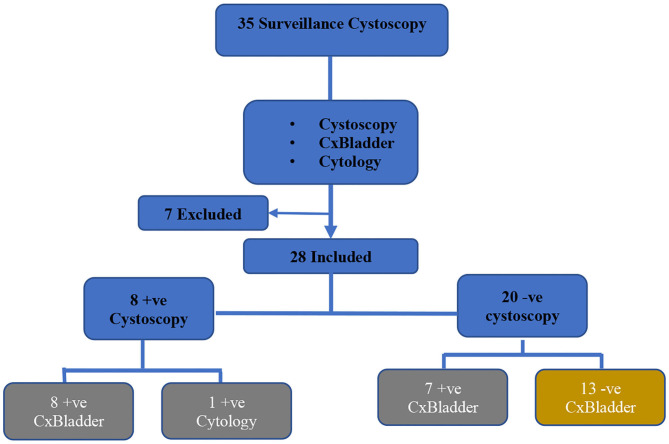
Guidelines advocate cystoscopy surveillance (CS) for non-muscle invasive bladder cancer (NMIBC) post-resection. However, cystoscopy is operator dependent and may miss upper tract lesions or carcinoma (CIS). Urine cytology is a common adjunct but lacks sensitivity and specificity in detecting recurrence. A new mRNA biomarker (CxBladder) was compared with urine cytology as an adjunct to cystoscopy in detecting a positive cystoscopy findings during surveillance cystoscopy in our center. Consented patients older than 18, undergoing CS for NMIBC, provide paired urine samples for cytology and CxBladder test. Patients with positive cystoscopy findings would undergo re-Trans Urethral Resection of Bladder Tumor (TURBT). Thirty-five patients were enrolled from April to June 2019. Seven contaminated urine samples were excluded. The remaining cohort of 23 (82%) and 5 (18%) females had a mean age of 66.69 (36-89). Eight (29%) patients with positive cystoscopy finding underwent TURBT. All 8 patients also had positive CxBladder result. This shows that CxBladder has a sensitivity and negative predictive value (NPV) of 100%, specificity of 75% and positive predictive value (PPV) of 62% in predicting a positive cystoscopy finding. TURBT Histo-pathological findings showed Low-grade Ta NMIBC in one patient (4%), and 7 (25%) patients had inflammatory changes. Urine cytology was only positive in one patient with a positive cystoscopy finding. This led to a sensitivity of merely 13% and NPV of 74%, while specificity and PPV was 100% in predicting a positive cystoscopy finding. CxBladder had high NPV and sensitivity which accurately predicted suspicious cystoscopy findings leading to further investigation. It has great potential for use as adjunct to cystoscopy for surveillance of NMIBC.
指南提倡对非肌层浸润性膀胱癌(NMIBC)切除术后进行膀胱镜监测(CS)。然而,膀胱镜检查依赖于操作者,且可能会遗漏上尿路病变或原位癌(CIS)。尿细胞学检查是一种常见的辅助检查,但在检测复发方面缺乏敏感性和特异性。在我们中心,一种新的mRNA生物标志物(CxBladder)与尿细胞学检查作为膀胱镜检查的辅助手段,用于在监测膀胱镜检查期间检测膀胱镜检查阳性结果。年龄超过18岁、因NMIBC接受CS的同意患者,提供配对的尿液样本进行细胞学检查和CxBladder检测。膀胱镜检查结果阳性的患者将接受再次经尿道膀胱肿瘤切除术(TURBT)。2019年4月至6月招募了35名患者。排除7份受污染的尿液样本。其余队列包括23名(82%)男性和5名(18%)女性,平均年龄为66.69岁(36 - 89岁)。8名(29%)膀胱镜检查结果阳性的患者接受了TURBT。所有8名患者的CxBladder结果也为阳性。这表明CxBladder在预测膀胱镜检查阳性结果方面的敏感性和阴性预测值(NPV)为100%,特异性为75%,阳性预测值(PPV)为62%。TURBT组织病理学结果显示,1名患者(4%)为低级别Ta NMIBC,7名(25%)患者有炎症改变。尿细胞学检查仅在1名膀胱镜检查结果阳性的患者中呈阳性。这导致其在预测膀胱镜检查阳性结果时的敏感性仅为13%,NPV为74%,而特异性和PPV为100%。CxBladder具有较高的NPV和敏感性,能够准确预测可疑的膀胱镜检查结果,从而进行进一步检查。它作为膀胱镜检查的辅助手段用于监测NMIBC具有很大的潜力。