Department of Human Genetics, Hannover Medical School, Hannover, Germany.
Institute of Hematology and Center for Hemato-Oncology Research, University and Hospital of Perugia, Perugia, Italy.
Fam Cancer. 2021 Oct;20(4):295-303. doi: 10.1007/s10689-021-00263-z. Epub 2021 May 31.
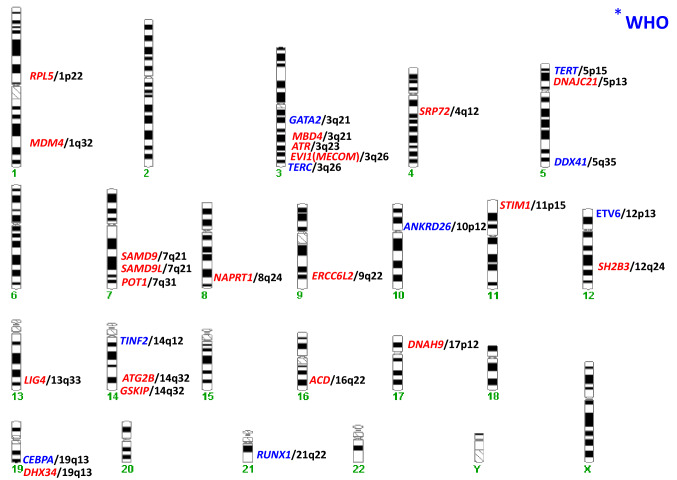
Since WHO has recognized myeloid neoplasms with germline predisposition as a new entity in 2016, it has become increasingly clear that diagnosing familial leukemia has critical implications for both the patient and his/her family, and that interdisciplinary teams of hematologists and clinical geneticists should provide care for this specific patient group. Here, we summarize consensus criteria for the identification and screening of patients with genetic predisposition for hematologic malignancies, as provided by different working groups, e.g. by the Nordic MDS group and the AACR. In addition to typical clinical features, results from targeted deep sequencing may point to a genetic predisposition. We review strategies to distinguish somatic and germline variants and discuss recommendations for genetic analyses aiming to identify the underlying genetic variant that should follow established quality criteria to detect both SNVs and CNVs and to determine the pathogenicity of genetic variants. To enhance the knowledge about hematologic neoplasms with germline predisposition we recommend archiving clinical and genetic data and archiving them in international registries.
自 2016 年世界卫生组织(WHO)将伴种系倾向的髓系肿瘤确认为一种新实体以来,越来越明显的是,诊断家族性白血病对患者及其家属都具有重要意义,血液学家和临床遗传学家的跨学科团队应为这一特定患者群体提供护理。在这里,我们总结了不同工作组(例如北欧 MDS 组和美国癌症研究协会)提供的用于鉴定和筛查遗传性血液恶性肿瘤易感性患者的共识标准。除了典型的临床特征外,靶向深度测序的结果也可能提示遗传易感性。我们回顾了区分体细胞和种系变异的策略,并讨论了遗传分析的建议,旨在确定潜在的遗传变异,这些建议应遵循既定的质量标准,以检测 SNV 和 CNV,并确定遗传变异的致病性。为了增强对伴种系倾向的血液肿瘤的认识,我们建议对临床和遗传数据进行存档,并将其存档于国际注册处。