Marsico Lung Institute/Cystic Fibrosis and Pulmonary Research Center, University of North Carolina at Chapel Hill, Chapel Hill, NC, USA.
Center for Environmental Medicine, Asthma, and Lung Biology, Division of Allergy and Immunology, University of North Carolina at Chapel Hill, Chapel Hill, NC, USA.
Lancet Respir Med. 2021 Nov;9(11):1241-1254. doi: 10.1016/S2213-2600(21)00079-5. Epub 2021 May 28.
We previously described the contributions of increased total airway mucin concentrations to the pathogenesis and diagnosis of the chronic bronchitic component of chronic obstructive pulmonary disease (COPD). Here, we investigated the relative contribution of each of the major airway gel-forming mucins, MUC5AC and MUC5B, to the initiation, progression, and early diagnosis of airways disease in COPD.
SPIROMICS was a multicentre, observational study in patients aged 40-80 years recruited from six clinical sites and additional subsites in the USA. In this analysis, MUC5AC and MUC5B were quantitated by stable isotope-labelled mass spectrometry in induced sputum samples from healthy never-smokers, ever-smokers at risk for COPD, and ever-smokers with COPD. Participants were extensively characterised using results from questionnaires, such as the COPD assessment test (CAT) and St George's Respiratory Questionnaire; quantitative CT, such as residual volume/total lung capacity ratio (RV/TLC) and parametric response mapping-functional small airway disease (PRM-fSAD); and pulmonary function tests, such as FEV, forced vital capacity (FVC), and forced expiratory flow, midexpiratory phase (FEF). Absolute concentrations of both MUC5AC and MUC5B were related to cross-sectional (baseline, initial visit) and 3-year follow-up longitudinal data, including lung function, small airways obstruction, prospective acute exacerbations, and smoking status as primary outcomes. This study is registered with ClinicalTrials.gov (NCT01969344).
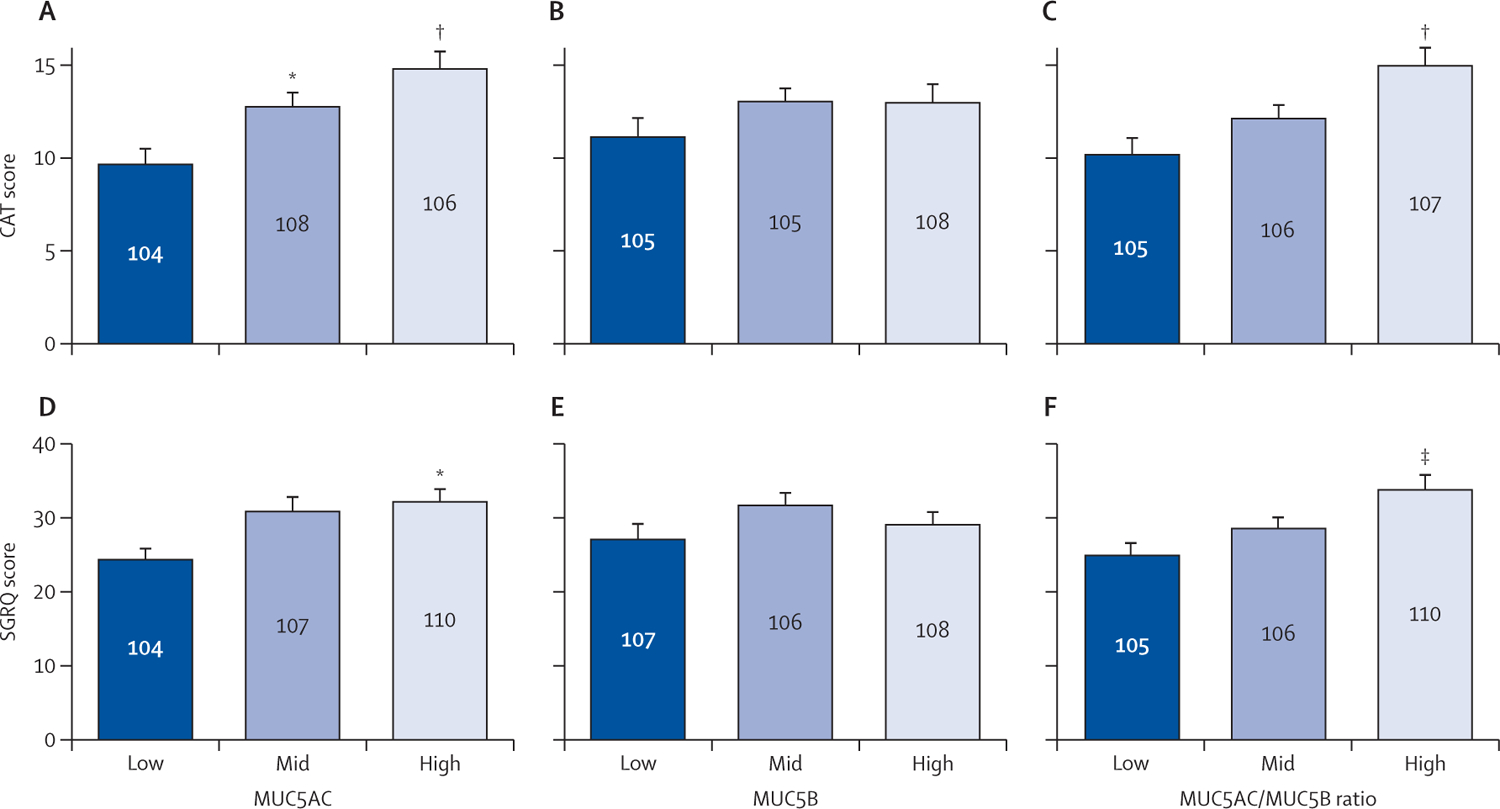
This analysis included 331 participants (mean age 63 years [SEM 9·40]), of whom 40 were healthy never-smokers, 90 were at-risk ever-smokers, and 201 were ever-smokers with COPD. Increased MUC5AC concentrations were more reliably associated with manifestations of COPD than were MUC5B concentrations, including decreased FEV and FEF, and increased prospective exacerbation frequency, RV/TLC, PRM-fSAD, and COPD assessment scores. MUC5AC concentrations were more reactive to cigarette smoke exposure than were MUC5B concentrations. Longitudinal data from 3-year follow-up visits generated a multivariate-adjusted odds ratio for two or more exacerbations of 1·24 (95% CI 1·04-1·47, p=0·015) for individuals with high baseline MUC5AC concentration. Increased MUC5AC, but not MUC5B, concentration at baseline was a significant predictor of FEV, FEV/FVC, FEF, and CAT score decline during the 3-year follow-up. Moreover, current smokers in the at-risk group showed raised MUC5AC concentrations at initial visits and decreased lung function over 3 years. By contrast, former smokers in the at-risk group showed normal MUC5AC concentrations at the initial visit and preserved lung function over 3 years.
These data indicate that increased MUC5AC concentration in the airways might contribute to COPD initiation, progression, exacerbation risk, and overall pathogenesis. Compared with MUC5B, greater relative changes in MUC5AC concentrations were observed as a function of COPD severity, and MUC5AC concentration seems to be an objective biomarker to detect disease in at-risk and pre-COPD individuals. These data suggest that MUC5AC-producing pathways could be potential targets for future therapeutic strategies. Thus, MUC5AC could be a novel biomarker for COPD prognosis and for testing the efficacy of therapeutic agents.
National Institutes of Health; National Heart, Lung, and Blood Institute.
我们之前描述了总气道黏蛋白浓度的增加对慢性阻塞性肺疾病(COPD)慢性支气管炎成分的发病机制和诊断的贡献。在这里,我们研究了主要气道凝胶形成黏蛋白 MUC5AC 和 MUC5B 中的每一种对 COPD 气道疾病的发生、进展和早期诊断的相对贡献。
SPIROMICS 是一项多中心、观察性研究,纳入了来自美国六个临床地点和其他亚地点的年龄在 40-80 岁的患者。在这项分析中,通过稳定同位素标记质谱法定量检测健康从不吸烟者、有 COPD 风险的吸烟者和有 COPD 的吸烟者诱导痰样本中的 MUC5AC 和 MUC5B。参与者通过问卷调查(如 COPD 评估测试(CAT)和圣乔治呼吸问卷)、定量 CT(如残气量/总肺容量比(RV/TLC)和参数反应映射-功能性小气道疾病(PRM-fSAD))和肺功能测试(如 FEV、用力肺活量(FVC)和用力呼气中期流速(FEF))等结果进行了广泛的特征描述。MUC5AC 和 MUC5B 的绝对浓度与横断面(基线、初次就诊)和 3 年随访纵向数据相关,包括肺功能、小气道阻塞、前瞻性急性加重和吸烟状况等主要结局。这项研究在 ClinicalTrials.gov (NCT01969344)注册。
这项分析包括 331 名参与者(平均年龄 63 岁[SEM 9.40]),其中 40 名是健康从不吸烟者,90 名是有 COPD 风险的吸烟者,201 名是有 COPD 的吸烟者。与 MUC5B 浓度相比,MUC5AC 浓度与 COPD 的表现更可靠地相关,包括 FEV 和 FEF 下降,以及前瞻性加重频率、RV/TLC、PRM-fSAD 和 COPD 评估评分增加。MUC5AC 浓度对香烟烟雾暴露的反应比 MUC5B 浓度更敏感。3 年随访的纵向数据生成了一个多变量调整的比值比,用于有或没有基线时高 MUC5AC 浓度的人有两个或更多次加重,比值比为 1.24(95%CI 1.04-1.47,p=0.015)。基线时升高的 MUC5AC 浓度是 FEV、FEV/FVC、FEF 和 CAT 评分在 3 年随访期间下降的显著预测因子。此外,高危组的当前吸烟者在初次就诊时显示出升高的 MUC5AC 浓度,并且在 3 年内肺功能下降。相比之下,高危组的前吸烟者在初次就诊时显示出正常的 MUC5AC 浓度,并且在 3 年内保持肺功能。
这些数据表明,气道中升高的 MUC5AC 浓度可能导致 COPD 的发生、进展、加重风险和整体发病机制。与 MUC5B 相比,MUC5AC 浓度的相对变化更大,作为 COPD 严重程度的函数,并且 MUC5AC 浓度似乎是检测高危和 COPD 前个体疾病的客观生物标志物。这些数据表明,MUC5AC 产生途径可能是未来治疗策略的潜在靶点。因此,MUC5AC 可以作为 COPD 预后和测试治疗药物疗效的新型生物标志物。
美国国立卫生研究院;美国国立心脏、肺和血液研究所。