Department of Epidemiology, University of North Carolina at Chapel Hill, Chapel Hill, NC, USA.
Department of Behavioral Science and Health Education, Saint Louis University, Saint Louis, MO, USA.
BMC Infect Dis. 2021 May 31;21(1):505. doi: 10.1186/s12879-021-06212-6.
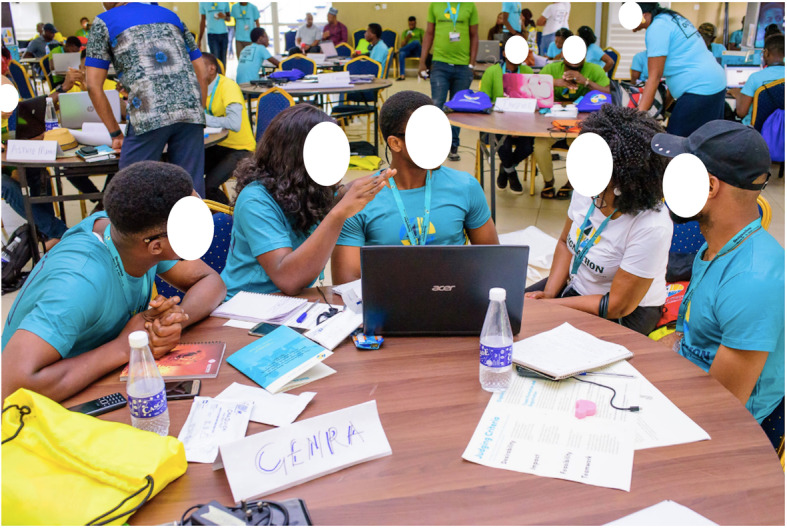
Youth are at high risk for HIV, but are often left out of designing interventions, including those focused on adolescents. We organized a designathon for Nigerian youth to develop HIV self-testing (HIVST) strategies for potential implementation in their local communities. A designathon is a problem-focused event where participants work together over a short period to create and present solutions to a judging panel.
We organized a 72-h designathon for youth (14-24 years old) in Nigeria to design strategies to increase youth HIVST uptake. Proposals included details about HIVST kit service delivery, method of distribution, promotional strategy, and youth audience. Teams pitched their proposals to a diverse seven-member judging panel who scored proposals based on desirability, feasibility, potential impact and teamwork. We examined participants' socio-demographic characteristics and summarized themes from their HIVST proposals.
Forty-two youth on 13 teams participated in the designathon. The median team size was 3 participants (IQR: 2-4). The median age was 22.5 years (IQR: 21-24), 66.7% were male, 47.4% completed tertiary education, and 50% lived in Lagos State. Themes from proposals included HIVST integration with other health services, digital marketing and distribution approaches, and engaging students. Judges identified seven teams with exceptional HIVST proposals and five teams were supported for further training.
The designathon provided a structured method for incorporating youth ideas into HIV service delivery. This approach could differentiate HIV services to be more youth-friendly in Nigeria and other settings.
年轻人感染艾滋病病毒的风险很高,但他们往往被排除在干预措施的设计之外,包括那些针对青少年的干预措施。我们组织了一次尼日利亚青年设计大赛,旨在为他们当地社区开发艾滋病病毒自我检测(HIVST)策略,这些策略可能会被采用。设计大赛是一个以问题为导向的活动,参与者在短时间内共同努力,为评审团创建和展示解决方案。
我们在尼日利亚为年轻人(14-24 岁)组织了一个为期 72 小时的设计大赛,以设计增加年轻人 HIVST 参与度的策略。提案包括有关 HIVST 试剂盒服务交付、分发方式、宣传策略和青年受众的详细信息。团队向由七名不同成员组成的评审团展示了他们的提案,并根据吸引力、可行性、潜在影响和团队合作对提案进行评分。我们检查了参与者的社会人口统计学特征,并总结了他们关于 HIVST 提案的主题。
42 名年轻人组成了 13 个团队参加了设计大赛。团队规模的中位数为 3 人(IQR:2-4)。中位数年龄为 22.5 岁(IQR:21-24),66.7%为男性,47.4%完成了高等教育,50%居住在拉各斯州。提案中的主题包括将 HIVST 与其他卫生服务相结合、数字营销和分发方法以及与学生的互动。评委确定了 7 个具有出色 HIVST 提案的团队,并为 5 个团队提供了进一步培训的支持。
设计大赛为将青年的想法纳入艾滋病病毒服务提供了一种结构化的方法。这种方法可以使尼日利亚和其他地区的艾滋病病毒服务更适合年轻人。