Tri-Chandra Multiple College, Tribhuvan University, Kathmandu, Nepal.
Amity Institute of Microbial Technology, Amity University Uttar Pradesh, Noida, UP, 201303, India.
Ann Clin Microbiol Antimicrob. 2021 May 31;20(1):41. doi: 10.1186/s12941-021-00447-6.
Coagulase-negative staphylococci (CNS) survive as commensals of skin, anterior nares and external canals of human and were regarded as non-infectious pathogens. However, they are emerging as a major cause of nosocomial infectious due to their ability to form biofilms and high resistance to several classes of antibiotics. This study examines the biofilm forming abilities of 214 clinical CNS isolates using phenotypic and genotypic methods, and determines their antibiotic susceptibility patterns.
A total of 214 clinical isolates collected from different clinical samples were identified as CNS and their antibiotic susceptibility determined by CLSI guidelines. The biofilm forming ability of all isolates was determined by three phenotypic methods; Congo red agar (CRA) method, tube adherence method (TM) and tissue culture plate (TCP) method and by genotypic method for the detection of icaAD genes.
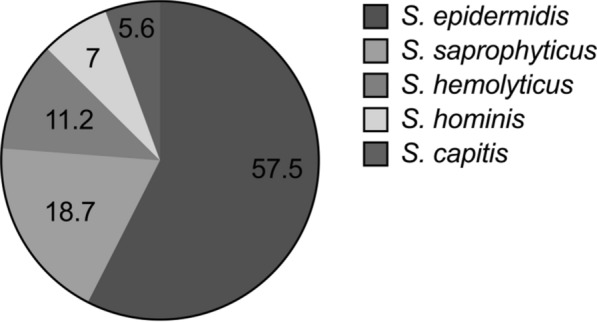
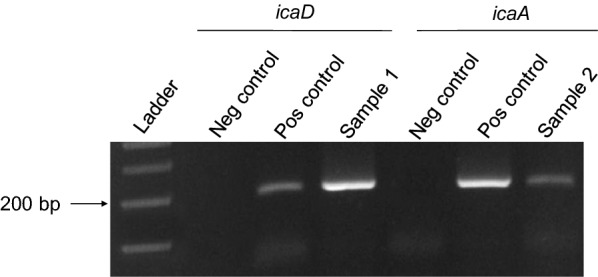
Among all the isolates, S. epidermidis (57.5%) was found the most frequently, followed by S. saprophyticus (18.7%), S. haemolyticus (11.2%), S. hominis (7%), and S. capitis (5.6%). Antibiotic susceptibility pattern demonstrated 91.6% isolates were resistant to penicillin and 66.8% to cefoxitin while 91.1% isolates were susceptible to chloramphenicol. Constitutive and inducible clindamycin resistant phenotype as measured by D-test was seen among 28% and 14.5% of isolates respectively. Tissue culture plate method detected biofilm production in 42.1% isolate followed by 31.8% through tube method while 20.1% isolates were found to produce slime in Congo red agar method. The genotypic assay revealed presence of icaA and icaD genes in 19.2% isolates.
The study shows a high prevalence of biofilm formation and inducible clindamycin resistance in CNS isolates, indicating the importance of in-vitro biofilm production test and D-test in routine laboratory diagnostics. Implementation of efficient diagnostic techniques for detection of biofilm production in clinical samples can help manage staphylococcal infections and minimize risks of treatment failures in hospitals.
凝固酶阴性葡萄球菌(CNS)作为人类皮肤、前鼻和外耳道的共生菌而存在,被认为是非传染性病原体。然而,由于它们能够形成生物膜和对几类抗生素具有高抗性,它们正成为医院感染的主要原因。本研究使用表型和基因型方法检查了 214 株临床 CNS 分离株的生物膜形成能力,并确定了它们的抗生素敏感性模式。
从不同临床标本中收集的 214 株临床分离株被鉴定为 CNS,并根据 CLSI 指南确定其抗生素敏感性。所有分离株的生物膜形成能力均通过三种表型方法(刚果红琼脂(CRA)法、管粘附法(TM)和组织培养板(TCP)法)和 icaAD 基因的基因型方法进行检测。
在所有分离株中,表皮葡萄球菌(57.5%)最为常见,其次是腐生葡萄球菌(18.7%)、溶血葡萄球菌(11.2%)、人葡萄球菌(7%)和头状葡萄球菌(5.6%)。抗生素敏感性模式显示,91.6%的分离株对青霉素耐药,66.8%对头孢西丁耐药,而 91.1%的分离株对氯霉素敏感。D 试验测定的固有和诱导性克林霉素耐药表型分别见于 28%和 14.5%的分离株。组织培养板法检测到 42.1%的分离株产生生物膜,其次是 31.8%的分离株通过管法,而 20.1%的分离株在刚果红琼脂法中产生粘液。基因检测显示,19.2%的分离株存在 icaA 和 icaD 基因。
该研究表明 CNS 分离株的生物膜形成和诱导性克林霉素耐药率较高,表明在常规实验室诊断中需要进行体外生物膜产生试验和 D 试验。实施有效的诊断技术检测临床样本中的生物膜产生,可以帮助管理葡萄球菌感染,并最大限度地减少医院治疗失败的风险。