Chen Da-Xia, Pan Yuan, Wang Yu, Cui Yan-Ze, Zhang Ying-Jun, Mo Rang-Yu, Wu Xiao-Li, Tan Jun, Zhang Jian, Guo Lian-An, Zhao Xiao, Jiang Wenkai, Sun Tian-Lin, Hu Xiao-Di, Li Long-Yun
Chongqing Academy of Chinese Materia Medica, 400065, Chongqing, China.
Chongqing Engineering Research Center for Fine Variety Breeding Techniques of Chinese Materia Medica, 400065, Chongqing, China.
Hortic Res. 2021 Jun 1;8(1):121. doi: 10.1038/s41438-021-00559-2.
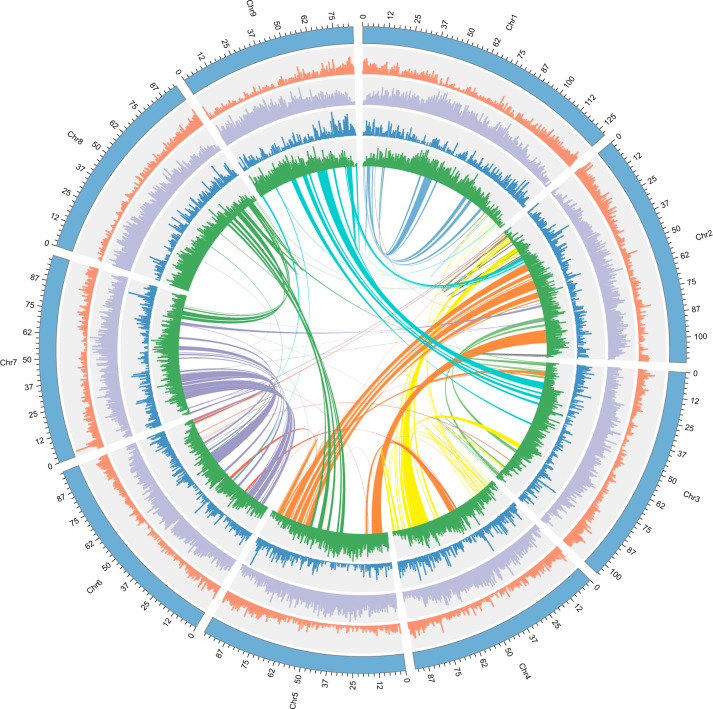
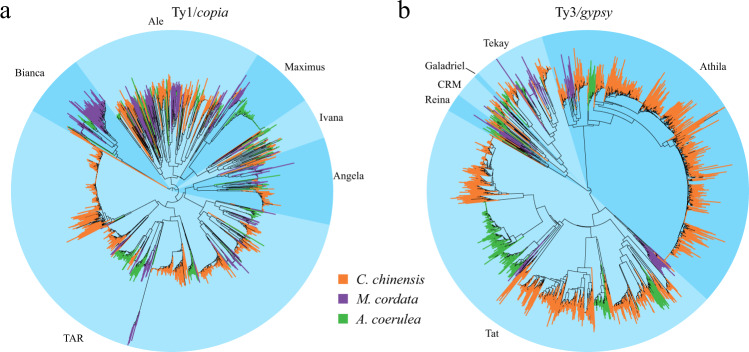
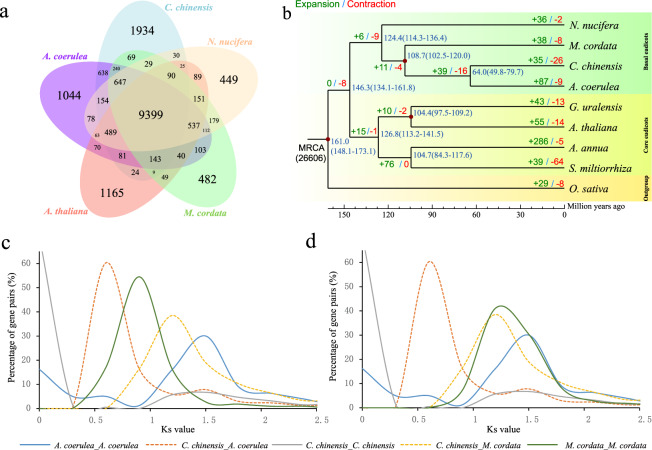
Coptis chinensis Franch, a perennial herb, is mainly distributed in southeastern China. The rhizome of C. chinensis has been used as a traditional medicine for more than 2000 years in China and many other Asian countries. The pharmacological activities of C. chinensis have been validated by research. Here, we present a de novo high-quality genome of C. chinensis with a chromosome-level genome of ~958.20 Mb, a contig N50 of 1.58 Mb, and a scaffold N50 of 4.53 Mb. We found that the relatively large genome size of C. chinensis was caused by the amplification of long terminal repeat (LTR) retrotransposons. In addition, a whole-genome duplication event in ancestral Ranunculales was discovered. Comparative genomic analysis revealed that the tyrosine decarboxylase (TYDC) and (S)-norcoclaurine synthase (NCS) genes were expanded and that the aspartate aminotransferase gene (ASP5) was positively selected in the berberine metabolic pathway. Expression level and HPLC analyses showed that the berberine content was highest in the roots of C. chinensis in the third and fourth years. The chromosome-level reference genome of C. chinensis provides important genomic data for molecular-assisted breeding and active ingredient biosynthesis.
黄连是一种多年生草本植物,主要分布于中国东南部。在中国及许多其他亚洲国家,黄连根茎作为传统药物已使用了2000多年。黄连的药理活性已得到研究验证。在此,我们展示了黄连的一个从头高质量基因组,其染色体水平基因组约为958.20 Mb,重叠群N50为1.58 Mb,支架N50为4.53 Mb。我们发现黄连相对较大的基因组大小是由长末端重复(LTR)逆转座子的扩增所致。此外,还发现了毛茛目祖先中的一次全基因组复制事件。比较基因组分析表明,酪氨酸脱羧酶(TYDC)和(S)-去甲乌药碱合酶(NCS)基因发生了扩增,并且天冬氨酸转氨酶基因(ASP5)在小檗碱代谢途径中受到正选择。表达水平和高效液相色谱分析表明,黄连根中的小檗碱含量在第三年和第四年最高。黄连的染色体水平参考基因组为分子辅助育种和活性成分生物合成提供了重要的基因组数据。