Lian Weitao, Jiang Chenhui, Yin Yiwei, Tang Rongfeng, Li Gang, Zhang Lijian, Che Bo, Chen Tao
Hefei National Laboratory for Physical Sciences at Microscale, CAS Key Laboratory of Materials for Energy Conversion, Department of Materials Science and Engineering, School of Chemistry and Materials Science, University of Science and Technology of China, Hefei, Anhui, P. R. China.
Institute of Energy, Hefei Comprehensive National Science Center, Hefei, China.
Nat Commun. 2021 May 31;12(1):3260. doi: 10.1038/s41467-021-23592-0.
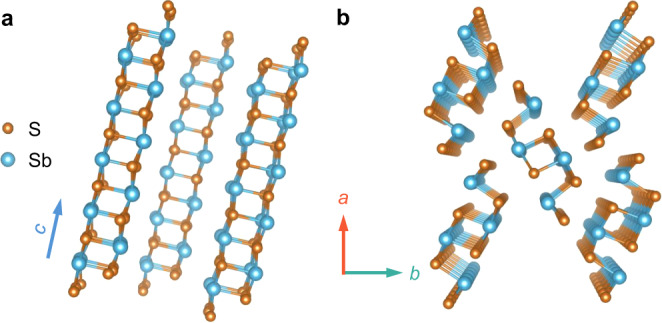
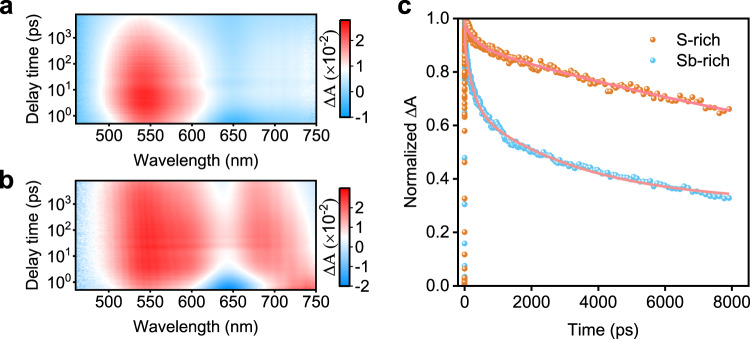
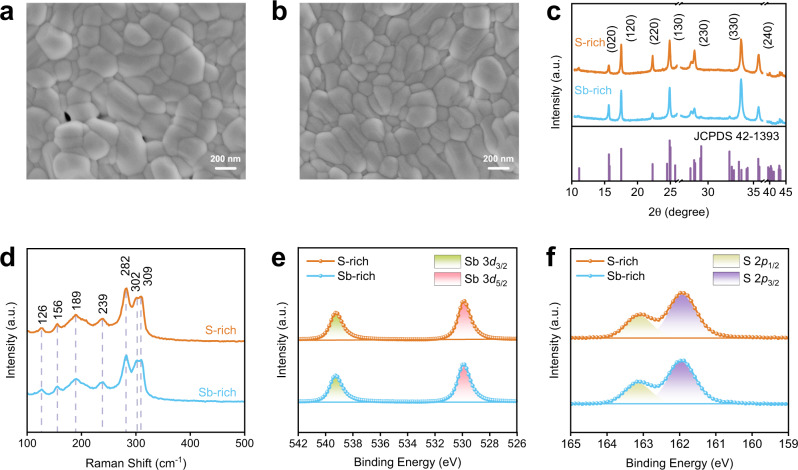
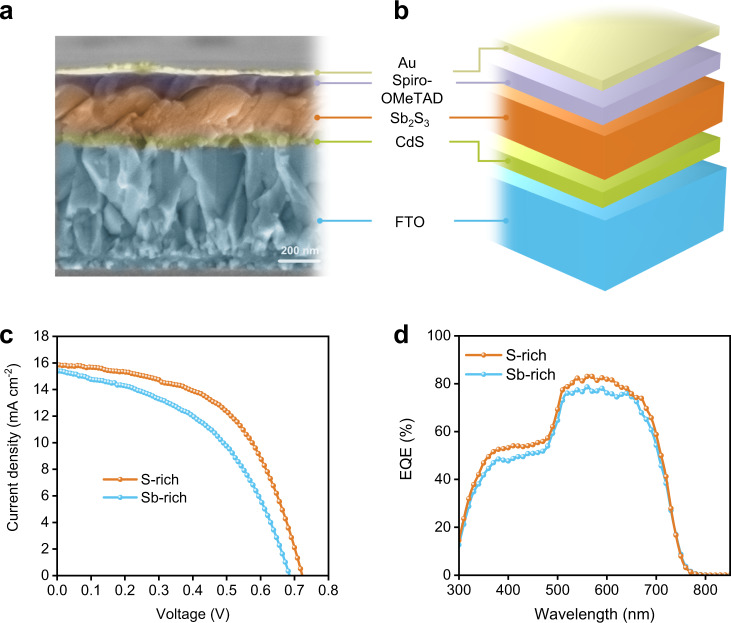
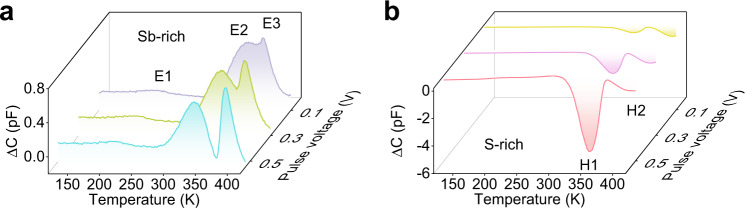
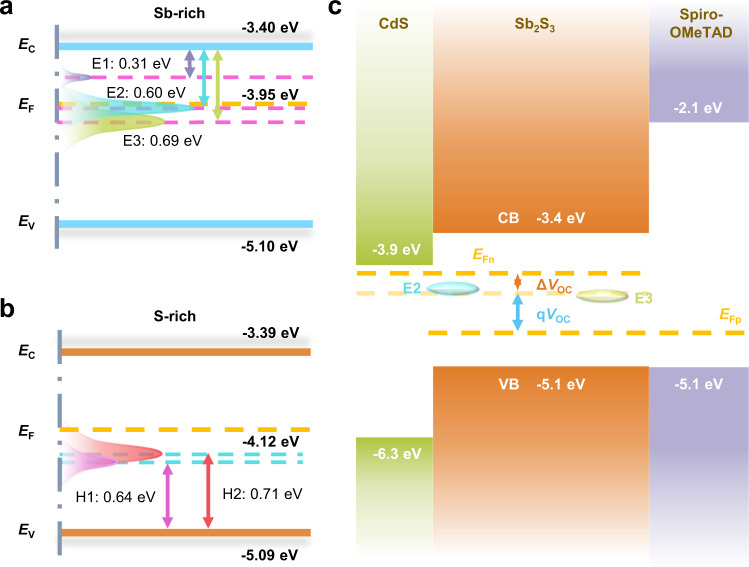
Antimony trisulfide (SbS) is a kind of emerging light-harvesting material with excellent stability and abundant elemental storage. Due to the quasi-one-dimensional symmetry, theoretical investigations have pointed out that there exist complicated defect properties. However, there is no experimental verification on the defect property. Here, we conduct optical deep-level transient spectroscopy to investigate defect properties in SbS and show that there are maximum three kinds of deep-level defects observed, depending on the composition of SbS. We also find that the Sb-interstitial (Sb) defect does not show critical influence on the carrier lifetime, indicating the high tolerance of the one-dimensional crystal structure where the space of (SbS) ribbons is able to accommodate impurities to certain extent. This study provides basic understanding on the defect properties of quasi-one-dimensional materials and a guidance for the efficiency improvement of SbS solar cells.
三硫化二锑(SbS)是一种新兴的光捕获材料,具有出色的稳定性和丰富的元素存储。由于其准一维对称性,理论研究指出存在复杂的缺陷特性。然而,尚无关于缺陷特性的实验验证。在此,我们进行光深能级瞬态光谱研究SbS中的缺陷特性,结果表明根据SbS的组成,观察到的深能级缺陷最多有三种。我们还发现,Sb间隙(Sb)缺陷对载流子寿命没有关键影响,这表明一维晶体结构具有较高的耐受性,其中(SbS)带的空间能够在一定程度上容纳杂质。本研究为准一维材料的缺陷特性提供了基本认识,并为提高SbS太阳能电池的效率提供了指导。