Department of Pediatrics, Faculty of Medicine, University of Debrecen, Debrecen, Hungary.
Doctoral School of Molecular Cell and Immune Biology, University of Debrecen, Debrecen, Hungary.
Amino Acids. 2021 Jul;53(7):1051-1063. doi: 10.1007/s00726-021-03006-7. Epub 2021 May 31.
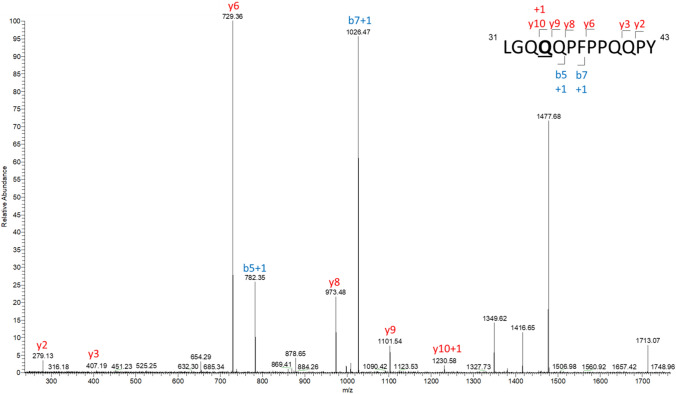
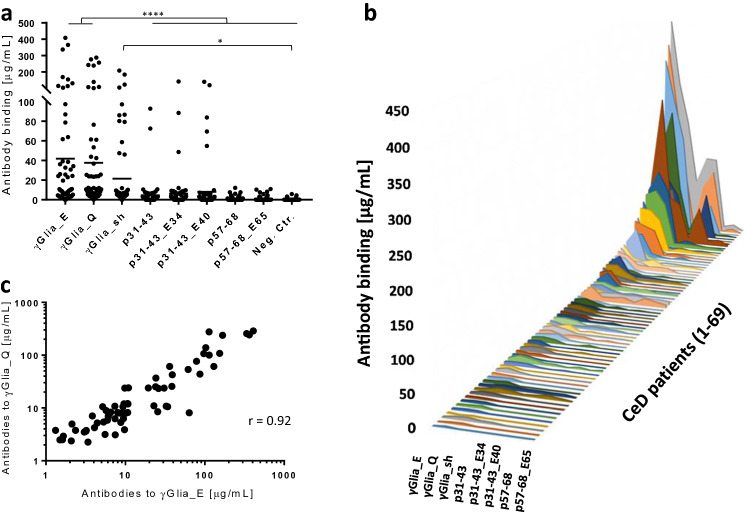
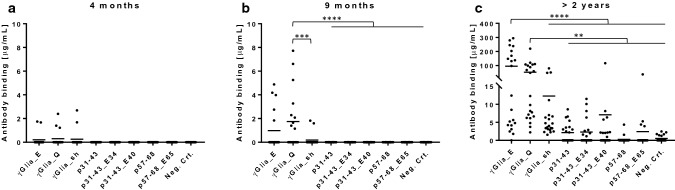
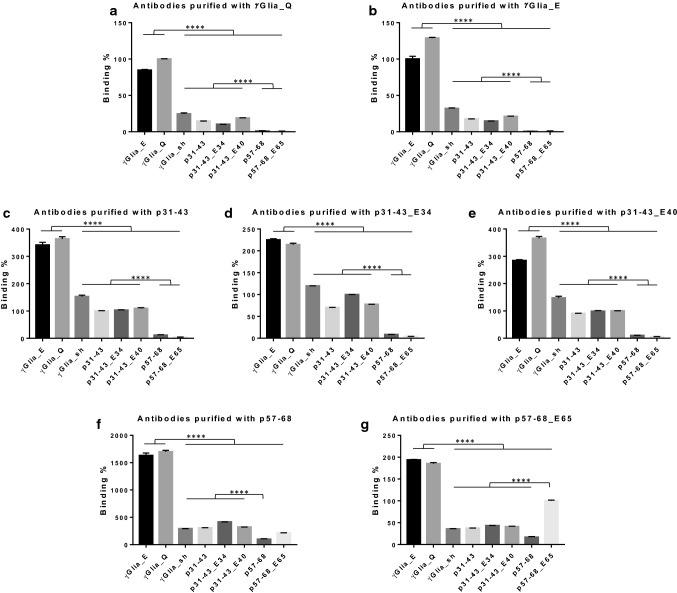
Celiac disease (CeD) is a T-cell-dependent enteropathy with autoimmune features where tissue transglutaminase (TG2)-mediated posttranslational modification of gliadin peptides has a decisive role in the pathomechanism. The humoral immune response is reported to target mainly TG2-deamidated γ-gliadin peptides. However, α-gliadin peptides, like p57-68, playing a crucial role in the T-cell response, and p31-43, a major trigger of innate responses, also contain B-cell gliadin epitopes and γ-gliadin like motifs. We aimed to identify if there are anti-gliadin-specific antibodies in CeD patients targeting the p31-43 and p57-68 peptides and to examine whether deamidation of these peptides could increase their antigenicity. We explored TG2-mediated deamidation of the p31-43 and p57-68 peptides, and investigated serum antibody reactivity toward the native and deamidated α and γ-gliadin peptides in children with confirmed CeD and in prospectively followed infants at increased risk for developing CeD. We affinity-purified antibody populations utilizing different single peptide gliadin antigens and tested their binding preferences for cross-reactivity in real-time interaction assays based on bio-layer interferometry. Our results demonstrate that there is serum reactivity toward p31-43 and p57-68 peptides, which is due to cross-reactive γ-gliadin specific antibodies. These γ-gliadin specific antibodies represent the first appearing antibody population in infancy and they dominate the serum reactivity of CeD patients even later on and without preference for deamidation. However, for the homologous epitope sequences in α-gliadins shorter than the core QPEQPFP heptapeptide, deamidation facilitates antibody recognition. These findings reveal the presence of cross-reactive antibodies in CeD patients recognizing the disease-relevant α-gliadins.
乳糜泻(CeD)是一种 T 细胞依赖性肠病,具有自身免疫特征,其中组织转谷氨酰胺酶(TG2)介导的麦胶蛋白肽的翻译后修饰在发病机制中起决定性作用。据报道,体液免疫反应主要针对 TG2 去酰胺化的γ-麦胶蛋白肽。然而,像 p57-68 这样在 T 细胞反应中起关键作用的α-麦胶蛋白肽,以及作为先天反应主要触发物的 p31-43,也含有 B 细胞麦胶蛋白表位和类似 γ-麦胶蛋白的基序。我们旨在确定乳糜泻患者中是否存在针对 p31-43 和 p57-68 肽的抗麦胶蛋白特异性抗体,并检查这些肽的去酰胺化是否能增加其抗原性。我们探索了 TG2 介导的 p31-43 和 p57-68 肽的去酰胺化,并在已确诊乳糜泻的儿童和具有发展乳糜泻高风险的前瞻性随访婴儿中研究了针对天然和去酰胺化的α和γ-麦胶蛋白肽的血清抗体反应性。我们利用不同的单一肽麦胶蛋白抗原亲和纯化抗体群体,并在基于生物层干涉测量的实时相互作用测定中测试它们对交叉反应性的结合偏好。我们的结果表明,针对 p31-43 和 p57-68 肽存在血清反应性,这是由于交叉反应性的γ-麦胶蛋白特异性抗体所致。这些γ-麦胶蛋白特异性抗体代表婴儿期出现的第一类抗体群体,即使在稍后阶段,它们也会主导乳糜泻患者的血清反应性,且不偏爱去酰胺化。然而,对于比核心 QPEQPFP 七肽短的α-麦胶蛋白中的同源表位序列,去酰胺化有利于抗体识别。这些发现揭示了乳糜泻患者中存在识别疾病相关的α-麦胶蛋白的交叉反应性抗体。